
Transition Networks XSDR22000-01 vs Transition Networks OCA-1AB201-NA: Specification Comparison
Both the Transition Networks XSDR22000-01 and OCA-1AB201-NA are 10-port, DIN rail-mountable switches rated for industrial operating temperatures and carrying lifetime warranties — placing them in the same broad class of hardened network switches for physical-security and industrial deployments. The comparison turns on three axes that matter most to installers and IT buyers in this segment: port speed and fiber architecture, management capability and operational flexibility, and physical form factor with environmental ratings.
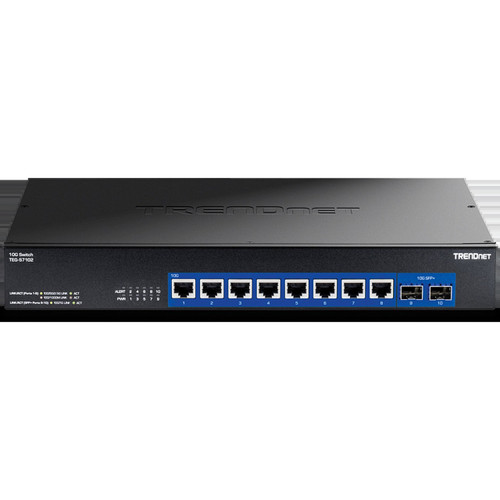
In This Guide
- Which switch delivers higher throughput, and does the fiber architecture match your backbone requirements?
- Does the level of management — unmanaged versus managed — align with the operational demands of your deployment?
- Which unit's physical dimensions, environmental rating, and mounting approach fit your enclosure and site conditions?
- Which should you choose: the XSDR22000-01 or the OCA-1AB201-NA?
- Side-by-Side Specs
- FAQ
Which switch delivers higher throughput, and does the fiber architecture match your backbone requirements?
The XSDR22000-01 operates all 10 ports at 10G over single-mode fiber. For backbone runs that exceed multimode fiber's distance limits, single-mode is the correct infrastructure choice, and running 10G on every port means no bottleneck at the edge. The port configuration is fixed: all 10 ports are 10G single-mode fiber with no copper or combo ports listed in the provided specs.
The OCA-1AB201-NA runs all 10 ports at Gigabit (1G) speed. No fiber type is specified in the provided specs for this model — buyers cannot confirm single-mode, multimode, or copper RJ-45 without consulting the datasheet at /content/product-datasheets/OCA-1AB201-NA.pdf. For sites where 1G per port is sufficient and fiber architecture is TBD, the OCA-1AB201-NA may fit, but the 10× throughput gap versus the XSDR22000-01 is a hard spec delta that cannot be ignored on bandwidth-intensive backbones.
Does the level of management — unmanaged versus managed — align with the operational demands of your deployment?
The XSDR22000-01 is unmanaged. There is no VLAN segmentation, no QoS prioritization, no port mirroring, and no remote monitoring capability. Installation is plug-and-play with zero configuration overhead, which is an advantage when a site calls for a fixed, static backbone connection and IT staff availability for ongoing management is limited.
The OCA-1AB201-NA is a managed switch. The provided specs identify it as managed, and the comparison page bullets cite VLAN, port mirroring, and QoS as supported capabilities. These features are critical for multi-tenant sites, camera-network segmentation from access-control traffic, and remote troubleshooting of cabinet-mounted equipment. Note that the specific management interface (web GUI, CLI, SNMP version) is not enumerated in the provided specs; buyers should verify via the referenced datasheet before specifying.
Which unit's physical dimensions, environmental rating, and mounting approach fit your enclosure and site conditions?
The XSDR22000-01 mounts on a standard 35mm DIN rail and carries an industrial operating temperature rating. No physical dimensions or weight are provided in the specs for this model, so enclosure planning must rely on the manufacturer's installation guide. The industrial temperature rating confirms suitability for field panels and outdoor enclosures subject to thermal extremes, but no explicit outdoor or IP ingress rating is listed.
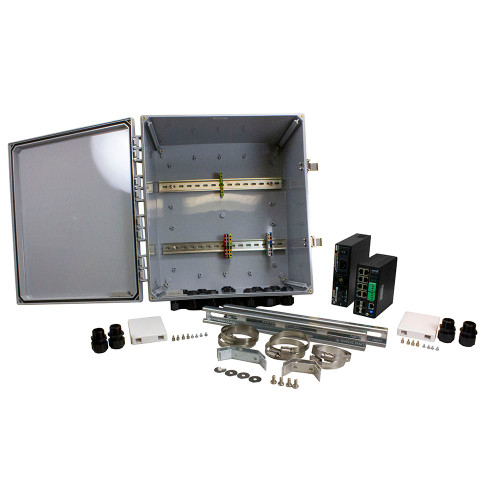
The OCA-1AB201-NA is described as a cabinet bundle assembly with explicit outdoor and industrial temperature ratings. Dimensions are provided: 10.0 × 18.0 × 16.0 in, weight 1.0 lb. It also mounts on a DIN rail. The cabinet form factor and outdoor environment rating make it a self-contained hardened assembly, which simplifies deployment in exposed or roadside enclosures. Its larger footprint (10 × 18 × 16 in) versus an unspecified DIN rail card is a practical consideration for tight panel layouts.
Which should you choose: the XSDR22000-01 or the OCA-1AB201-NA?
Our take: The XSDR22000-01 is the stronger choice when backbone throughput is the primary constraint and the network topology is fixed — its 10G single-mode fiber on all 10 ports delivers 10× the per-port bandwidth of the OCA-1AB201-NA's Gigabit ports, and its unmanaged, fanless design minimizes failure points in static field installations. The OCA-1AB201-NA is the stronger choice when operational control matters more than raw speed: its managed feature set (VLAN, QoS, port mirroring) enables network segmentation and remote diagnostics that are absent on the XSDR22000-01, and its explicit outdoor cabinet rating with published dimensions (10.0 × 18.0 × 16.0 in, 1.0 lb) simplifies enclosure procurement. Both carry lifetime warranties and DIN rail mounts. Specify the XSDR22000-01 for high-bandwidth, low-touch single-mode fiber backbones; specify the OCA-1AB201-NA for managed, outdoor cabinet deployments where 1G per port is sufficient and VLAN segmentation or QoS is operationally required.
Side-by-Side Comparison
Spec-for-spec, from manufacturer data.
| Specification | Transition Networks XSDR22000-01 | Transition Networks OCA-1AB201-NA |
|---|---|---|
| Product Type | Switch | Switch |
| SKU | XSDR22000-01 | OCA-1AB201-NA |
| Port Count | 10 | 10 |
| Port Speed | 10G | Gigabit (1G) |
| Fiber Type | Single-mode | — |
| Managed | Unmanaged | Managed |
| VLAN / QoS / Port Mirroring | — | Yes (per specs) |
| DIN Rail Mount | Yes | Yes |
| Operating Temperature | Industrial | Industrial |
| Environment Rating | — | Outdoor |
| Form Factor | DIN rail card | Cabinet bundle assembly |
| Dimensions (in) | — | 10.0 x 18.0 x 16.0 |
| Weight | — | 1.0 lb |
| Warranty | Lifetime | Lifetime |
| Datasheet Referenced | — | /content/product-datasheets/OCA-1AB201-NA.pdf |
Frequently Asked Questions
Which should you choose: the XSDR22000-01 or the OCA-1AB201-NA?
The XSDR22000-01 is the stronger choice when backbone throughput is the primary constraint and the network topology is fixed — its 10G single-mode fiber on all 10 ports delivers 10× the per-port bandwidth of the OCA-1AB201-NA's Gigabit ports, and its unmanaged, fanless design minimizes failure points in static field installations. The OCA-1AB201-NA is the stronger choice when operational control matters more than raw speed: its managed feature set (VLAN, QoS, port mirroring) enables network segmentation and remote diagnostics that are absent on the XSDR22000-01, and its explicit outdoor cabinet rating with published dimensions (10.0 × 18.0 × 16.0 in, 1.0 lb) simplifies enclosure procurement. Both carry lifetime warranties and DIN rail mounts. Specify the XSDR22000-01 for high-bandwidth, low-touch single-mode fiber backbones; specify the OCA-1AB201-NA for managed, outdoor cabinet deployments where 1G per port is sufficient and VLAN segmentation or QoS is operationally required.
Is the XSDR22000-01 or OCA-1AB201-NA better for a high-bandwidth multi-camera backbone?
The XSDR22000-01 is better for raw throughput — all 10 ports run at 10G over single-mode fiber versus the OCA-1AB201-NA's Gigabit ports. If your camera count or video bitrate demands more than 1G per uplink, the XSDR22000-01 is the correct choice. The OCA-1AB201-NA's 1G ports are adequate for most standard IP camera deployments but will bottleneck high-resolution or high-stream-count backbones.
Can I segment camera traffic from access-control traffic on either of these switches?
Only the OCA-1AB201-NA supports network segmentation. It is a managed switch with VLAN capability listed in the provided specs. The XSDR22000-01 is unmanaged — it has no VLAN, QoS, or port-level configuration capability. If traffic isolation between cameras, access control, and IT infrastructure is a project requirement, the OCA-1AB201-NA is the only option of the two.
Which switch is easier to install in a tight outdoor enclosure?
The OCA-1AB201-NA provides explicit dimensions (10.0 × 18.0 × 16.0 in, 1.0 lb) and an outdoor environment rating, making enclosure planning straightforward. The XSDR22000-01's dimensions are not provided in the available specs, so cabinet fit must be confirmed with the manufacturer's datasheet before installation. Both units support DIN rail mounting and industrial temperature ratings, but only the OCA-1AB201-NA carries a documented outdoor rating.
More Network Switch Comparisons
- TP-Link IES210GPP vs Transition Networks OCA-1AB201-NA
- TP-Link IES210GPP vs Transition Networks OCA-1BA1A0
- TP-Link IES210GPP vs Transition Networks OCA-1BA101
- TP-Link IES210GPP vs TP-Link DS110GMP
- TP-Link IES210GPP vs TP-Link SG1210PP
- TP-Link DS110GMP vs Transition Networks OCA-1AB201-NA
Network Switch Buying Guides
Get a Second Opinion on Your Camera Choice
Share your site layout, coverage goals, and budget. Our team will validate the camera selection, flag anything we would change, and recommend products that match the use case.