
TP-Link DS110GMP vs Transition Networks OCA-1AB201-NA: Specification Comparison
Both the TP-Link DS110GMP and the Transition Networks OCA-1AB201-NA are 10-port Gigabit switches aimed at physical-security deployments, but they serve fundamentally different installation contexts. The DS110GMP is a desktop/wall-mount unmanaged PoE+ switch designed for indoor, budget-conscious edge installs, while the OCA-1AB201-NA is a managed, DIN-rail-mount cabinet assembly rated for outdoor and industrial environments. A buyer cross-shopping these would be weighing indoor simplicity and PoE power delivery against outdoor hardening and full management capability.
In This Guide
- Which switch delivers the right port density, PoE capability, and throughput for the deployment?
- Which unit is built for the physical environment of the intended install site?
- Which switch offers the management and control capabilities needed for ongoing network operations?
- Which should you choose: the DS110GMP or the OCA-1AB201-NA?
- Side-by-Side Specs
- FAQ
Which switch delivers the right port density, PoE capability, and throughput for the deployment?
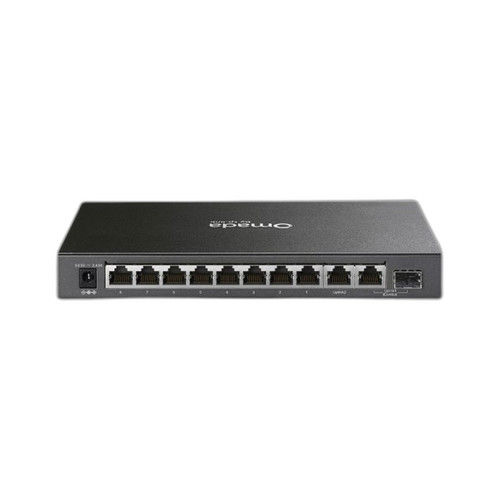
The DS110GMP provides 10 ports total — 8 PoE+ (802.3at/af) copper ports plus 1 combo SFP/RJ45 uplink and 1 additional copper port — with a 123 W total PoE budget and a per-port maximum of 30 W. Its non-blocking switching capacity is 20 Gbps. This budget can realistically power four to five high-draw IP cameras simultaneously at full 30 W draw, making it well suited for small camera clusters.
The OCA-1AB201-NA lists 10 Gigabit ports and a managed switch architecture, but its spec sheet does not disclose a PoE budget, per-port PoE wattage, SFP slot count, or switching capacity figure. Whether the unit includes PoE at all is not confirmed in the provided specifications. Installers requiring PoE in the cabinet must verify this directly with Transition Networks before specifying the OCA-1AB201-NA.
Which unit is built for the physical environment of the intended install site?
The DS110GMP is rated for indoor use with an operating temperature range of 0°C to 40°C (32°F to 104°F). It carries a compact desktop/wall-mount form factor measuring 8.2 × 4.9 × 1.0 in and draws up to 123 W under full PoE load with 7.93 W idle. IEEE certifications include 802.3af, 802.3at, 802.3ab, 802.3x, and 802.1p. This unit is not rated for outdoor or harsh-environment deployment.
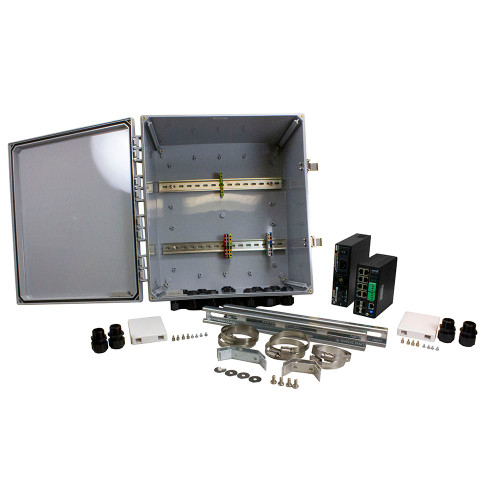
The OCA-1AB201-NA is explicitly rated for outdoor environments and carries an industrial operating temperature classification, though exact minimum/maximum temperature figures are not provided in the supplied specifications. It mounts on DIN rail inside a cabinet enclosure and weighs 1.0 lb. The Transition Networks unit is purpose-built for roadside cabinets, traffic-control enclosures, and outdoor network nodes where temperature swings, moisture, and vibration are factors the DS110GMP cannot address.
Which switch offers the management and control capabilities needed for ongoing network operations?
The DS110GMP is explicitly classified as unmanaged (plug-and-play). It does not support VLAN configuration, SNMP, port mirroring, or remote monitoring via a management interface. Its operational modes are hardware-selected: Priority Mode for QoS on ports 1–2, Isolation Mode for traffic segmentation, and PoE Auto Recovery. These are useful fixed behaviors but cannot be changed remotely or adapted after deployment without physical intervention.
The OCA-1AB201-NA is a managed switch, supporting port-level configuration and monitoring, VLAN, port mirroring, and QoS per its specifications. This enables remote fault isolation, traffic prioritization for camera streams, and integration into a centrally managed network — capabilities critical in outdoor cabinet deployments where physical access is costly. Specific management protocols (SNMP version, CLI access, web GUI, Omada-style cloud controller) are not enumerated in the provided specifications and should be confirmed with Transition Networks.
Which should you choose: the DS110GMP or the OCA-1AB201-NA?
Our take: The DS110GMP is the stronger choice when the install is indoors, PoE budget is a primary concern, and management overhead must be minimized. It delivers a documented 123 W PoE+ budget, a 20 Gbps non-blocking fabric, and 802.3at/af compliance — concrete, verifiable numbers the OCA-1AB201-NA does not match in the available specs. Conversely, the OCA-1AB201-NA is the correct specification for outdoor cabinet, roadside, or industrial deployments: it carries an explicit outdoor environment rating, industrial temperature classification, DIN-rail mount, and full management capability — none of which the DS110GMP provides. The DS110GMP suits small indoor camera clusters of four to five high-draw devices on a tight budget; the OCA-1AB201-NA suits hardened field deployments requiring remote VLAN and QoS control. These products are not true substitutes; site environment and management requirements should drive the selection.
Side-by-Side Comparison
Spec-for-spec, from manufacturer data.
| Specification | TP-Link DS110GMP | Transition Networks OCA-1AB201-NA |
|---|---|---|
| Product Type | Desktop Managed Switch (unmanaged) | Managed Switch Cabinet Assembly |
| Managed | Unmanaged (plug-and-play) | Managed |
| Total Ports | 10 | 10 |
| PoE Standard | 802.3at/af (PoE+) | Not specified |
| PoE Budget | 123 W | — |
| Max PoE Per Port | 30 W | — |
| SFP Uplink Slots | 1 (combo SFP/RJ45) | — |
| Switching Capacity | 20 Gbps | — |
| Operating Temp | 0°C to 40°C | Industrial (range not specified) |
| Environment Rating | Indoor | Outdoor |
| Mount Type | Wall / Desktop | DIN Rail (Cabinet) |
| Dimensions | 8.2 × 4.9 × 1.0 in | 10.0 × 18.0 × 16.0 in |
| Weight | — | 1.0 lbs |
| Warranty | — | Lifetime |
| QoS / Priority | Hardware Priority Mode (ports 1–2) | Managed QoS (configurable) |
| VLAN / Port Isolation | Isolation Mode (hardware-fixed) | VLAN (managed, configurable) |
Frequently Asked Questions
Which should you choose: the DS110GMP or the OCA-1AB201-NA?
The DS110GMP is the stronger choice when the install is indoors, PoE budget is a primary concern, and management overhead must be minimized. It delivers a documented 123 W PoE+ budget, a 20 Gbps non-blocking fabric, and 802.3at/af compliance — concrete, verifiable numbers the OCA-1AB201-NA does not match in the available specs. Conversely, the OCA-1AB201-NA is the correct specification for outdoor cabinet, roadside, or industrial deployments: it carries an explicit outdoor environment rating, industrial temperature classification, DIN-rail mount, and full management capability — none of which the DS110GMP provides. The DS110GMP suits small indoor camera clusters of four to five high-draw devices on a tight budget; the OCA-1AB201-NA suits hardened field deployments requiring remote VLAN and QoS control. These products are not true substitutes; site environment and management requirements should drive the selection.
Can either switch power IP cameras directly without a separate PoE injector?
The DS110GMP explicitly supports PoE+ (802.3at/af) on 8 ports with a 123 W total budget and 30 W per-port maximum, so it can power cameras directly. The OCA-1AB201-NA's specifications do not confirm PoE capability or budget; buyers must verify with Transition Networks before assuming cameras can be powered from that unit.
Which switch is appropriate for an outdoor traffic or utility cabinet installation?
The OCA-1AB201-NA is the correct choice. It is rated for outdoor environments, carries an industrial temperature classification, and mounts on DIN rail inside a cabinet enclosure. The DS110GMP is rated only to 40°C with no outdoor or ingress-protection rating and is not suitable for uncontrolled exterior environments.
Do I need a controller or software license to manage the OCA-1AB201-NA or the DS110GMP?
The DS110GMP is unmanaged and requires no software — operational modes are set by physical switch selection. The OCA-1AB201-NA is a managed switch, but the specific management platform, software requirements, or licensing terms are not disclosed in the provided specifications; contact Transition Networks to confirm whether a controller, license, or subscription is required.
More Network Switch Comparisons
- TP-Link IES210GPP vs Transition Networks OCA-1AB201-NA
- TP-Link IES210GPP vs Transition Networks OCA-1BA1A0
- TP-Link IES210GPP vs Transition Networks OCA-1BA101
- TP-Link IES210GPP vs TP-Link DS110GMP
- TP-Link IES210GPP vs TP-Link SG1210PP
- TP-Link DS110GMP vs Transition Networks OCA-1BA1A0
Network Switch Buying Guides
Get a Second Opinion on Your Camera Choice
Share your site layout, coverage goals, and budget. Our team will validate the camera selection, flag anything we would change, and recommend products that match the use case.