
TP-Link IES210GPP vs TP-Link SG1210PP: Specification Comparison
Both the TP-Link IES210GPP and TL-SG1210PP are 10-port gigabit PoE switches sharing the same port count and TP-Link brand, making them a legitimate cross-shop for buyers deploying IP cameras, wireless APs, or other PoE devices. The comparison spans form factor and deployment environment, PoE architecture and total power budget, and management capability — the three axes that most sharply differentiate an industrial managed switch from an unmanaged desktop unit in a surveillance or commercial LAN context.
In This Guide
- How do the PoE architecture and total power budget compare between the IES210GPP and TL-SG1210PP?
- Which switch is better suited for harsh or outdoor-adjacent deployments based on build and operating environment specs?
- What management and integration capabilities does each switch offer for network administrators?
- Which should you choose: the IES210GPP or the SG1210PP?
- Side-by-Side Specs
- FAQ
How do the PoE architecture and total power budget compare between the IES210GPP and TL-SG1210PP?
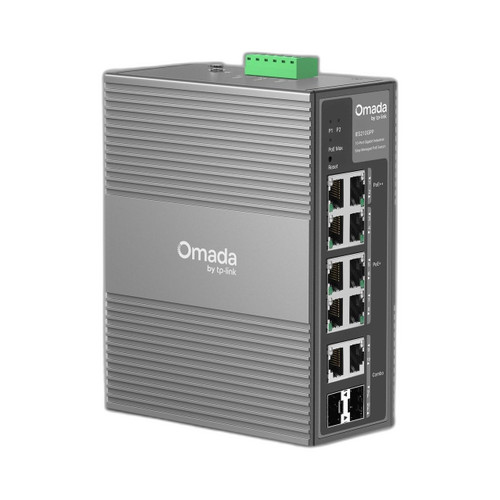
The IES210GPP specifies a 240W total PoE budget across 8 PoE-capable ports — 6 ports rated at 802.3at (PoE+, 30W each) and 2 ports rated at 802.3bt (PoE++, up to 95W combined per spec). This tiered architecture accommodates high-draw devices such as PTZ cameras, thermal imagers, or multi-radio APs without requiring separate power injectors.
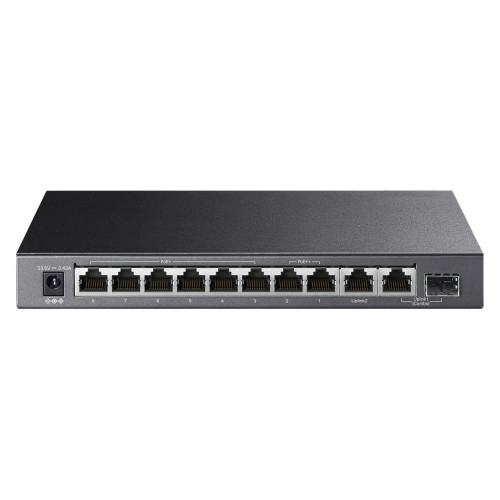
The TL-SG1210PP specifies a 123W total PoE budget across 8 PoE-capable ports. The spec sheet does not differentiate per-port wattage tiers beyond listing PoE (802.3af/at implied by the 'PoE' label) and calling out an extend mode on ports 1–4 at up to 250m. The power consumption figure is listed as 123W, which appears to represent maximum system draw rather than a separate PoE budget line; buyers should verify the actual dedicated PoE budget against the datasheet.
In raw budget terms the IES210GPP provides roughly 95% more PoE capacity (240W vs 123W). The IES210GPP also adds PoE++ (802.3bt) support not present in the TL-SG1210PP spec, enabling single-cable power to devices that exceed the 30W PoE+ ceiling.
Which switch is better suited for harsh or outdoor-adjacent deployments based on build and operating environment specs?
The IES210GPP is explicitly designated as an industrial switch. It specifies an operating temperature range of -40°C to 75°C (-40°F to 167°F), an IP40 enclosure rating, DIN-rail mounting support, wall mounting, redundant 1+1 power input, and ±6 kV common-mode surge protection on Ethernet ports. These attributes are consistent with installation in industrial cabinets, traffic enclosures, factory floors, or outdoor-rated junction boxes where temperature extremes and electrical transients are real concerns.
The TL-SG1210PP is designated as a desktop switch. No operating temperature range is provided in the supplied specs beyond what is implied by 'desktop.' No IP rating, DIN-rail capability, or surge protection specification is listed. It supports wall mounting per the spec, but no hardened enclosure or extended-temperature claim is made.
For any deployment outside a climate-controlled IT room — utility closets, rooftop enclosures, manufacturing floors — the IES210GPP's documented industrial ratings are the differentiating factor. The TL-SG1210PP's operating environment specifications are absent from the provided data and cannot be assumed equivalent.
What management and integration capabilities does each switch offer for network administrators?
The IES210GPP is a managed switch with Omada SDN controller integration. This enables centralized configuration, monitoring, VLAN management, QoS, and policy enforcement across a unified Omada network fabric alongside compatible TP-Link routers, APs, and other Omada switches. The switching fabric is specified at 20 Gbps. Memory is listed as 64 Mbit Flash and 4 Mbit packet buffer.
The TL-SG1210PP is an unmanaged switch. No management interface, CLI, web GUI, SNMP, or SDN integration is specified. Its documented operating modes — Priority Mode, Isolation Mode, and PoE Auto Recovery — are hardware-level features selectable via physical switch or button, not software-configurable policies. It offers one SFP combo slot for fiber or copper uplink; the IES210GPP provides two SFP combo slots.
For installations requiring VLANs, centralized policy, remote monitoring, or integration into a managed network architecture, only the IES210GPP supports those capabilities as specified. The TL-SG1210PP is appropriate where plug-and-play simplicity without management overhead is acceptable and the three hardware modes cover operational needs.
Which should you choose: the IES210GPP or the SG1210PP?
Our take: The IES210GPP is the stronger choice when the deployment demands industrial-grade resilience, higher PoE headroom, or centralized network management. Concretely: its PoE budget is 240W versus 123W — nearly double — allowing more or higher-draw devices per switch; it adds PoE++ (802.3bt) support absent from the TL-SG1210PP; and its operating temperature range of -40°C to 75°C with IP40 rating, DIN-rail mounting, redundant power input, and ±6 kV surge protection address environments the TL-SG1210PP's spec does not cover. The TL-SG1210PP is the simpler, lighter-footprint option for a controlled indoor environment where an unmanaged switch with basic PoE, Priority Mode, Isolation Mode, and PoE Auto Recovery hardware features is sufficient. Choose the IES210GPP for hardened surveillance deployments, industrial edge locations, or any Omada-managed network. Choose the TL-SG1210PP for straightforward desktop or low-complexity indoor PoE distribution where Omada SDN and industrial ratings are unnecessary.
Side-by-Side Comparison
Spec-for-spec, from manufacturer data.
| Specification | TP-Link IES210GPP | TP-Link SG1210PP |
|---|---|---|
| Product Type | Industrial Managed Switch | Desktop Unmanaged Switch |
| Total Ports | 10 | 10 |
| PoE-Capable Ports | 8 (6× PoE+, 2× PoE++) | 8 |
| PoE Standards | 802.3af / 802.3at / 802.3bt | PoE (802.3af/at per label; bt not specified) |
| Max PoE Budget | 240W | 123W |
| Max Per-Port PoE | 30W (PoE+); 95W combined on PoE++ ports | Not specified per port |
| SFP Combo Slots | 2 | 1 |
| Switching Capacity | 20 Gbps | Not specified |
| Operating Temperature | -40°C to 75°C | Not specified |
| IP Rating | IP40 | Not specified |
| DIN-Rail Mount | Yes | Not specified |
| Surge Protection | ±6 kV common-mode (Ethernet ports) | Not specified |
| Redundant Power Input | Yes (1+1) | Not specified |
| Management | Managed — Omada SDN | Unmanaged — hardware modes only |
| Operating Modes | SDN / Omada controller | Priority, Isolation, PoE Auto Recovery |
| Extend Mode Range | 820 ft (250m) PoE | 250m (ports 1–4) |
Frequently Asked Questions
Which should you choose: the IES210GPP or the SG1210PP?
The IES210GPP is the stronger choice when the deployment demands industrial-grade resilience, higher PoE headroom, or centralized network management. Concretely: its PoE budget is 240W versus 123W — nearly double — allowing more or higher-draw devices per switch; it adds PoE++ (802.3bt) support absent from the TL-SG1210PP; and its operating temperature range of -40°C to 75°C with IP40 rating, DIN-rail mounting, redundant power input, and ±6 kV surge protection address environments the TL-SG1210PP's spec does not cover. The TL-SG1210PP is the simpler, lighter-footprint option for a controlled indoor environment where an unmanaged switch with basic PoE, Priority Mode, Isolation Mode, and PoE Auto Recovery hardware features is sufficient. Choose the IES210GPP for hardened surveillance deployments, industrial edge locations, or any Omada-managed network. Choose the TL-SG1210PP for straightforward desktop or low-complexity indoor PoE distribution where Omada SDN and industrial ratings are unnecessary.
Can either switch power a high-wattage PTZ or thermal camera that needs more than 30W?
Yes, but only the IES210GPP supports PoE++ (802.3bt) on its two designated ports, delivering up to 95W combined on those ports per spec. The TL-SG1210PP does not list PoE++ support in the provided specifications, making it unsuitable for single-cable power to devices exceeding the 30W PoE+ ceiling.
Is the IES210GPP or TL-SG1210PP better for a deployment in an outdoor cabinet or unheated utility room?
The IES210GPP is the documented choice for that environment. It specifies operation from -40°C to 75°C, an IP40 rating, DIN-rail mounting, redundant power input, and ±6 kV Ethernet surge protection. The TL-SG1210PP is designated a desktop switch and no operating temperature range, IP rating, or surge specification is provided in the available specs.
Do I need an Omada controller to use the IES210GPP, or does it work standalone?
The IES210GPP specifies Omada SDN controller integration as a management option. The specs do not explicitly state whether a standalone web-GUI mode is available without a controller; buyers should consult the IES210GPP datasheet at /content/product-datasheets/IES210GPP.pdf for standalone management details. The TL-SG1210PP requires no controller and operates entirely via hardware-level mode switches.
More Network Switch Comparisons
- TP-Link IES210GPP vs Transition Networks OCA-1AB201-NA
- TP-Link IES210GPP vs Transition Networks OCA-1BA1A0
- TP-Link IES210GPP vs Transition Networks OCA-1BA101
- TP-Link IES210GPP vs TP-Link DS110GMP
- TP-Link DS110GMP vs Transition Networks OCA-1AB201-NA
- TP-Link DS110GMP vs Transition Networks OCA-1BA1A0
Network Switch Buying Guides
Get a Second Opinion on Your Camera Choice
Share your site layout, coverage goals, and budget. Our team will validate the camera selection, flag anything we would change, and recommend products that match the use case.