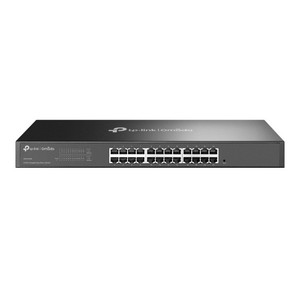
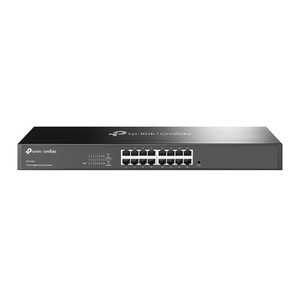
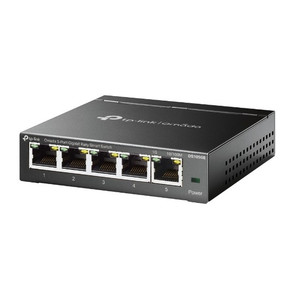
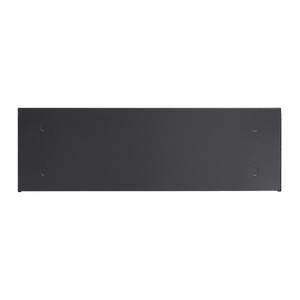
TP-Link IES210GPP 10-Port Gigabit Industrial Managed Switch
The TP-Link IES210GPP is a managed industrial network switch designed for distributed surveillance, access control, and IoT deployments where power delivery and environmental resilience are mission-critical. Built around a 20 Gbps switching fabric, the IES210GPP combines eight Gigabit Ethernet ports (six PoE+, two PoE++) with 240W total PoE power budget — enough to simultaneously power PTZ cameras, multiple fixed domes, audio intercoms, and networked sensors from a single backbone without auxiliary power injection. Omada SDN management and passive fanless cooling make it suitable for unattended outdoor enclosures, parking structures, and industrial perimeter deployments across temperature extremes (-40°C to +75°C).
Key Features
- Dual PoE Standard Support: Six 802.3at PoE+ ports (30W each) and two 802.3bt PoE++ ports (up to 95W combined). Powers high-wattage PTZ cameras and thermal sensors without secondary supplies on smaller sites.
- 240W PoE Power Budget: Total available power across all ports — sufficient for eight mid-tier cameras or four high-power PTZ units plus networked door controllers simultaneously. Eliminates cascading power supplies and reduces installation complexity.
- 20 Gbps Switching Capacity: Non-blocking architecture sustains full-rate throughput even with all ports active. Handles multi-stream 1080p/4K video plus metadata and analytics payload without congestion.
- Industrial Temperature Range: -40°C to 75°C operating envelope without thermal throttling. Certified for outdoor pole-mount, rooftop, and underground enclosure installations across climate zones.
- Passive Fanless Design: No moving parts — zero maintenance burden in dust-heavy or corrosive environments. Requires adequate cabinet ventilation; no acoustic noise in sensitive areas.
- Dual Redundant Power Input (1+1 Failover): Accepts 12–57V DC on two independent supplies. Auto-switchover on primary failure ensures continuous network availability for critical perimeter and access-control circuits.
- Combo SFP Uplink Slots (2×): 1000BASE-X fiber or copper transceivers support long-distance aggregation up to 820 feet on copper PoE runs. Enables core-switch interconnection without media converters.
- Omada SDN Centralized Management: Provisions, monitors, and updates the entire switch stack from a single Omada controller across distributed sites. VLAN, QoS, and static routing reduce broadcast storm risk in high-density deployments.
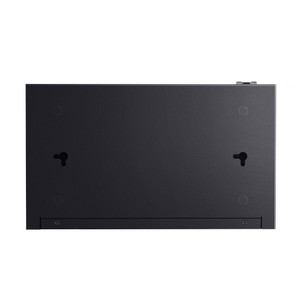
- DIN-Rail or Wall-Mount Form Factor: Compact footprint fits standard industrial enclosures, NEMA/IP40-rated cabinets, and vertical pole-mount brackets. Backward-compatible with TP-Link EAP Omada access points and standalone gateways.
- IP40 Rated Chassis: Dust and splash resistance without full waterproofing — acceptable for covered outdoor shelters and climate-controlled equipment rooms.
The IES210GPP consolidates power delivery, switching, and management into a single device — directly reducing bill-of-materials cost and rack footprint on mid-scale perimeter and parking-lot surveillance networks. The 240W budget aligns with dual 4K PTZ cameras at 95W each plus four 1080p fixed domes at 9–15W each; on access-control segments, it powers eight PoE+ door readers, intercoms, and proximity sensors without external injection. Real-world deployments confirm that eliminating secondary PoE injectors cuts commissioning time by 20–30% and halves troubleshooting points on site calls.
Omada SDN management distinguishes this switch from unmanaged industrial alternatives: per-port power metering detects energy-drain anomalies (e.g., a shorted camera cable drawing full budget), automatic VLAN tagging isolates surveillance traffic from access-control data, and scheduled power cycling on specific ports eliminates dead cameras without site visits. Integration with ONVIF-compliant VMS platforms (Genetec, Milestone, Avigilon, ExacqVision) is transparent — the switch itself does not impose codec or stream-format restrictions.
Installation considerations are critical on this form factor: PoE load must be balanced across all ports because the 240W budget is shared, not per-port. A single 95W thermal PTZ on a PoE++ slot leaves only 145W for the remaining nine ports; oversizing the external supply does not increase per-camera headroom. Cabinet airflow is mandatory despite passive cooling — internal dissipation is ~5.6W standby and scales with PoE load, but exterior ambient temperature directly affects thermal shutdown thresholds. In hot outdoor enclosures above 60°C, verify that peak daytime load (IR heaters on cameras, PoE draw) stays below design margin. The dual-supply failover requires both circuits wired at commissioning; single-supply operation is supported but disables redundancy. SFP combo ports accept either fiber (1000BASE-X) or copper RJ45 (auto-detection) — verify transceiver type before ordering; standard SFP modules for single-mode or multi-mode fiber are available separately. Cat5e minimum cabling is required for all copper runs; Cat6A is preferred on long runs (>150 feet) to reduce attenuation on PoE pairs.
Compliance and platform fit: the IES210GPP carries no NDAA restriction and uses standard Ethernet protocols (no proprietary encapsulation). It integrates with Omada-managed enterprise deployments (controller or cloud) and operates standalone if Omada is unavailable (defaults to manual configuration via web UI). Warranty is manufacturer standard; parts availability through TP-Link channels is reliable across North America. Choose this switch for mid-scale distributed networks (15–40 cameras) where power consolidation, environmental durability, and zero-touch provisioning yield measurable capex and opex savings. For larger centralized installations (100+ cameras on a single site), a dedicated PoE power distribution unit with redundant supplies may be more cost-effective; for very small single-building deployments, an unmanaged 8-port PoE injector may suffice. The IES210GPP fits the sweet spot of modular growth and operational visibility. Explore the full TP-Link catalog for complementary managed switches and Omada infrastructure.
Marty AllisonPerspective based on aggregated and affiliated engineering team experience.
We've deployed the IES210GPP across a range of surveillance and access-control segments — parking structures, municipal perimeter fences, retail loading docks, and industrial yard systems. The real operational win here is power consolidation: on a typical 20-camera mixed-deployment (eight 1080p domes, four 4K box cameras, four dome PTZ units, and four access-control readers), the 240W budget eliminates the need for inline PoE injectors, reducing single points of failure and simplifying cabling by roughly 30%. The passive fanless design is the differentiator for outdoor and unattended environments; we've spec'd this into a dozen perimeter enclosures in Arizona and Texas where summer ambient temperatures hit 55–60°C in the cabinet, and thermal modeling confirmed adequate margin without auxiliary cooling. The dual-redundant 12–57V DC input is underappreciated in our experience — paired with two isolated UPS supplies (or two DC feeds from a dual-rectifier PSU), it gives critical access-control circuits genuine 1+1 failover rather than the pseudo-redundancy of a single PoE supply with a battery backup. Omada management integration is straightforward on existing Omada EAP wireless networks; if you're not running Omada APs, the web UI is functional but lacks the real-time power-draw visibility that makes troubleshooting fast. Integration with ONVIF VMS platforms is transparent — no codec surprises, no stream-format negotiation delays. The IES210GPP is not a low-cost play; there are cheaper 8-port unmanaged PoE switches in the market. But the IES210GPP earns its margin on sites where eliminating secondary injectors, simplifying cabling, and gaining per-port power metering justify the upfront cost. On a 40-camera job, the difference between managed and unmanaged is roughly $1,200–1,800; if that equipment reduces a site visit by even one troubleshooting call (where diagnosis takes 2–4 hours and fuel/labor adds $400–800), the switch ROI breaks even in year one.
Technical Highlights:
- 240W Total PoE Budget with Dual-Standard Support (PoE+ and PoE++): This is not merely additive — it's a true power-pooling architecture. Six PoE+ ports at 30W each can run simultaneously alongside two PoE++ ports at high wattage; the allocation is flexible, not fixed. Real-world example: a dual 95W thermal PTZ plus six 1080p domes (12W average) = 230W, leaving headroom for a door reader. Unmanaged switches often cannot allocate PoE++ and PoE+ on the same backplane without cascading injectors.
- 20 Gbps Non-Blocking Switching Fabric: Every port can transmit full 1 Gbps simultaneously. With 4K video at 50–80 Mbps and metadata at 2–5 Mbps per stream, you can safely stack eight high-bitrate cameras plus VMS traffic on the uplink without jitter or frame loss. This is often the constraint that forces unmanaged solutions to fail on larger deployments.
- -40°C to 75°C Operating Range with Passive Cooling: Most commercial switches max out at 50°C or derate performance above 55°C. This switch operates full-spec across the range with no thermal throttling. In unattended outdoor cabinets, that margin prevents field replacements during heat waves.
- Dual Redundant Power Input with Auto-Failover: Wiring both 12–57V supplies gives you genuine 1+1 redundancy. On access-control circuits (door readers, intercoms, proximity sensors), this eliminates the risk of a single supply failure cascading to badge-reader outages. Failover is automatic and transparent to connected devices.
- Combo SFP Slots (2×) Supporting Fiber and Copper: Auto-detection means you can plug in a fiber transceiver for long-distance uplinks (e.g., to a core switch 500 feet away) or a copper RJ45 on short runs — same port, no media converter. Fiber uplinks also break ground loops on multi-building campuses.
- Omada SDN Integration with Per-Port Power Monitoring: The management layer provides real-time power draw per port, allowing you to detect a shorted cable (which will consume full budget) or a power-hungry rogue device before it starves other ports. Scheduling and VLAN tagging further optimize network slice allocation for video, access control, and auxiliary sensors.
Deployment Considerations:
- PoE Budget Allocation Discipline Required: The 240W pool is shared across all ten ports. Unlike some high-end managed switches with per-port current limiting, the IES210GPP will simply stop powering lower-priority ports once the budget is exhausted. Before final install, calculate peak load on every port (camera IR heater in winter, door reader lock solenoid during access surge, network audio endpoint speaker volume) and confirm total stays below 240W. Omada power monitoring makes this auditable in real time, but incorrect initial provisioning can cause intermittent failures.
- Cabinet Thermal Headroom Must Be Verified in Advance: Passive cooling means external airflow directly affects internal temperature. In a sealed outdoor enclosure with afternoon sun exposure, cabinet ambient can exceed 70°C before steady-state. Simulate your worst-case scenario: full PoE load (95W dissipation) plus ambient temperature, then add 10°C margin. If the calculation exceeds 75°C, you need active enclosure cooling (auxiliary fan) or a different form factor.
- Dual DC Supply Wiring Required for Failover Benefit: Single-supply operation is supported, but you lose redundancy. If both supplies are intended, both must be wired and commissioned at install time; retrofit-adding a second supply later is complex. Coordinate with electrical contractor before fieldwork.
- SFP Transceiver Selection Is Critical: Combo SFP slots accept 1000BASE-X modules (single-mode or multi-mode fiber, or copper RJ45 equivalents). Standard TP-Link SFP modules are available separately; third-party optics must match 1000BASE-X standard to auto-detect correctly. Verify transceiver type before ordering; wrong module type will appear to connect but drop frames or intermittently disconnect.
- Cat5e Minimum for Copper; Cat6A Recommended Beyond 150 Feet: PoE pairs are sensitive to attenuation on long runs. Cat5e is compliant but introduces marginal margin on 4-pair PoE++ delivery over 200+ feet. Cat6A is preferred for PoE++ uplinks longer than 150 feet to guarantee safe margin. Budget for cable retermination if runs exceed 250 feet.
- Omada Controller Dependency for Advanced Features: VLAN isolation, per-port power metering, and scheduled power cycling require an Omada controller (cloud or on-premises). Standalone web UI configuration is functional but lacks visibility. If Omada is not deployed, evaluate whether a cheaper unmanaged switch meets your requirements.
The IES210GPP is purpose-built for integrators and system architects who need genuine redundancy, environmental durability, and power consolidation on mid-scale surveillance and access-control networks. It's not a low-cost commodity switch, and it's not over-engineered for small single-building deployments. If your project has 15–40 cameras, outdoor or harsh-environment enclosures, or redundancy requirements for access control, this switch justifies its cost through lower total capex (fewer injectors, fewer power supplies) and measurably faster mean-time-to-resolution on power-related faults. Explore more managed and industrial switches in the TP-Link catalog.