
TP-Link IES210GPP vs Transition Networks OCA-1AB201-NA: Specification Comparison
The TP-Link IES210GPP and Transition Networks OCA-1AB201-NA are both 10-port managed gigabit switches designed for hardened, industrial installations — DIN-rail-mountable, rated for industrial temperature extremes, and managed at the port level. The IES210GPP adds a full 240W PoE budget (802.3af/at/bt) for powering edge devices directly, while the OCA-1AB201-NA is positioned as an outdoor cabinet assembly bundle. This comparison examines PoE and power delivery, environmental and physical build specs, and management platform depth as the three axes most relevant to a security-systems integrator or IT buyer selecting a switch for a remote cabinet or field enclosure.
In This Guide
- Which switch delivers more usable PoE power, and what device classes can each drive?
- How do the two switches compare on enclosure rating, operating temperature, and physical form factor?
- Which switch offers deeper management integration, and how does each fit into a larger network or security platform?
- Which should you choose: the IES210GPP or the OCA-1AB201-NA?
- Side-by-Side Specs
- FAQ
Which switch delivers more usable PoE power, and what device classes can each drive?
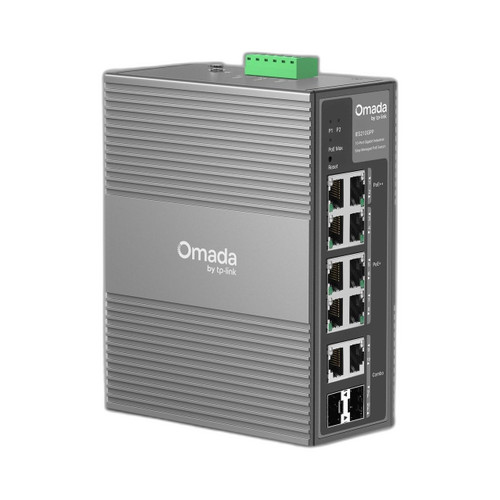
The IES210GPP carries a 240W total PoE budget across 8 powered ports — 6 ports at PoE+ (802.3at, 30W each) and 2 ports at PoE++ (802.3bt, up to 95W combined as spec'd). This budget supports PTZ cameras, thermal imagers, multi-radio access points, and other high-draw edge devices without secondary power supplies. The standard coverage spans 802.3af, 802.3at, and 802.3bt, so legacy and current PoE endpoints are both served.
The OCA-1AB201-NA provides no PoE specification in the available data — no per-port wattage, no PoE standard, and no total power budget are listed. Buyers who need to power cameras, intercoms, or access-control readers directly from the switch must treat the OCA-1AB201-NA as a non-PoE device based on current specs, and plan for separate injectors or power supplies at each endpoint. This is a fundamental architectural difference for camera and access-control deployments.
How do the two switches compare on enclosure rating, operating temperature, and physical form factor?
The IES210GPP is rated IP40, suitable for protected indoor industrial enclosures and panels where the unit is shielded from direct water ingress and large particulate matter. Its operating temperature range is -40°C to 75°C (-40°F to 167°F), and the spec notes ±6 kV common-mode surge protection on Ethernet ports. It mounts on DIN rail and also supports wall mount. Standby power consumption is listed as 5.64–5.95W depending on input voltage. Power input uses a 1+1 redundant configuration.
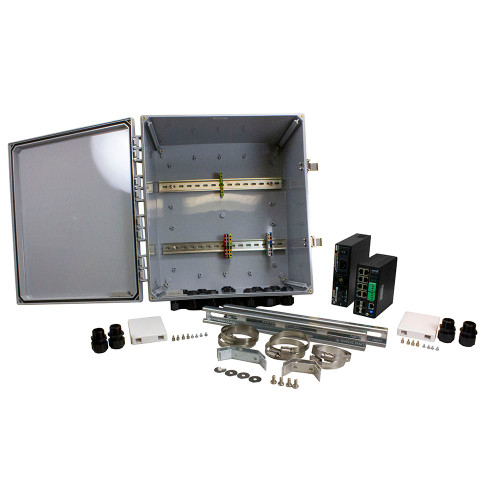
The OCA-1AB201-NA is described as outdoor-rated and deployed as a cabinet bundle assembly — the form factor implies it ships as a complete enclosure kit rather than a bare switch. Its operating temperature is listed as industrial-class, consistent with the IES210GPP range, though no specific °C limits appear in the available spec data. Physical dimensions are stated as 10.0 × 18.0 × 16.0 in and weight is 1.0 lb, suggesting the dimensional figure likely includes cabinet structure. DIN rail mount is confirmed. No IP rating number is provided beyond the 'Outdoor' environment descriptor.
Which switch offers deeper management integration, and how does each fit into a larger network or security platform?
The IES210GPP integrates with TP-Link's Omada SDN controller, enabling centralized management of multiple switches, access points, and gateways under a single pane of glass. Omada supports VLAN, QoS, port mirroring, and cloud or on-premises controller deployment. Switching capacity is confirmed at 20 Gbps with 64 Mbit Flash and 4 Mbit packet buffer. It includes 2 SFP combo uplink slots (1000BASE-X) for fiber backbone connections, and the maximum PoE cable reach is rated at 820 ft.
The OCA-1AB201-NA is described as managed with port-level configuration and monitoring, supporting VLAN, port mirroring, and QoS per the available spec bullets. However, no named controller platform, cloud management option, or SDN ecosystem is identified in the provided data. There are no uplink slot counts, switching capacity figures, or memory specs listed. The switch carries a lifetime warranty, which the IES210GPP spec does not state. Buyers operating a multi-site Omada deployment would find no confirmed integration path for the Transition Networks unit based on available data.
Which should you choose: the IES210GPP or the OCA-1AB201-NA?
Our take: The IES210GPP is the stronger choice when powered edge devices — cameras, intercoms, or access-control readers — must be driven directly from the switch and when Omada SDN controller integration is already in use or planned. It delivers a confirmed 240W PoE budget (802.3af/at/bt) across 8 ports, a 20 Gbps switching fabric, 2 SFP fiber uplinks, and -40°C to 75°C operation with IP40 and ±6 kV surge protection, all backed by explicit spec data. The OCA-1AB201-NA lists no PoE specification, no switching capacity, and no named management platform, making direct numerical comparison on those axes impossible from available data. Where the OCA-1AB201-NA has a documented edge is its outdoor cabinet bundle form factor, lifetime warranty, and explicit outdoor environment rating — advantages that matter in exposed roadside or perimeter enclosures. Buyers prioritizing a complete weatherproof enclosure assembly with a lifetime warranty and no requirement to power PoE endpoints should evaluate the Transition Networks unit further with its full datasheet before deciding.
Side-by-Side Comparison
Spec-for-spec, from manufacturer data.
| Specification | TP-Link IES210GPP | Transition Networks OCA-1AB201-NA |
|---|---|---|
| Product Type | Managed Industrial Gigabit Switch | Managed Gigabit Switch Cabinet Bundle |
| Total Ports | 10 | 10 |
| Port Speed | Gigabit (10/100/1000 Mbps) | Gigabit |
| PoE Support | 802.3af / 802.3at / 802.3bt | — |
| PoE Ports | 6× PoE+ (30W), 2× PoE++ (95W combined) | — |
| Total PoE Budget | 240W | — |
| Uplink / Fiber Slots | 2× SFP Combo (1000BASE-X) | — |
| Switching Capacity | 20 Gbps | — |
| Flash / Buffer Memory | 64 Mbit Flash; 4 Mbit Packet Buffer | — |
| Operating Temperature | -40°C to 75°C (-40°F to 167°F) | Industrial (specific range not stated) |
| IP / Environment Rating | IP40 (indoor industrial) | Outdoor (IP number not stated) |
| Surge Protection | ±6 kV common mode (Ethernet ports) | — |
| DIN Rail Mount | Yes | Yes |
| Wall Mount | Yes | — |
| Management Platform | Omada SDN (cloud or on-premises controller) | Port-level managed (no named platform stated) |
| Warranty | — | Lifetime |
Frequently Asked Questions
Which should you choose: the IES210GPP or the OCA-1AB201-NA?
The IES210GPP is the stronger choice when powered edge devices — cameras, intercoms, or access-control readers — must be driven directly from the switch and when Omada SDN controller integration is already in use or planned. It delivers a confirmed 240W PoE budget (802.3af/at/bt) across 8 ports, a 20 Gbps switching fabric, 2 SFP fiber uplinks, and -40°C to 75°C operation with IP40 and ±6 kV surge protection, all backed by explicit spec data. The OCA-1AB201-NA lists no PoE specification, no switching capacity, and no named management platform, making direct numerical comparison on those axes impossible from available data. Where the OCA-1AB201-NA has a documented edge is its outdoor cabinet bundle form factor, lifetime warranty, and explicit outdoor environment rating — advantages that matter in exposed roadside or perimeter enclosures. Buyers prioritizing a complete weatherproof enclosure assembly with a lifetime warranty and no requirement to power PoE endpoints should evaluate the Transition Networks unit further with its full datasheet before deciding.
Can either switch power PTZ or thermal cameras without a separate power injector?
The IES210GPP can — it provides 240W total PoE budget with 802.3bt support up to 95W on its two highest-power ports, which covers PTZ cameras and most thermal imagers. The OCA-1AB201-NA has no PoE specifications in its available data, so buyers should confirm with Transition Networks whether any powered ports exist before assuming it can drive PoE endpoints.
Which switch is better suited for a completely exposed outdoor enclosure?
The OCA-1AB201-NA is explicitly described as outdoor-rated and is packaged as a cabinet bundle assembly for outdoor hardened environments. The IES210GPP carries an IP40 rating, which is appropriate for protected indoor industrial panels but does not carry an outdoor or weatherproof designation. For a fully exposed installation, the OCA-1AB201-NA's outdoor rating is the relevant spec — though its exact IP number is not stated in available data and should be confirmed via datasheet.
Is the IES210GPP or OCA-1AB201-NA better for a multi-site managed network running a common controller?
The IES210GPP has confirmed integration with TP-Link's Omada SDN controller, supporting centralized VLAN, QoS, port mirroring, and cloud or on-premises management across multiple sites. The OCA-1AB201-NA is described as managed but lists no named controller platform or SDN ecosystem in available spec data. If the deployment already runs Omada — or if unified multi-site management is a requirement — the IES210GPP has a clear, documented integration path that the Transition Networks unit does not currently show.
More Network Switch Comparisons
- TP-Link IES210GPP vs Transition Networks OCA-1BA1A0
- TP-Link IES210GPP vs Transition Networks OCA-1BA101
- TP-Link IES210GPP vs TP-Link DS110GMP
- TP-Link IES210GPP vs TP-Link SG1210PP
- TP-Link DS110GMP vs Transition Networks OCA-1AB201-NA
- TP-Link DS110GMP vs Transition Networks OCA-1BA1A0
Network Switch Buying Guides
Get a Second Opinion on Your Camera Choice
Share your site layout, coverage goals, and budget. Our team will validate the camera selection, flag anything we would change, and recommend products that match the use case.