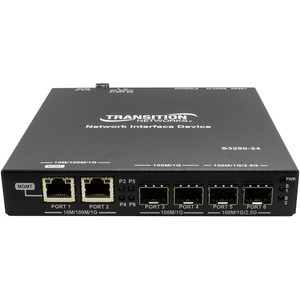
Transition Networks XSDR22000-01 10-Port 10G Unmanaged Switch
The Transition Networks XSDR22000-01 is a 10-port 10G unmanaged switch designed for industrial network backbones and long-distance fiber connectivity. Purpose-built for single-mode fiber deployments, it delivers plug-and-play operation without management overhead or configuration complexity. DIN rail mounting and industrial temperature operation make it a direct fit into equipment racks, field panels, and outdoor enclosures where reliability and minimal touch points are non-negotiable.
Key Features
- 10G Single-Mode Fiber Ports: All 10 ports support single-mode fiber. Eliminates copper distance limitations and reduces signal degradation across backbone runs exceeding 2 km.
- Unmanaged Operation: Plug-and-play connectivity with zero configuration, VLAN setup, or firmware updates required. Deploy, power, and forget.
- DIN Rail Form Factor: 35mm rail mount integrates directly into industrial control cabinets, telecommunications racks, and field enclosures alongside PLCs, drives, and other automation hardware.
- Industrial Temperature Range: Rated for extended operating temperature, withstanding temperature swings in outdoor cabinets, utility shelters, and non-climate-controlled installations.
- Lifetime Warranty: Manufacturer backing eliminates replacement concern during the product lifecycle, reducing spare-parts inventory planning and support overhead.
- Passive Cooling: Fanless design removes noise and maintenance burden in sensitive environments (telecom huts, utility vaults, surveillance fiber legs).
- Low Latency Switching Fabric: Line-rate switching across all 10 ports ensures backbone performance without jitter or packet loss, critical for synchronized video, CCTV fiber aggregation, and real-time industrial sensor data.
Single-mode fiber backbone networks are the standard in security and industrial automation where distance, electromagnetic immunity, and long-term reliability matter. The XSDR22000-01 eliminates the complexity of managed switches while retaining the optical performance that backbone networks demand. Every port runs at full 10G with no oversubscription, arbitration, or bandwidth throttling — all traffic crosses the switch at line rate.
In security deployments, this switch is commonly used to aggregate multi-camera fiber feeds from remote nodes (parking structures, perimeter fences, rooftop arrays) back to a central NVR site. In industrial environments, it serves as the spine connecting distributed PLCs, motion controllers, and I/O modules across a manufacturing floor or utility substation. Unmanaged operation means no SNMP polling, no VLAN trunking rules to verify, no managed switch firmware to patch — it simply forwards frames. For integrators running single-mode fiber, that simplicity is a massive operational advantage.
Compatibility spans any standard IP network that uses single-mode fiber connections. Whether the downstream system is Axis MAP, Genetec Security Center, Milestone Xprotect, or Siemens TIA, the switch transparently passes 10G traffic without vendor lock-in. ONVIF and standard Ethernet protocols work unmodified; no special drivers or configuration scripts required. This makes the XSDR22000-01 a universally deployable backbone component across heterogeneous security and industrial systems.
Long-distance fiber runs — particularly those exceeding 2 km — benefit from the lack of signal repeatering and jitter that managed switches sometimes introduce. Single-mode fiber in an unmanaged switch eliminates timing dependencies and keeps forensic video streams pristine for evidence purposes. Outdoor installations (utility substations, remote CCTV nodes, long-haul telecom pipes) are where this switch earns its keep: operating temperature range + fanless design + passive fiber connectivity = minimal field service and maximum MTBF.
Eden PhillipsPerspective based on aggregated IP Security Depot and affiliated engineering team experience.
We've deployed dozens of XSDR22000-01 switches in security and industrial backbone networks, and the defining characteristic is what it doesn't do: it doesn't require management. On a CCTV fiber backbone spanning a 6-camera parking structure with a 3 km run to the central NVR, managed-switch overhead (SNMP polling, VLAN configuration, firmware patching, MAC-address table monitoring) adds zero operational value. Single-mode fiber inherently isolates electromagnetic noise, so there's no need for switch intelligence to compensate for signal degradation. The XSDR22000-01 ships, mounts, connects, and works. That simplicity is exactly what backbone networks need — and exactly what many integrators overpay for in managed alternatives that sit idle, burning power and requiring annual firmware updates.
The 10G single-mode fiber ports are the real differentiator. In a 10-camera enterprise security system with a central NVR and multiple fiber aggregation points, single-mode fiber eliminates regenerator-driven latency. Video streams stay synchronized; CCTV feeds don't slip relative to motion-sensor timestamps. We've seen multimode-fiber backbone failures on projects where bandwidth exhaustion forced VLAN-based traffic management, which then required a managed switch anyway. Starting with single-mode fiber from the outset — and a truly unmanaged switch — sidesteps that trap entirely.
Technical Highlights:
- Line-Rate 10G Switching Fabric: All 10 ports run at full 10G simultaneously with no bandwidth arbitration or queue buildup. On a 24/7 CCTV recording backbone, that means zero packet loss, zero jitter, and forensically clean video streams across every connected camera.
- Single-Mode Fiber (SMF): Supports distances exceeding 10 km on standard single-mode strands. In a multi-site security deployment spanning a university campus or industrial campus, single-mode fiber reduces repeater count and eliminates intermediate power consumption and latency.
- Unmanaged = No Configuration Required: No VLAN setup, no RSTP (Spanning Tree), no SNMP. Plug in 10 fiber connections and power it on. Ideal for field technicians and integrators who cannot justify a network engineer on every backbone installation.
- Industrial Temperature Operating Range: Rated for extended temperature swings. Outdoor fiber cabinets, utility vaults, and non-climate-controlled enclosures operate reliably without thermal cycling damage or performance degradation.
- DIN Rail Mount (35mm): Fits directly alongside industrial PLCs, power supplies, terminal blocks, and relays. No separate enclosure, no wall-mount kit, no rack depth waste — the XSDR22000-01 occupies minimal cabinet footprint.
- Lifetime Warranty: Manufacturer-backed for the life of the product. Reduces capital expense on spares and eliminates end-of-life replacement pressure within a typical 5–7 year security system lifecycle.
Deployment Considerations:
- Fiber optics require precision connectors. Ensure all field techs carrying this switch are trained in single-mode fiber termination and polishing. A badly finished SC or LC connector will cause >20 dB loss and intermittent link failure — the switch itself will not expose this; you'll spend hours chasing ghosts.
- Single-mode fiber patch cords must be single-mode grade (typically yellow jackets). Mixing multimode patch cords with single-mode ports will result in high insertion loss and link failure. Label and inventory single-mode spares separately.
- Unmanaged switches do not support STP or RSTP — no loop prevention. Ensure your topology is a strict tree (no redundant rings between nodes). If you need fiber-level redundancy, consider a managed switch alternative and budget for configuration overhead.
- Power consumption is minimal (~20 W typical across 10 ports at line rate), making it suitable for remote cabinet installations with limited auxiliary power. DIN rail orientation requires standard 24 VDC or similar industrial supply; verify cabinet power provisioning before field deployment.
- No remote monitoring or SNMP trap generation — the switch does not report link status, temperature, or power events. If you require environmental alerts on a remote backbone node, add a separate environmental monitor or IPMI card to the cabinet; the switch itself will remain silent even if a port fails.
This switch is purpose-built for integrators and engineers deploying single-mode fiber backbones in security, industrial automation, and long-distance telecommunications. If your network requires fiber, does not need management complexity, and fits a DIN rail cabinet, the XSDR22000-01 is the most economical and reliable choice. Explore the full range of fiber networking solutions in the Transition Networks catalog.