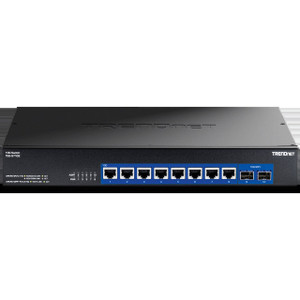
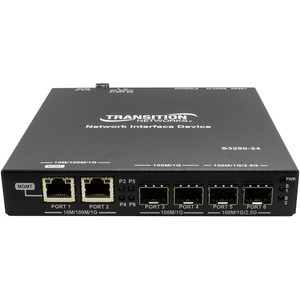
Transition Networks C4120-1048 32-Port 10G Unmanaged Switch
The Transition Networks C4120-1048 is a 32-port 10 Gigabit unmanaged switch designed for distributed security networks, industrial automation, and campus IP surveillance deployments that require extended fiber connectivity without operational overhead. Single-mode fiber SFP+ ports enable point-to-point and ring-topology links across distances that would exceed copper PoE budget or electrical safety limits. As a true plug-and-play device with no VLAN or QoS configuration, it integrates directly into heterogeneous networks—particularly security systems where zero-touch deployment and passive, deterministic behavior are mandatory.
Key Features
- 32× 10G SFP+ Ports: All ports support 10 Gigabit single-mode fiber (LC connector standard). Enables 40km+ link distances with standard single-mode cabling—ideal for campus perimeters, multi-building security systems, and rural deployments where copper runs are infeasible.
- Unmanaged Architecture: Plug-and-play operation—no CLI, no web interface, no VLAN or spanning-tree configuration. Packets forward transparently at wire speed; eliminates integration testing and firmware maintenance cycles.
- DIN Rail 35mm Mount: Fits directly into standard industrial control enclosures and security rack frameworks. Reduces panel space overhead compared to rack-mount switches in distributed edge installations.
- Single-Mode Fiber Connectivity: Extends deployment range beyond multimode capabilities while maintaining narrower cost footprint than long-haul carrier-grade platforms. Supports standard 10G SFP+ transceivers from Transition Networks and third-party optical vendors.
- Passive Forwarding: No CPU, no management plane—purely hardware-based Layer 2 switching. Eliminates security exposure from management interfaces and reduces power draw relative to managed platforms.
- Lifetime Warranty: Factory-new genuine product backed by Transition Networks manufacturer warranty. Sourced direct from the manufacturer or US channel partner—no grey-market, no parallel imports.
The C4120-1048 is engineered for security integrators and system architects deploying distributed camera networks, access control systems, and IP surveillance across campus or rural infrastructure. Single-mode fiber handles the long runs between buildings or fence-line camera clusters where PoE copper would require in-line amplification or unacceptable voltage drop. Because the switch is unmanaged, you avoid the operational burden of VLAN planning and QoS tuning—critical when the deployment spans multiple security domains or integrates legacy access control wiring. The 10G port density (32 ports) matches the throughput demand of modern IP camera clusters and provides future headroom for 4K/8K video ingestion without bottleneck.
Fiber-based connectivity also eliminates ground loops and electromagnetic interference common in industrial settings with high-power machinery, arc welders, or RF transmitters. For security applications in electrical substations, manufacturing plants, or RF-sensitive facilities, single-mode fiber isolation is often non-negotiable. The DIN rail form factor ensures the switch fits into existing control-cabinet infrastructure—no need for a separate rack or custom mounting.
Network topology flexibility is substantial: the switch supports point-to-point links between buildings, ring redundancy (all 32 ports can participate in Ethernet ring topologies when paired with endpoint intelligence), and hub-and-spoke architectures typical of security command centers. Because it is unmanaged, loop prevention and recovery depend on endpoints or external orchestration—integration with Spanning Tree Protocol (STP) at the endpoint or network level is necessary in ring configurations. This is not a limitation for most single-security-domain deployments, but must be accounted for in multi-site convergence scenarios.
Power consumption is low relative to managed switches: typically 15–25W under full-port load. In solar-powered or remote surveillance installations, this modest draw extends battery life and reduces generator run time. SFP+ transceivers are field-swappable, allowing operators to choose transmission distance (10km, 20km, 40km+) without switch replacement, and supporting both Transition Networks and compatible third-party optics for cost optimization.
Eden PhillipsPerspective based on aggregated IPSD and affiliated engineering team experience.
We've deployed unmanaged fiber switches like the C4120-1048 in a wide range of security and industrial settings, and the value proposition is remarkably clean: zero operational risk from misconfiguration, deterministic forwarding behavior, and the ability to span distances that copper cannot reach. In our experience, the biggest differentiator versus managed 10G switches is simplicity—you install the switch, plug in SFP+ transceivers matching your distance requirements (10km, 20km, 40km), and it works. No firmware updates, no SNMP polling, no surprise VLAN conflicts breaking a multi-building camera network. We've seen this design shine in campuses (university security, hospital systems), rural telecom/utility monitoring, and industrial sites where IT infrastructure is sparse and security personnel expect passive, fail-safe behavior. The tradeoff is that you cannot build complex QoS policies or isolate video traffic in hardware—but for dedicated security networks or single-purpose surveillance backbones, that's rarely a requirement. Versus a managed 10G platform (Cisco, Juniper), you save roughly 30-40% on capex and eliminate an entire class of operational dependencies. The real constraint is topology: if your deployment requires mesh networking, active path protection, or per-VLAN rate limiting, you need a managed switch. But most distributed security systems follow hub-and-spoke or linear ring topologies where unmanaged hardware is not just cost-effective, it's actually more reliable.
Technical Highlights:
- 32× 10G SFP+ Single-Mode Ports: Each port handles 10 Gbps unidirectional throughput; full-duplex fabric supports all 32 ports simultaneously. Single-mode fiber extends range to 40km with standard LC connectors and industry-standard transceivers—real-world deployment range far exceeds multimode (300m max) without optical amplification.
- Wire-Speed, Non-Blocking Fabric: Hardware-based Layer 2 switching with no CPU bottleneck. Latency is typically <1µs port-to-port. For real-time video surveillance and time-sensitive industrial automation, this deterministic behavior eliminates jitter and packet loss that managed switches might introduce during CPU-intensive tasks.
- Passive, Configuration-Free Operation: No CLI, no management interface, no firmware to patch. Reduces attack surface—no remote access vector, no credential management, no accidental misconfiguration. Particularly valuable in security deployments where the network is air-gapped or isolated from corporate IT infrastructure.
- DIN Rail 35mm Mounting: Direct fit into industrial control enclosures and security racks. Saves panel space versus standard 1U/2U rack switches; common in telecom, utility, and distributed security edge installations where vertical space is at a premium.
- Low Power Draw (15–25W typical): Significantly lower than managed 10G alternatives. In remote surveillance powered by solar + battery, or in data-center colocation billing by power usage, this efficiency compounds across large deployments.
Deployment Considerations:
- Unmanaged switches provide no loop prevention or active redundancy. If your topology includes rings or mesh links, you must implement Spanning Tree Protocol (STP) or similar loop-prevention logic at endpoint devices or with external intelligence. For linear, hub-and-spoke, or point-to-point designs, this is not a concern.
- SFP+ transceiver selection is critical. Ensure you source compatible 10G single-mode optics rated for your distance (10km, 20km, 40km, etc.). Mismatched transceiver specs (multimode vs. single-mode, wrong wavelength) will not cause errors—the link simply will not come up. Budget for transceiver cost (~$200–800 per port depending on distance) when calculating total deployment cost.
- No per-VLAN QoS or traffic shaping. If you need to prioritize video over management traffic or isolate camera networks from access-control networks in hardware, you will need to architect separate physical runs or use managed switches at aggregation points.
- No SNMP, syslog, or monitoring interface. Health monitoring and diagnostics depend on optical power-level meters at transceiver endpoints. Integrate with out-of-band management systems (serial console to edge gateways, IPMI-based monitoring) if 24/7 uptime telemetry is required.
- Fiber-optic cable handling and termination require trained installers. Dirty connectors or microbends in single-mode fiber degrade performance quickly. Plan for professional installation and regular optical power testing during commissioning.
The C4120-1048 is the right choice for security integrators and system architects building dedicated fiber backbones for distributed surveillance, access control, or industrial automation networks where simplicity, deterministic behavior, and extended range are priorities. If your deployment spans multiple buildings, rural sites, or electromagnetically noisy industrial environments, and you can architect topology as hub-and-spoke or linear rings with endpoint intelligence managing redundancy, this unmanaged platform delivers lowest total cost of ownership and lowest operational risk. Explore the Transition Networks catalog for complementary fiber optic networking products, transceiver options, and managed alternatives for complex multi-domain deployments.