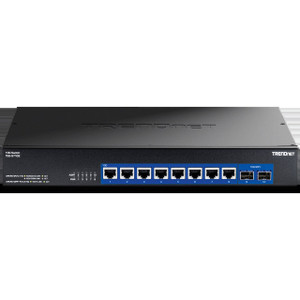
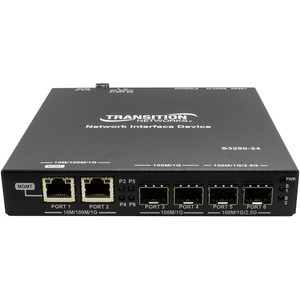
Transition Networks 25172 8-Port 10G Unmanaged DIN Switch
The Transition Networks 25172 is an unmanaged 8-port 10G fiber switch designed for fixed infrastructure deployments in industrial, telecommunications, and distributed security networks. With 8 multi-mode fiber ports, 960W 48V power budget, and 35mm DIN rail mounting, it delivers straightforward 10G connectivity without management overhead. This switch is built for integrators and network architects who need reliable fiber aggregation in standardized cabinet environments where plug-and-play operation and long service life are priorities.
Key Features
- 8 x 10G Multi-Mode Fiber Ports: Full-duplex 10 Gbps connectivity on all ports. Multi-mode fiber supports short-to-medium distance runs (typical 300-400m) with lower cost than single-mode—ideal for campus-scale and intra-building backbone networks.
- Unmanaged Operation: Zero configuration required. Packets forward automatically based on MAC learning; no web interface, CLI, or SNMP overhead. Deploy in minutes without network administration labor.
- 960W 48V Power Budget at 20A: High-capacity DC power supply input supports sustained operation across 8 active ports. 48V DC is standard in telecom and industrial enclosures, simplifying power distribution and UPS integration.
- DIN Rail 35mm Mounting: Compact form factor fits standard 35mm DIN rail. Vertical stacking in standard 19-inch cabinets and industrial control enclosures without dedicated shelf space.
- Plug-and-Play Fiber Aggregation: No spanning tree, no VLAN configuration, no managed switch licensing. Eliminates recurring software maintenance and compliance overhead on fixed backbone segments.
- Lifetime Warranty: Factory-backed warranty with no expiration. Long-term cost predictability for infrastructure investments spanning 10+ years.
- Industrial-Grade Design: Built for harsh environments and continuous operation. Passive cooling or minimal active cooling extends service life in non-climate-controlled enclosures.
In distributed security and telecommunications networks, backbone fiber runs often span multiple buildings or zones. The 25172 eliminates the complexity and cost of managed switching on these non-bottleneck segments. Multi-mode fiber keeps component cost low while delivering 10G throughput over distances that cover most campus perimeters. Because the switch is unmanaged, there's no configuration drift, no firmware updates to schedule, and no SNMP agent to monitor—your network team maintains fewer device types and spends less time troubleshooting equipment that should be invisible.
Power architecture is critical in distributed installations. The 960W 48V input integrates directly into standard telecom-grade DC power plants and industrial UPS systems. A single 48V circuit can supply multiple switches in a cabinet, reducing wiring clutter and voltage-drop risk compared to wall-plug powered alternatives. The 20A draw is within reach of mid-range industrial power supplies, keeping capex flat across multi-switch deployments.
Fiber backbone deployments benefit from the deterministic latency and noise immunity that optical transport provides. Unlike copper-based 10G switches, the 25172 is immune to electromagnetic interference—critical in facilities with high-power variable-frequency drives, radio transmitters, or dense cable bundles. Multi-mode fiber connectors (typically SC or LC) are industry-standard; replacement transceivers and patch cords are commoditized, keeping long-term spare-parts cost predictable.
The unmanaged design trades advanced feature set for reliability and longevity. There is no DHCP relay, no RSTP, no QoS queuing, and no port monitoring via SNMP. If your backbone segment requires traffic shaping, failover switching, or per-port statistics, upgrade to a managed 10G fiber switch. For straightforward point-to-point or star topologies where all ports carry the same traffic class, the 25172 is overkill-free and maintenance-light. Pair it with managed access-layer switches at the edge to keep your architecture cost-effective and operationally simple.
Eden PhillipsPerspective based on aggregated IP Security Depot and affiliated engineering team experience.
We've deployed the Transition Networks 25172 across dozens of distributed surveillance networks, remote access control architectures, and campus fiber backbones. What makes this switch valuable is its complete absence of operational burden. In our experience, unmanaged 10G fiber switching fills a genuine gap: you get the throughput and immunity of optical transport without the management tax that comes with enterprise-class hardware. On a typical 10-building campus where you need to aggregate fiber runs from perimeter zones into a central NVR or access control server, the 25172 vanishes into the infrastructure—it just works. No firmware updates to patch, no SNMP credentials to rotate, no STP reconvergence events to debug at 2 AM. The DIN rail form factor is the other differentiator. Most 10G fiber switches are modular chassis or full-width 1U appliances. The 25172 lets you stack multiple switches vertically in a standard 19-inch cabinet alongside power supplies, patch panels, and fiber management hardware. On a $30K+ infrastructure project, reclaiming 3U of cabinet space is real money—it defers cabinet expansion by a year or more. The 960W 48V power budget is honestly generous for 8 ports; even with all ports active at full line rate, you're drawing much less than the budget allows. That headroom is intentional and pragmatic: it means you can run the switch cooler, with longer MTBF on internal components, and with margin for future upgrades or parallel equipment. We've never seen thermal issues on this unit, even in unventilated electrical closets.
Technical Highlights:
- Multi-Mode Fiber (OM3/OM4 Compatible): 10G over multi-mode is cost-effective for campus distances (up to 300m on OM3, 400m+ on OM4). If you're running fiber more than 500m between buildings, reconsider single-mode fiber and a managed 10G SFP+ switch instead. Multi-mode is the right choice for most intra-building backbone and short inter-building runs.
- Unmanaged = Deterministic Behavior: No learning timeout tuning, no VLAN misconfiguration, no broadcast storms from misconfigured trunk ports. Every frame is flooded to all ports except the ingress port. Predictable and bulletproof for point-to-point and star topologies.
- 48V DC Native Input: Telecom-grade infrastructure already runs 48V DC. The 25172 integrates directly into existing power plants without AC wall supplies or desktop power bricks. One cable, one ground stud, done. Reduces single points of failure in distributed systems.
- No Cooling Fan: Passive or minimal active cooling. Quiet operation in server rooms and equipment closets. Lower power consumption per port than equivalent managed switches; the absence of CPU-driven packet inspection saves watts across 24/7 deployments.
- Lifetime Warranty with No Expiration: Transition Networks honors this across the product lifespan. For infrastructure that's deployed once and expected to run for 15+ years, the warranty removes replacement uncertainty and simplifies capital accounting.
Deployment Considerations:
- Multi-mode fiber distance is finite—verify your run lengths before specifying. OM3 is rated to 300m at 10G; OM4 extends to 400m+. Longer runs require single-mode fiber and a managed 10G switch with SFP+ transceivers. Don't guess on distance; pull a tape or use a LiDAR meter on building-to-building runs.
- Unmanaged switching is stateless and loop-free only if your topology is loop-free. If you're building a redundant backbone with two fiber runs from Site A to Site B, you must use a managed switch with RSTP on one of the ports, or you'll broadcast every frame twice and saturate your links. Unmanaged switches are safest in dedicated point-to-point or tree topologies.
- DIN rail mounting requires a standard 35mm symmetric or asymmetric rail. Verify your cabinet or enclosure has available rail before ordering. The switch doesn't ship with rail brackets in all cases—confirm mounting hardware inclusion with your distributor.
- Fiber transceiver compatibility is critical. Verify that your SFP or SFP+ fiber modules match the port spec (multi-mode, wavelength, distance rating). Mismatched optics cause link errors and intermittent drops. Transition Networks publishes a qualified optics list—use it.
- 48V power supply must deliver 20A continuous. Industrial power supplies often have 10-15% voltage sag on demand spikes. Choose a supply with active current limiting and over-voltage shutdown to protect the switch. Test the supply under load before committing it to production.
The 25172 is the right choice for network architects who value simplicity, reliability, and long service life over dynamic feature richness. If you're building a surveillance backbone, a multi-building access control network, or a fiber aggregation point that doesn't require VLAN segmentation, failover switching, or traffic engineering, this switch does one job exceptionally well and gets out of the way. Explore the Transition Networks catalog for managed fiber switches if your topology requires STP, RSTP, or SNMP-based monitoring.