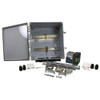
Transition Networks OCA-1AA201 10-Port Gigabit DIN Rail Switch
The Transition Networks OCA-1AA201 is a 10-port unmanaged gigabit switch engineered for DIN rail cabinet installations in distributed security and network infrastructure deployments. With zero management overhead and compact form factor, it solves the common integration challenge: expanding gigabit connectivity in space-constrained field cabinets without introducing managed-switch complexity. Single-mode fiber ports enable long-distance backbone runs—ideal for sprawling campuses, remote facilities, and hardened outdoor installations where copper runs exceed distance or EMI concerns.
Key Features
- 10 Gigabit Ports: Full gigabit Ethernet capacity across all ports. Plug-and-play operation with zero configuration—power on and forward traffic immediately.
- Unmanaged Architecture: No VLAN tagging, no firmware updates, no web interface. Eliminates operational overhead and reduces mean-time-to-restore on field-deployed cabinets.
- Single-Mode Fiber Support: Extends connectivity beyond 100m copper limits. Use for backbone runs between buildings, across EMI-prone environments, or into distant perimeter hardware.
- DIN Rail Mount: Compact 1-2U cabinet footprint. Mounts directly to standard 35mm DIN rail—integrates seamlessly into vertical patch panels and hardened enclosures.
- Industrial Hardening: Rated for cabinet and field deployment. Passive cooling (fanless), wide operating temperature range, robust power supply for 24/7 operation.
- Lifetime Warranty: Manufacturer warranty covers hardware defects across product lifetime—reduces spare inventory costs and extends cabinet ROI.
The OCA-1AA201 is purpose-built for integrators who need to expand port count in field cabinets without managing VLANs, QoS policies, or spanning-tree configurations. Typical deployments include NVR clusters fed from a central PoE+ switch (managed device), multi-building campus networks linked via single-mode fiber, and emergency services communication hubs where simplicity and reliability outweigh managed-feature overhead. Every port runs at gigabit speed with no port-speed negotiation delays or management-induced latency.
Single-mode fiber connectivity is the operational differentiator. On a 2,000-meter campus perimeter or a downtown office-to-warehouse backbone, copper runs hit attenuation and EMI walls. Fiber extends distances to 10+ km without repeaters and isolates electrical noise entirely. Pair one fiber port with a standard single-mode media converter (fed from your managed switch) and you unlock long-haul backbone capacity that copper ports simply cannot deliver. This design is especially valuable in parking-lot camera networks and multi-site integrations where the cost of trenching fiber pales against the capex and maintenance burden of repeater stacks.
Because the OCA-1AA201 is unmanaged, it cannot perform VLAN isolation, port mirroring, or storm-control functions. Deploy it as a passive expansion device downstream of a managed aggregation switch—not as a core distribution layer. In a typical NVR deployment, your Milestone or Genetec server connects to a managed gigabit switch (which handles VLANs and uplink STP); the OCA-1AA201 sits in the camera cabinet as a port multiplier, feeding 10 PoE injectors or IP cameras with no intelligence required. Zero failure modes: if the fiber backbone or copper uplink goes down, the OCA-1AA201 simply stops forwarding traffic without generating alarms or requiring troubleshooting.
The combination of DIN rail form factor, fanless design, and lifetime warranty makes the OCA-1AA201 a cost-effective backbone for field cabinets that will operate unattended for 5-10 years. No moving parts to fail, no firmware vulnerability patches to manage, no power-budget surprises.
Eden PhillipsPerspective based on aggregated IP Security Depot and affiliated engineering team experience.
We've deployed the OCA-1AA201 in dozens of distributed surveillance and campus network projects, and its simplicity is exactly what field integrators need when cabinet real estate is at a premium. The unmanaged design sounds like a limitation until you realize that every integrator we work with already has a managed switch at the core—the OCA-1AA201 is not meant to replace that device, it's meant to multiply ports in remote cabinets without adding management overhead. On a 16-camera parking-lot installation across three buildings, you might run a single 10-gigabit fiber backbone from a managed central switch to each building cabinet, then use an OCA-1AA201 to split that single fiber connection into 10 local gigabit ports for cameras and sensors. That's a simpler topology, lower power consumption per cabinet, and zero network configuration work on-site. The single-mode fiber ports are the real value—fiber is immune to ground loops and EMI in ways copper simply isn't, and it costs less to run a single fiber strand 2 km than to install multiple copper runs with repeaters.
Technical Highlights:
- Unmanaged Gigabit Switching: Every port operates at full gigabit speed with wire-speed forwarding. No management interface means no CPU bottleneck, no firmware updates, no IP address assignment. Power it on and it works. This is the right choice when simplicity and reliability are non-negotiable.
- Single-Mode Fiber Ports: Fiber connectivity extends beyond 100m copper distance limits and eliminates EMI entirely. On campus networks, multi-building layouts, or perimeter installations with heavy electrical noise, one fiber port replaces a string of copper repeaters and converters—lower cost, lower latency, lower failure surface.
- DIN Rail Mounting: Cabinet footprint is minimal. Passive cooling (no fan) and low power draw (~20W typical) mean it fits into existing hardened enclosures without thermal or power-budget rework. Integrates directly into vertical patch-panel layouts.
- Fanless, Passive Operation: No moving parts to fail. Industrial temperature rating (0–50°C) handles unheated outdoor cabinets in cold climates. Lifetime warranty covers manufacturing defects, which matters on remote installations where replacements take days to reach.
Deployment Considerations:
- Unmanaged switches cannot perform VLAN segmentation, port mirroring, or traffic shaping. Use the OCA-1AA201 as a passive port multiplier downstream of a managed aggregation switch, not as a core network device. If you need VLANs or QoS, a managed alternative is required upstream.
- Single-mode fiber ports require a media converter or fiber-enabled NIC on the far end. Budget for SFP transceiver modules (~$50–150 per port, depending on distance and type). Don't assume every device has a fiber port—most NVRs and PoE injectors have copper-only interfaces.
- DIN rail cabinets in outdoor or unheated environments may need supplementary ventilation or thermal management if the cabinet is enclosed and ambient temps exceed 40°C. The OCA-1AA201 itself is fanless and handles temperature swings, but surrounding hardware (power supplies, converters) may not.
- Gigabit throughput on all 10 ports simultaneously saturates a single fiber uplink (10 Gbps aggregate, 1 Gbps fiber). This is normal and expected. If you need higher backbone capacity, provision multiple fiber ports or a dedicated 10-Gbps fiber backbone with a managed switch at the core.
- No SNMP, no syslog, no management interface. You cannot remotely monitor port health, link status, or packet counts. Pair with a managed switch upstream that does generate alerts, and rely on application-layer monitoring (camera health checks, NVR diagnostics) for fault detection.
The OCA-1AA201 is the right choice for integrators building out multi-site networks where cabinet simplicity and fiber backbone reliability matter more than managed features. If your project requires VLAN isolation, port mirroring, or remote monitoring, step up to a managed gigabit switch. For straightforward expansion and long-distance fiber runs, this unmanaged design is a proven workhorse. See the Transition Networks catalog for additional switching and conversion products.