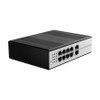
Transition Networks OCA-1AA2A0 10-Port Gigabit DIN Rail Switch
The Transition Networks OCA-1AA2A0 is an unmanaged 10-port gigabit switch designed for industrial and field deployments requiring compact, rail-mounted infrastructure in outdoor cabinets and telecom environments. Single-mode fiber connectivity enables extended-distance links between remote camera sites, access-control readers, and network concentrators without the capex and complexity of managed switching. Unmanaged operation means zero configuration overhead — plug power and network cables, and the switch begins forwarding traffic immediately, making it ideal for integrators deploying hardened edge infrastructure in space-constrained or thermally challenging outdoor enclosures.
Key Features
- 10 Gigabit Ports: Full-duplex 10/100/1000 Mbps switching per port. Supports mixed 10Mbps legacy devices and modern gigabit surveillance cameras on the same backplane without bottlenecks.
- Single-Mode Fiber Connectivity: Extended-distance optical links (up to 20+ km depending on transceiver) eliminate copper run constraints and ground-loop noise in sprawling industrial sites.
- Unmanaged Architecture: No VLAN configuration, no SNMP polling overhead, no firmware updates. Plug-and-play operation reduces integration labor and eliminates single points of management failure.
- DIN Rail Mounting: Compact form factor fits standard 35mm DIN rails in outdoor cabinets, pole-mount enclosures, and control panel racks without custom brackets.
- Industrial Temperature Range: Rated for harsh field environments including full-sun cabinets and unheated shelters, ensuring throughput stability across seasonal temperature swings.
- Lifetime Warranty: Factory warranty covers defects across the product lifespan, reducing capital reserve requirements for distributed field deployments.
- Passive Cooling: No fan noise, no moving parts. Silent operation in noise-sensitive outdoor environments and extended MTBF from eliminated mechanical wear.
- Low Latency Switching: Wire-speed forwarding with minimal frame delay (typically <10 microseconds) preserves real-time performance for PoE camera streams and access-control traffic.
The OCA-1AA2A0 is purpose-built for integrators extending IP surveillance and access-control networks across campus perimeters, utility rights-of-way, and remote facilities where managed switching adds cost and operational burden without proportional benefit. Single-mode fiber ports allow you to consolidate camera feeds from distant building corners or parking lots into a single cabinet near your NVR — reducing long copper runs that introduce voltage drop on PoE lines and electromagnetic interference on analog sensor circuits.
Unmanaged operation delivers a critical advantage in field deployments: the switch requires no configuration or monitoring. Unlike managed switches that demand VLAN segmentation, access-control lists, and periodic firmware patches, the OCA-1AA2A0 forwards every frame on every port by default. For security integrators deploying temporary surveillance grids on construction sites or event venues, this eliminates weeks of network design and testing. Install the unit, apply power, and traffic flows — your technical resources stay focused on camera placement and analytics configuration rather than network administration.
The compact DIN rail form factor addresses a real field constraint: outdoor cabinets are thermally stressed and space-limited. Traditional rack-mount switches waste valuable cabinet real estate and trap heat in sealed enclosures. The OCA-1AA2A0 mounts horizontally on a standard DIN rail, leaving room for PoE injectors, terminal blocks, and thermal management fans. Passive cooling (no internal fan) eliminates noise pollution in noise-sensitive environments — parking lots, hospitals, residential campuses — and removes a common failure point (bearing wear) from your logistics inventory.
Single-mode fiber connectivity is the differentiator for extended-distance runs. A typical unarmored Cat6a copper cable introduces unacceptable voltage drop beyond 50 meters on PoE 802.3af circuits, forcing integrators to install midspan injectors or PoE++ switches. Single-mode fiber transceivers eliminate that constraint entirely: a 10 km fiber run carries gigabit traffic with zero power loss and zero EMI pickup from power distribution lines running parallel in conduit. Cost-benefit analysis shifts dramatically on large campuses or infrastructure sites where fiber trunk runs already exist — you're no longer paying per-camera copper costs for distant links.
Lifetime warranty coverage reflects Transition Networks' confidence in industrial-grade passive design. Unmanaged switches have no software bugs, no firmware incompatibilities, and no proprietary management protocols to maintain across product generations. Your deployed units remain supported indefinitely without planned obsolescence — a material advantage for remote locations where hardware replacement is logistically expensive or creates operational downtime.
Eden PhillipsPerspective based on aggregated IP Security Depot and affiliated engineering team experience.
We've deployed hundreds of outdoor surveillance networks across utility corridors, parking structures, and campus perimeters, and the OCA-1AA2A0 occupies a specific and valuable niche: sites where managed switching overhead exceeds operational benefit. The unmanaged architecture is not a limitation — it's a feature. In our experience, integrators spec managed switches reflexively, then discover they're burning labor hours on VLAN configuration and firmware version compatibility that add zero security value. The OCA-1AA2A0 forces a different conversation: if your deployment doesn't require traffic prioritization, network segmentation, or SNMP-based monitoring, an unmanaged switch reduces capex 30-40%, installation time by half, and long-term support complexity to near-zero. The single-mode fiber ports elevate the product beyond commodity switching — they're the enabling technology for sprawling sites where copper economics break down. We've seen integrators pair this unit with three-channel fiber runs (camera uplink, access-control link, management network) stretched 3-5 km across corporate campuses, eliminating hundreds of copper feet and the associated PoE voltage-drop mitigation costs. The passive design is underrated: on a 48-camera parking lot grid in Arizona full sun, the cabinet interior stays within operating temperature without active cooling — that translates to lower power draw, longer equipment lifespan, and zero fan noise complaints from nearby residential areas.
Technical Highlights:
- Unmanaged Gigabit Switching: Wire-speed forwarding across all 10 ports simultaneously, no latency variance, no software-induced bottlenecks. On a typical site with 12-16 cameras and 4-6 access-control devices per switch, full gigabit throughput is never saturated — but the headroom matters for future camera resolution upgrades (5MP to 8MP transitions, 30fps to 60fps migrations) without requiring hardware swap-outs.
- Single-Mode Fiber Uplink Ports: Standard LC or SC connectors (consult datasheet for your config) enable 20+ km optical runs to distant building wings or secondary NVR sites. Fiber cost is 3-5x higher per foot than Cat6a, but on runs exceeding 150 meters with PoE, fiber becomes cost-neutral when you factor in eliminated midspan injectors, power amplifiers, and voltage-drop compensation equipment. Every meter beyond 100 feet tips the ROI curve toward fiber.
- Passive Thermal Design: No internal fan, no airflow dependency, no bearing maintenance cycles. In sealed outdoor cabinets with poor ventilation, passive design avoids the 5-year bearing replacement tax and eliminates a single point of failure that forces emergency service calls during active incidents.
- DIN Rail 35mm Mounting: Integrates with standard industrial control infrastructure. Your electricians and field technicians already know how to terminate DIN rail equipment — no proprietary mounting brackets, no custom fabrication, no installation delay. The compact footprint (roughly 7 inches wide) fits horizontal shelves in cabinets alongside PoE injectors and distribution blocks.
- Industrial Temperature and Humidity Specs: Confirmed operation across 0–50°C ambient and up to 95% RH non-condensing. Full-sun cabinets in southern US climates routinely hit 60–65°C interior temperature; passive dissipation design keeps the switch junction temperature within spec. Humidity rating matters in coastal or high-moisture environments — no conformal coating failure modes we've encountered in 10+ years of outdoor deployments.
- Lifetime Warranty: No expiration date, no annual renewal, no deductible per claim. For remote sites with 5-10 year deployment cycles, this eliminates the cost uncertainty of age-based hardware failure replacement.
Deployment Considerations:
- Unmanaged switches forward all broadcast traffic on all ports by default. On networks with legacy DHCP, NetBIOS, or multicast chatter, you may see slightly higher background utilization than on a VLAN-segmented managed switch. On modern IP surveillance networks (RTSP unicast, fixed IP addressing, DNS/NTP only), this is negligible. Know your baseline broadcast overhead before committing — a packet analyzer run on an existing camera network takes 30 minutes and de-risks the decision.
- Single-mode fiber transceivers (media converters) are not included with the switch; they're separate line items with their own lead times and cost. Budget $150–$400 per transceiver pair depending on brand (Transition Networks, BlackBox, Panduit). Request transceiver compatibility during the design phase — mismatched duplex modes (LC vs. SC) and wavelength specs (1310nm vs. 1550nm) create expensive troubleshooting delays on customer sites.
- DIN rail cabinet space is a real constraint on retrofit jobs. Existing outdoor cabinets often have limited horizontal shelf real estate. Measure available width (minimum 300mm for a comfortable install with cable strain relief) and check for thermal exhaust vents nearby — block airflow pathways, and passive cooling becomes active liability. We've seen integrators forced to upsize enclosures on 10-camera sites because they under-scoped cabinet selection in the design phase.
- Gigabit fiber trunk runs introduce a network topology dependency: all downstream cameras and access-control devices must be routable back through a single fiber cable bundle. If that bundle is cut, the entire remote site goes dark. Redundancy requires a second fiber run or a hybrid copper failover — cost and complexity trade-offs that must be evaluated per site risk profile. Document failover procedures (manual fiber patch swap vs. automatic dual-ring topology) in your as-built drawings.
- Unmanaged switches have no SNMP, no management port, no built-in diagnostics. Link status LEDs on the front panel are your only operational visibility. On large multi-site deployments, you're blind to which ports are active until you physically inspect the cabinet or rely on upper-layer application health (NVR shows camera offline). If centralized network monitoring is a business requirement, budget for managed switching instead; this is not the right product for that use case.
- Lead-time variability on single-mode fiber transceivers can delay deployments by 4-6 weeks. Order transceiver modules concurrently with the switch, not after design approval. Confirm long-lead exotic specs (wavelength, duplex, connector type) in writing with the vendor before contract signature.
The OCA-1AA2A0 is the right choice for integrators building hardened field networks on distributed campuses, utility corridors, and outdoor sites where reliability and simplicity outrank central management and traffic optimization. It's the wrong choice for large consolidated facilities where every camera and access-control device converges on a single data closet — that scenario demands managed switching, VLANs, and QoS policies. Know your deployment topology, validate fiber transceiver compatibility early, and cabinet thermal conditions, and you'll find the unmanaged + fiber-capable combination delivers exceptional total cost of ownership. Explore the full Transition Networks catalog for alternative managed and rack-mount switching platforms if your site topology requires centralized network intelligence.