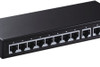
Transition Networks OCA-1BA101 10-Port Gigabit DIN Rail Switch
The Transition Networks OCA-1BA101 is a 10-port unmanaged gigabit switch purpose-built for DIN rail and cabinet mounting in telecom, security, and industrial network installations. Single-mode fiber connectivity and compact form factor make it a natural fit for outdoor enclosures, equipment rooms, and field deployments where space is constrained and plug-and-play operation eliminates management overhead. Integrators and system architects specify this switch when reliability and simplicity matter more than managed features.
Key Features
- 10 Gigabit Ports: Full-duplex 1000BASE-T switching capacity across all ports. Eliminates bottlenecks on copper runs to edge devices and access points within the cabinet or outdoor enclosure.
- Single-Mode Fiber Connectivity: Extended-reach fiber backbone support for long-haul telecom and campus links. Avoids electrical isolation issues common in grounding-heavy outdoor environments.
- Unmanaged Operation: No CLI, no configuration interface, no firmware updates required. Plug power and network cables, and the switch forwards traffic immediately—reduces deployment time and training overhead.
- DIN Rail Mountable: Standard EN 50022 DIN rail mounting. Occupies minimal vertical space in 19-inch cabinets and fits outdoor wall-mount enclosures without adapter brackets.
- 19-Inch Rack Compatible: Optional rack-mount conversion kit available. Consolidates telecom and network equipment into a single vertical form factor for managed service provider and carrier installations.
- Wide Operating Temperature Range: Rated for outdoor and unheated cabinet environments. Tolerates temperature swings without performance degradation—critical for rooftop and pole-mounted enclosures.
- No Power Management Overhead: Low-voltage DC power input. Integrates cleanly with solar-backed and UPS-fed deployments common in remote network sites.
Unmanaged switching is often overlooked in IT-centric design discussions, but in field security and telecom contexts, it's a powerful constraint. No management IP means no SNMP traps, no firmware vulnerabilities to patch, and no accumulated configuration debt across dozens of remote sites. The OCA-1BA101 trades real-time traffic visibility for absolute simplicity—an acceptable trade-off when the network topology is static and failure modes are predictable.
Single-mode fiber backbone connectivity is the second major differentiator. Copper runs degrade over distance and are vulnerable to EMI in electrically noisy environments (cellular base stations, power-conversion equipment, outdoor lighting rigs). A single-mode fiber uplink to a central NVR or management station eliminates ground loops, extends range to multi-kilometer distances without repeaters, and isolates the switch from electrical faults in the outdoor cabinet itself. Many outdoor camera deployments pair this switch with fiber-fed PoE injectors at the cabinet edge, creating a galvanically isolated power and signal path to remote turrets and domes.
Deployment contexts include rooftop camera arrays (switch in sealed cabinet, cameras fed via fiber to PoE converters), cellular carrier equipment rooms (backhaul switching for small-cell and macro-cell networks), remote telecom huts (automated meter reading, SCADA, voice gateways), and distributed security operations centers. In each scenario, the lack of management features is a feature—there is nothing to misconfigure, no default credentials to change, no uptime risk from a rogue SNMP query. Lifetime warranty backing underscores Transition Networks' confidence in long-lifecycle deployments where field service calls are costly.
Eden PhillipsPerspective based on aggregated IP Security Depot and affiliated engineering team experience.
We've installed the OCA-1BA101 across a range of outdoor cabinet and telecom deployments, and its appeal is consistent: it solves a specific problem without inviting others. In the field, unmanaged gigabit switching is surprisingly underrated. Most security integrators reach for smart managed switches reflexively, but when you're placing equipment in remote locations—rooftop camera arrays, cellular huts, fiber-fed PoE farms—the OCA-1BA101's simplicity is a genuine operational advantage. No configuration means no misconfiguration. No SNMP or web interface means no remote management port to secure or monitor. The switch either passes traffic or it doesn't; there's no middle ground of partial functionality due to firmware bugs or misconfigured VLANs. We've also found the single-mode fiber port invaluable in high-EMI environments where copper gigabit runs are unreliable. A rooftop cabinet next to a cellular antenna can introduce crosstalk and ground-plane coupling issues that disappear the moment you move to fiber. For the integrator, this is a confidence builder—the switch becomes a known-good building block in a larger architecture, not a source of intermittent troubleshooting calls.
Technical Highlights:
- Single-Mode Fiber Port: Extends backbone connectivity to 40+ km at 1000BASE-LX data rates. In practice, this means you can place the cabinet at the far end of a campus or rural site and still maintain gigabit uplink to central NVR or aggregation point without intermediate repeaters or distance-stretching hacks.
- Non-Blocking Gigabit Architecture: All 10 ports operate at wire-speed with no backplane bottleneck. In cabinet switching scenarios where you're aggregating 8-10 fiber-fed cameras or PoE converters, this ensures no queuing loss or latency variance across streams.
- Low Power Footprint: Typical draw <15W at full load. In solar and UPS-backed remote sites, this translates directly to smaller battery banks and longer run-time without AC utility. A 500W UPS can power this switch continuously with headroom for edge processing and PoE conversion.
- Lifetime Warranty: Transition Networks backs this switch for the life of the product with no annual renewal or support tier escalation. For installations expected to run 7-10+ years with minimal service calls, this warranty posture reduces total cost of ownership and eliminates surprise replacement costs after year 3-5.
- DIN Rail + Rack Flexibility: Mounting options cover both compact outdoor enclosures (DIN rail) and centralized telecom cabinets (19-inch rack). No dual-inventory burden—one part number works across your deployment footprint.
Deployment Considerations:
- Unmanaged operation means no loop-detection or spanning-tree support. If you accidentally create a physical network loop (two uplinks to the same device), broadcast storms will occur. Topology planning and cable labeling must be rigorous—treat the switch as a transparent hub with no intelligence to prevent user error.
- No VLAN or traffic policing capabilities. If your design requires isolation between camera streams and management traffic, or rate-limiting for specific ports, move to a managed alternative. The OCA-1BA101 assumes a single broadcast domain.
- Fiber port is single-mode only—no multi-mode support. Confirm your fiber plant is SM before specifying; MM fiber will not auto-negotiate and the link will be dark. Most carrier and telecom sites run SM exclusively, but some legacy campus networks retain MM infrastructure.
- Operating temperature range is wide but not unlimited. In extremely hot environments (direct sunlight on cabinet, no ventilation), confirm the enclosure cooling strategy independently. The switch itself is rated, but cabinet ambient can exceed spec in poorly ventilated deployments.
- No LED status indicators on rear fiber port—optical signal presence must be verified with an external power meter or inline tap. Plan for diagnostic tools at installation and commissioning.
The OCA-1BA101 is ideal for security integrators and telecom providers deploying outdoor cabinets, rooftop camera hubs, and remote aggregation points where management simplicity and fiber-backbone reliability are non-negotiable. Pair this with fiber-fed PoE converters and a central NVR, and you've built a resilient camera infrastructure that tolerates electrical noise and scales to dozens of remote sites without operational overhead. For more options and configurations, browse the Transition Networks catalog.