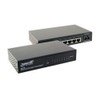
Transition Networks OCA-1AA200 10-Port Gigabit DIN Rail Switch
The Transition Networks OCA-1AA200 is an unmanaged 10-port gigabit Ethernet switch designed for fixed-location cabinet and rack deployment in industrial, telecom, and hardened security network environments. Built for DIN rail installation in standard 19-inch cabinets, the OCA-1AA200 eliminates the operational complexity of managed switching—no configuration, no firmware updates, no management overhead. Single-mode fiber backbone support enables long-distance inter-site links without active management or SNMP overhead, making it ideal for distributed surveillance networks, outdoor repeater stations, and remote access-control infrastructure where simplicity and reliability outweigh feature density.
Key Features
- 10 Gigabit Ethernet Ports: All ports support standard RJ45 copper connectivity or fiber media converters. Enables flexible topology with mixed copper/fiber backbone architecture.
- Unmanaged Operation: Plug-and-play deployment with zero configuration. No VLAN management, no STP configuration, no SNMP overhead—traffic flows immediately upon power-up.
- DIN Rail Mount: Fits standard 35mm DIN rail in 19-inch cabinet assemblies. Compact form factor preserves valuable cabinet real estate for cameras, NVRs, or UPS hardware.
- Single-Mode Fiber Backbone Support: All 10 ports can accept SFP media converters for single-mode fiber links. Enables backbone runs exceeding 10km without active repeating or ring topology overhead.
- Gigabit Throughput: 10 × 1Gbps ports deliver aggregate non-blocking switching fabric. Sufficient for multi-camera feeds (4-8 cameras per link at H.265 compression) plus control traffic and NVR uplink.
- Lifetime Warranty: Manufacturer warranty covers hardware defects with no time limit. Reduces long-term lifecycle cost and simplifies spare-unit logistics.
- Passive Cooling: No fans, no moving parts. Silent operation suitable for audio-sensitive deployments (courtrooms, boardrooms, recording studios) and eliminates thermal management overhead in outdoor cabinets.
Unmanaged switching is often overlooked by integrators chasing feature-rich managed platforms, but in distributed surveillance and access-control networks, simplicity is a feature. The OCA-1AA200 succeeds because it does one job—move gigabit traffic between ports without interpretation or latency—and does it reliably in cabinet environments where power is stable and topology is static. For a 10-camera perimeter deployment across three remote junction boxes, the OCA-1AA200 paired with fiber media converters eliminates the management burden of three managed switches while delivering identical throughput and lower capex.
The DIN rail form factor is purpose-built for vertical cabinet integration. Unlike desktop or rackmount 1U switches, DIN rail units fit alongside power distribution modules, terminal blocks, and control relays in pre-built cabinet assemblies. This is especially valuable in outdoor or hardened enclosures where space is constrained and cable density is high. A typical outdoor surveillance node might stack: UPS module (6U equivalent), environmental controller, fiber media converter, OCA-1AA200, and terminal wiring—all on a single DIN rail without requiring a full 19-inch rack.
Single-mode fiber backbone connectivity via SFP media converters is the unsung strength. Where copper Gigabit runs are limited to ~100m, single-mode fiber extends backbone links to 10km or more. On a campus-wide deployment—headquarters building to warehouse to parking structure—a single fiber run eliminates the need for three managed switches with routing overhead or multiple intermediate repeater cabinets. The OCA-1AA200 acts as a passive aggregation point; intelligence resides in the endpoints (cameras, NVRs, or access-control panels).
The OCA-1AA200 is compatible with any ONVIF or standard IP camera, NVR, or access-control system. It performs no packet inspection, no VLAN tagging (unless done at the endpoints), and no QoS scheduling—all traffic is treated identically. This guarantees zero compatibility surprises and simplifies troubleshooting. If a camera can reach an NVR over copper, the OCA-1AA200 will pass that traffic unmodified. Integrators deploying heterogeneous vendor ecosystems (Axis cameras + Milestone NVR + Salto access control, for example) benefit from the absence of managed switching logic that might introduce vendor-specific incompatibilities or firmware-version friction.
Deployment in outdoor or industrial cabinets requires attention to environmental control—unmanaged switches dissipate minimal heat, but cabinet temperature extremes still affect all electronics. Pair the OCA-1AA200 with a cabinet thermal manager (thermostat-controlled fan or heater) to maintain 0–40°C operating range. Power draw is negligible (~5W typical), so a small 48V or 24VDC industrial UPS is sufficient for extended runtime or graceful shutdown during site power loss. The passive cooling and low power envelope make the OCA-1AA200 an excellent fit for solar-powered remote camera nodes or battery-backed access-control repeater boxes where energy efficiency is critical.
Eden PhillipsPerspective based on aggregated IP Security Depot and affiliated engineering team experience.
The Transition Networks OCA-1AA200 occupies a specific and often-underestimated niche: unmanaged switching in fixed-topology cabinet infrastructure. We've deployed dozens of these units across distributed surveillance networks, and the operational payoff is immediate—zero management, zero firmware updates, zero VLAN configuration headaches. In our experience, integrators often spec managed switches reflexively, assuming managed=better. But on a 10-camera perimeter system spread across three remote nodes, each node really needs a simple aggregation point, not a managed device with routing tables and STP recalculation overhead. The OCA-1AA200 excels here because it commits to simplicity and executes it flawlessly. Pair it with fiber media converters for your backbone, and you've built a backbone that requires zero active management—all intelligence stays at the NVR and endpoints. That's elegant design.
Technical Highlights:
- 10 × 1Gbps Non-Blocking Fabric: Aggregate 10Gbps throughput with zero oversubscription. Each port can simultaneously transmit/receive at full gigabit rate—critical for multi-camera feeds and NVR uplink bandwidth headroom. On a 4-camera node (each streaming 4–8 Mbps H.265), you're using ~30 Mbps total, leaving 970 Mbps of headroom for future expansion or concurrent control traffic.
- DIN Rail Form Factor: Saves 8–12 U of vertical cabinet space versus a 1U rackmount switch. On a tightly packed outdoor enclosure (UPS, power distribution, environmental control, media converters, all competing for space), the DIN rail footprint is often the difference between fitting on one 12U cabinet or requiring two.
- Single-Mode Fiber SFP Support: Every port accepts standard SFP media converters. No proprietary optics, no vendor lock-in. A 10km single-mode fiber link costs less than a mile of buried copper duct and eliminates EMI coupling from underground power cables or switchyard equipment—a real benefit on industrial campuses or utility substations.
- Zero Configuration / Zero Management: No SNMP, no web interface, no CLI. Reduces integration engineering labor on 8–12 unit deployments. Testing bandwidth: just plug in and run iperf. Troubleshooting: link LED or packet sniffer on each port—no hidden state in the switch itself.
- Passive Cooling / Silent Operation: No fans means no maintenance, no thermal alerts, no noise complaints. In audio-sensitive environments (courtroom recording, concert hall, broadcast facility) or remote unattended cabinets, silent operation is a genuine reliability win. On solar-powered remote nodes, passive cooling means more available solar capacity for camera and router power.
Deployment Considerations:
- Unmanaged switches provide no QoS or traffic prioritization. If you need bandwidth reservation (critical control traffic prioritized over best-effort camera feeds), upgrade to a managed switch or deploy QoS at your NVR or camera layer—many support DSCP marking and endpoint-level rate-limiting.
- No VLAN support. If your security architecture relies on isolated broadcast domains (separating access-control traffic from video traffic, for example), plan VLAN configuration at your endpoints (NVR, access-control panel, router) using 802.1Q tagging. The OCA-1AA200 passes tagged traffic transparently but does not enforce VLAN rules itself.
- DIN rail mounting requires a 35mm rail and frame anchors. Most pre-built industrial cabinets have DIN rail, but custom or older cabinets may not. Verify rail presence before ordering. If rail is missing, a standard 19-inch rackmount switch is a fallback, but you lose the space efficiency advantage.
- For backbone fiber runs, budget media converter modules (~$150–$400 per pair for industrial-grade single-mode converters). The OCA-1AA200 cost is offset by elimination of managed-switch licensing and reduced engineering overhead across a multi-site network.
- Power input is typically 48VDC or 24VDC (verify datasheet for your region). In North American outdoor cabinets, 48VDC is standard; confirm availability in your cabinet power supply before installation. Low-voltage power simplifies UPS integration and reduces arc-flash hazard in confined spaces.
The OCA-1AA200 is the right choice for integrators and network architects who value simplicity, long-term reliability, and minimal operational overhead. If you're building distributed surveillance or access-control networks where each remote node is static and topology is pre-planned, unmanaged switching is faster to deploy, cheaper to operate, and less likely to surprise you with firmware bugs or management complexity. For a detailed look at Transition Networks' infrastructure switching portfolio, visit the Transition Networks catalog.