
TP-Link SG3452XP vs Ubiquiti USW-48: Specification Comparison
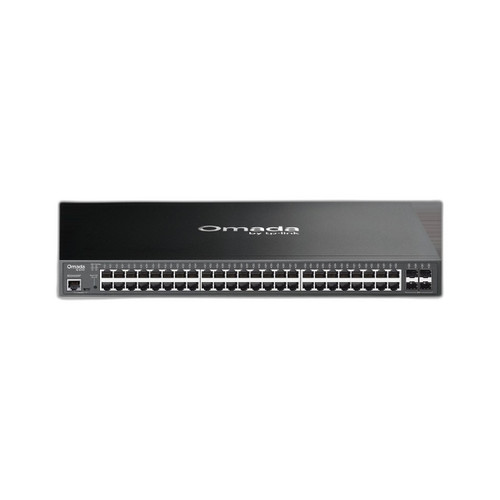
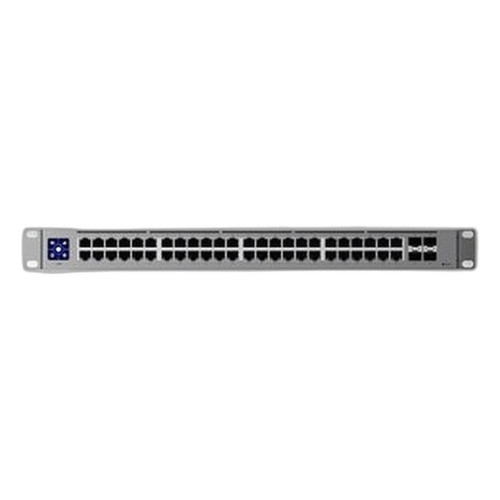
Both the TP-Link SG3452XP and Ubiquiti USW-48 are 1U rackmount, L2-managed, 48-port Gigabit switches intended for access-layer or aggregation deployments. However, they diverge sharply on two axes that define buyer segments: the SG3452XP adds 802.3at PoE+ across all 48 ports with a 500W budget and provides 4× 10GbE SFP+ uplinks, while the USW-48 is a non-PoE switch with 4× 1GbE SFP uplinks. This comparison examines uplink bandwidth, power delivery, and management ecosystem to help installers choose the right platform.
In This Guide
Which switch provides more headroom in uplink speed and switching fabric?
The SG3452XP uses 4× 10 Gbps SFP+ ports as uplinks, contributing to a total switching capacity of 176 Gbps and a forwarding rate of 130.94 Mpps. This fabric is sized to sustain non-blocking throughput across all 48 downlink ports plus the high-speed uplinks simultaneously.
The USW-48 provides 4× 1 Gbps SFP uplinks, yielding a switching capacity of 104 Gbps and a forwarding rate of 77 Mpps. Its non-blocking throughput is specified at 52 Gbps. The SFP ports are 1G only — no 10G SFP+ capability is listed in the provided specs.
For environments requiring fiber backbone aggregation at 10G or multi-switch stacking at high throughput, the SG3452XP's fabric is 69% larger (176 vs. 104 Gbps) and its uplinks are 10× faster per port. For branch or IDF deployments where 1G uplinks are sufficient, the USW-48's fabric covers line-rate forwarding across all 48 ports at the 1G downlink level.
Which switch can power PoE devices, and how do their power profiles compare?
The SG3452XP supports 802.3af/at (PoE+) on all 48 downlink ports, with a total PoE budget of 500W and a maximum of 30W per port. It also implements perpetual PoE and fast PoE modes, which allow powered devices such as IP cameras to receive uninterrupted or rapidly restored power during switch reboots — a meaningful operational feature in surveillance deployments. Total system power consumption reaches 500W at full PoE load, supplied by a 100–240V AC internal power supply.
The USW-48 is a non-PoE switch. Its total power consumption is 40W, drawn from an internal 60W AC/DC supply (100–240V AC). No PoE budget, per-port wattage, or PoE standard is listed in the provided specs for this model.
Any deployment requiring PoE-powered endpoints — IP cameras, access control readers, VoIP phones, or wireless APs — must use the SG3452XP or supplement the USW-48 with external PoE injectors or a separate PoE switch. The USW-48's 40W idle draw is substantially lower, which is relevant in energy-constrained or thermally limited enclosures where PoE is not needed.
Which switch offers broader management integration and compliance coverage?
The SG3452XP is an L2+ managed switch operable in three modes: standalone web/CLI/SNMP, Omada On-Premises Controller, and Omada Cloud. It supports 802.1X port authentication with RADIUS and TACACS+ backends. The provided specs list ONVIF compatibility, which is notable for physical-security integration. No NDAA compliance status is stated in the provided specs for this model.
The USW-48 is managed via UniFi Network (Ethernet management interface). The provided specs confirm NDAA compliance and certifications including CE, FCC, IC, and Anatel (Brazil). VLAN support is specified at up to 1,000 VLANs. No RADIUS, TACACS+, or ONVIF information is listed in the provided specs.
Buyers already invested in a TP-Link Omada ecosystem — or those requiring cloud-managed multi-site deployments via a single pane of glass — will find the SG3452XP's three management modes and ONVIF flag advantageous. Ubiquiti UniFi shops benefit from native USW-48 integration into the UniFi controller, and federal or government-adjacent buyers will note the USW-48's confirmed NDAA compliance, which is not confirmed for the SG3452XP in the provided specs.
Which should you choose: the SG3452XP or the USW-48?
Our take: The SG3452XP is the stronger choice when the deployment requires PoE+ power delivery and higher-speed uplinks. It delivers 500W of 802.3at PoE budget across all 48 ports (30W per port maximum) versus zero PoE capability on the USW-48, making it the only viable option for powering IP cameras, access readers, or APs directly from the switch. Its 4× 10GbE SFP+ uplinks and 176 Gbps switching fabric outpace the USW-48's 4× 1GbE SFP ports and 104 Gbps fabric by a substantial margin. Conversely, the USW-48 draws only 40W total — suitable for IDF closets or branch locations where power budget and heat are constrained and PoE is not required. Its confirmed NDAA compliance and native UniFi integration make it the correct pick for UniFi-standardized networks or government-adjacent projects. Choose the SG3452XP for PoE-dependent, higher-throughput access or aggregation layers; choose the USW-48 for lean, non-PoE UniFi or NDAA-mandated environments.
Side-by-Side Comparison
Spec-for-spec, from manufacturer data.
| Specification | TP-Link SG3452XP | Ubiquiti USW-48 |
|---|---|---|
| Product Type | L2+ Managed Access Switch | L2 Managed Access Switch |
| Form Factor | 1U Rackmount | 1U Rack Mount |
| Downlink Ports | 48 × 1 Gbps (RJ45) | 48 × 1 Gbps Ethernet |
| Uplink Ports | 4 × 10 Gbps SFP+ | 4 × 1 Gbps SFP |
| Switching Capacity | 176 Gbps | 104 Gbps |
| Forwarding Rate | 130.94 Mpps | 77 Mpps |
| Non-Blocking Throughput | — | 52 Gbps |
| PoE Standard | 802.3af/at (PoE+) | — |
| PoE Budget (Total) | 500W | — |
| PoE Per Port (Max) | 30W | — |
| Perpetual / Fast PoE | Yes | — |
| Total Power Consumption | 500W (full PoE load) | 40W |
| Power Supply | 100–240V AC, 50/60 Hz (internal) | 100–240V AC, 50/60 Hz (internal, 60W) |
| Management Modes | Standalone, Omada Cloud, Omada On-Premises | UniFi Network (Ethernet) |
| Operating Temperature | -5°C to 45°C | -15°C to 40°C |
| NDAA Compliant | — | Yes |
| VLAN Support | — | Up to 1,000 |
| Dimensions | 440 × 330 × 44 mm | 442 × 285 × 44 mm |
Frequently Asked Questions
Which should you choose: the SG3452XP or the USW-48?
The SG3452XP is the stronger choice when the deployment requires PoE+ power delivery and higher-speed uplinks. It delivers 500W of 802.3at PoE budget across all 48 ports (30W per port maximum) versus zero PoE capability on the USW-48, making it the only viable option for powering IP cameras, access readers, or APs directly from the switch. Its 4× 10GbE SFP+ uplinks and 176 Gbps switching fabric outpace the USW-48's 4× 1GbE SFP ports and 104 Gbps fabric by a substantial margin. Conversely, the USW-48 draws only 40W total — suitable for IDF closets or branch locations where power budget and heat are constrained and PoE is not required. Its confirmed NDAA compliance and native UniFi integration make it the correct pick for UniFi-standardized networks or government-adjacent projects. Choose the SG3452XP for PoE-dependent, higher-throughput access or aggregation layers; choose the USW-48 for lean, non-PoE UniFi or NDAA-mandated environments.
Can the USW-48 power IP cameras or access control readers directly?
No. Based on the provided specs, the USW-48 is a non-PoE switch with no listed PoE standard, no per-port wattage, and no PoE budget. Powering PoE devices would require external injectors or a separate PoE switch. The SG3452XP supports 802.3at PoE+ on all 48 ports with a 500W total budget and 30W per port.
Is the SG3452XP or USW-48 better for larger multi-site deployments?
The SG3452XP supports Omada Cloud management, enabling centralized control of multiple sites through TP-Link's cloud platform or an on-premises Omada controller. The USW-48 integrates natively into the UniFi ecosystem. The better choice depends on the existing management platform: Omada-standardized networks favor the SG3452XP; UniFi-standardized networks favor the USW-48. No third-party multi-site management compatibility beyond their respective ecosystems is specified for either model.
Which switch is appropriate for a government or NDAA-sensitive project?
The USW-48 lists confirmed NDAA compliance in its provided specs. The SG3452XP's provided specs do not include an NDAA compliance declaration. For projects subject to NDAA Section 889 requirements, the USW-48 has documented compliance; the SG3452XP's status cannot be confirmed from the available spec data alone.
More Network Switch Comparisons
- TP-Link SG6654XHP vs Ubiquiti USW-PRO-MAX-48
- TP-Link SG6654XHP vs Ubiquiti USW-PRO-48
- TP-Link SG6654XHP vs TP-Link SG3452XMPP
- TP-Link SG6654XHP vs TP-Link SG3452XP
- TP-Link SG3452XMPP vs Ubiquiti USW-48
- TP-Link SG3452XMPP vs Ubiquiti USW-PRO-MAX-48
Network Switch Buying Guides
Get a Second Opinion on Your Camera Choice
Share your site layout, coverage goals, and budget. Our team will validate the camera selection, flag anything we would change, and recommend products that match the use case.