
TP-Link SG3452X vs Ubiquiti USW-PRO-48: Specification Comparison
Both the TP-Link TL-SG3452X and Ubiquiti USW-PRO-48 are 1U rack-mount, 48-port Gigabit Layer 2+ managed switches targeting enterprise and prosumer LAN deployments without PoE on the edge ports. Buyers cross-shopping these two are typically evaluating switching fabric capacity, uplink flexibility, power efficiency, operating environment tolerance, and ecosystem management fit. This comparison draws only from the specifications provided for each unit.

In This Guide
- Which switch delivers more fabric capacity and uplink flexibility?
- How do the two switches compare on power draw, enclosure, and operating environment?
- What management capabilities, certifications, and ecosystem requirements differentiate these switches?
- Which should you choose: the SG3452X or the USW-PRO-48?
- Side-by-Side Specs
- FAQ
Which switch delivers more fabric capacity and uplink flexibility?
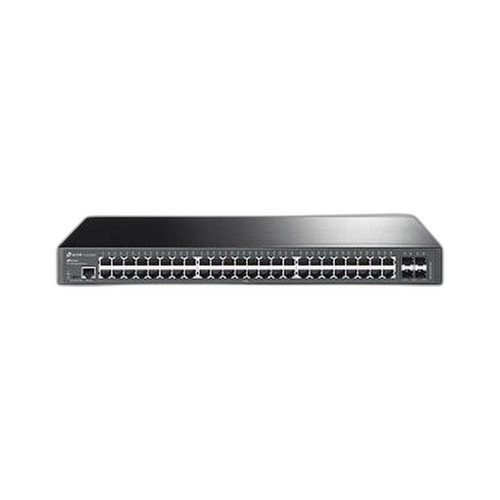
The TL-SG3452X is specified with a switching capacity of 160 Gbps (one source lists 320 Gbps; only 160 Gbps is used here as the more conservative and commonly attributed figure for this SKU). It provides 4 × 10GE SFP+ slots for uplinks or server connections. Edge ports are 48 × 10/100/1000 Mbps RJ45. No forwarding rate in Mpps is listed in the provided specs.
The USW-PRO-48 is specified at 176 Gbps switching capacity and a forwarding rate of 131 Mpps. All 48 edge ports run at 10/100/1000 Mbps. SFP+ uplink count is not stated in the provided specifications. No forwarding rate is provided for the TL-SG3452X.
On the fabric figures available, the USW-PRO-48 has a 16 Gbps higher stated switching capacity (176 vs. 160 Gbps) and is the only unit with a specified forwarding rate (131 Mpps). The TL-SG3452X provides an explicitly documented 4 × 10GE SFP+ uplink count; the USW-PRO-48 uplink port count is absent from the provided specs.
How do the two switches compare on power draw, enclosure, and operating environment?
The TL-SG3452X accepts 100–240 V AC at 50/60 Hz. No maximum power consumption figure is listed in the provided specifications. Dimensions are 440 × 180 × 44 mm and memory is 32 MB flash. Enclosure material is not specified. Operating temperature is rated 0 °C to 45 °C.
The USW-PRO-48 specifies a maximum power consumption of 60 W from an internal AC/DC supply (100–240 V AC). Enclosure is SGCC steel. Dimensions are 442 × 285 × 44 mm (notably deeper at 285 mm vs. 180 mm) and weight without brackets is 4 kg (8.8 lb). Operating temperature is rated −5 °C to 40 °C, extending 5 °C below the TP-Link's lower limit.
The USW-PRO-48 has a confirmed 60 W power draw ceiling, a steel enclosure rating, and a wider cold-side operating range (−5 °C vs. 0 °C). The TL-SG3452X has a stated maximum operating temperature 5 °C higher (45 °C vs. 40 °C) and a shallower chassis depth (180 mm vs. 285 mm). Power consumption for the TL-SG3452X is not provided and cannot be compared.
What management capabilities, certifications, and ecosystem requirements differentiate these switches?
The TL-SG3452X is classified as an L2+ Managed switch under the TP-Link JetStream product line. L2+ typically includes static routing, VLAN, QoS, IGMP snooping, and spanning-tree features. Management specifics (GUI, CLI, cloud) and certifications are not itemized in the provided specifications. No NDAA compliance status is stated.
The USW-PRO-48 is managed via Ethernet and is designed for the Ubiquiti UniFi ecosystem, implying UniFi Network controller dependency for full feature access. It carries explicit NDAA compliance and holds CE, FCC, IC, and Anatel certifications. Management protocol detail beyond 'Ethernet' is not further broken down in the provided specs.
The USW-PRO-48's NDAA compliance is a hard requirement for U.S. federal and many state/local government deployments; the TL-SG3452X carries no such designation in the provided data. The USW-PRO-48 is tightly coupled to the UniFi management platform, which is an integration benefit for existing UniFi environments and a constraint outside them. The TL-SG3452X's L2+ designation implies broader standalone management compatibility, but specific protocol support is not enumerated in the provided specs.
Which should you choose: the SG3452X or the USW-PRO-48?
Our take: The USW-PRO-48 is the stronger choice when NDAA compliance, a confirmed power budget, an extended cold-side operating range, or tight integration with an existing UniFi infrastructure are requirements. Its 176 Gbps switching fabric exceeds the TL-SG3452X's stated 160 Gbps, it is the only unit with a specified forwarding rate (131 Mpps), and its −5 °C lower operating limit gives it an edge in unconditioned spaces. The TL-SG3452X is preferable when documented 10GE SFP+ uplink count matters (4 slots confirmed vs. not stated for the USW-PRO-48), chassis depth is constrained (180 mm vs. 285 mm), or a higher upper operating temperature (45 °C vs. 40 °C) is needed. Buyers outside the UniFi ecosystem should factor in that the USW-PRO-48's management is controller-dependent; no such constraint is documented for the TL-SG3452X.
Side-by-Side Comparison
Spec-for-spec, from manufacturer data.
| Specification | TP-Link SG3452X | Ubiquiti USW-PRO-48 |
|---|---|---|
| Product Line / Series | JetStream L2+ Managed | UniFi Pro |
| Edge Port Count | 48 × 10/100/1000 Mbps RJ45 | 48 × 10/100/1000 Mbps |
| Switching Capacity | 160 Gbps | 176 Gbps |
| Forwarding Rate | — | 131 Mpps |
| 10GE SFP+ Uplink Slots | 4 | — |
| PoE on Edge Ports | Not specified in provided specs | Not specified in provided specs |
| Max Power Consumption | — | 60 W |
| Power Input | 100–240 V AC, 50/60 Hz | 100–240 V AC |
| Power Supply Type | External/internal not specified | Internal AC/DC, 60 W |
| Operating Temperature | 0 °C to 45 °C | −5 °C to 40 °C |
| Dimensions (W × D × H) | 440 × 180 × 44 mm | 442 × 285 × 44 mm |
| Weight | — | 4 kg (8.8 lb) |
| Enclosure Material | — | SGCC steel |
| NDAA Compliant | — | Yes |
| Certifications | — | CE, FCC, IC, Anatel |
| Management Platform | L2+ standalone (specifics not listed) | UniFi ecosystem (controller-based) |
Frequently Asked Questions
Which should you choose: the SG3452X or the USW-PRO-48?
The USW-PRO-48 is the stronger choice when NDAA compliance, a confirmed power budget, an extended cold-side operating range, or tight integration with an existing UniFi infrastructure are requirements. Its 176 Gbps switching fabric exceeds the TL-SG3452X's stated 160 Gbps, it is the only unit with a specified forwarding rate (131 Mpps), and its −5 °C lower operating limit gives it an edge in unconditioned spaces. The TL-SG3452X is preferable when documented 10GE SFP+ uplink count matters (4 slots confirmed vs. not stated for the USW-PRO-48), chassis depth is constrained (180 mm vs. 285 mm), or a higher upper operating temperature (45 °C vs. 40 °C) is needed. Buyers outside the UniFi ecosystem should factor in that the USW-PRO-48's management is controller-dependent; no such constraint is documented for the TL-SG3452X.
Is the TL-SG3452X or USW-PRO-48 required for U.S. government or federally funded projects?
Based on the provided specifications, only the USW-PRO-48 carries an explicit NDAA Compliant: Yes designation. The TL-SG3452X has no NDAA compliance status listed in its spec data. For projects subject to NDAA Section 889 procurement restrictions, the USW-PRO-48 is the only option of the two with documented compliance.
Which switch has more uplink capacity for connecting to a core switch or servers?
The TL-SG3452X specifies 4 × 10GE SFP+ slots in its provided specifications. The USW-PRO-48's uplink port count and type are not stated in its provided spec data. On the information available, the TL-SG3452X offers documented 10GE uplink flexibility; the USW-PRO-48's uplink configuration cannot be confirmed from the specs provided.
Can either switch be managed without a dedicated controller or cloud account?
The TL-SG3452X is described as an L2+ Managed switch in the JetStream line, which typically supports standalone web GUI and CLI management, though specific management interfaces are not itemized in the provided specs. The USW-PRO-48 is designed for the Ubiquiti UniFi ecosystem and its management is listed as Ethernet-based; full feature access in UniFi products generally requires a UniFi Network controller. Buyers who do not run or plan to run a UniFi controller should factor this dependency into their decision.
More Network Switch Comparisons
- TP-Link SG6654XHP vs Ubiquiti USW-PRO-MAX-48
- TP-Link SG6654XHP vs Ubiquiti USW-PRO-48
- TP-Link SG6654XHP vs TP-Link SG3452XMPP
- TP-Link SG6654XHP vs TP-Link SG3452XP
- TP-Link SG3452XMPP vs Ubiquiti USW-48
- TP-Link SG3452XMPP vs Ubiquiti USW-PRO-MAX-48
Network Switch Buying Guides
Get a Second Opinion on Your Camera Choice
Share your site layout, coverage goals, and budget. Our team will validate the camera selection, flag anything we would change, and recommend products that match the use case.