
TP-Link SG3452X vs Ubiquiti USW-48: Specification Comparison
Both the TP-Link TL-SG3452X and the Ubiquiti USW-48 are 1U rack-mount, 48-port gigabit L2 managed switches designed for access-layer deployment in enterprise or prosumer LAN environments. The comparison centers on three meaningful divergences: uplink speed and switching headroom, PoE capability and power budget, and management ecosystem plus environmental tolerance. Buyers cross-shopping these models are typically equipping a wiring closet or small campus distribution layer and need to decide whether 10GE uplinks or Ubiquiti's UniFi ecosystem and the tradeoffs each carries better fits their infrastructure.
In This Guide
Which switch delivers more headroom for uplinks and aggregate throughput?
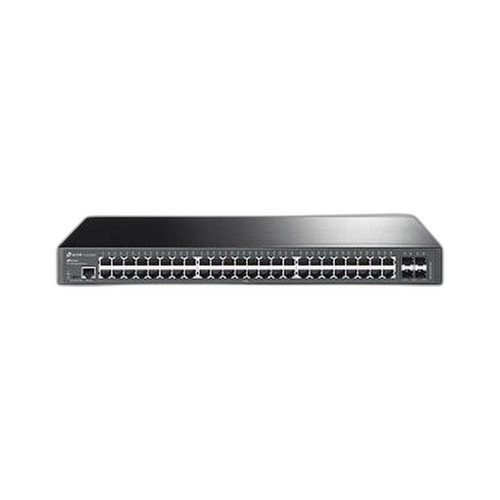
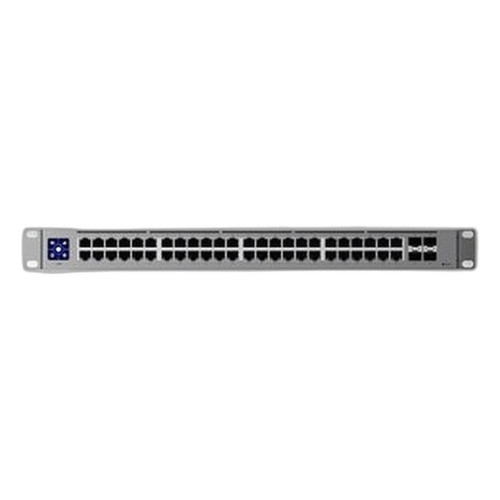
The TL-SG3452X operates at 160 Gbps switching capacity with four 10GE SFP+ uplink slots, giving each uplink port a full 10 Gbps of bandwidth to spine or core switches. The USW-48 provides 104 Gbps switching capacity, 52 Gbps non-blocking throughput, and a forwarding rate of 77 Mpps, but its four uplink slots are 1G SFP — one-tenth the uplink bandwidth per port. For environments where server blades, NAS arrays, or high-density IP camera streams need to egress at multi-gigabit rates, the SG3452X's 10GE uplinks are a concrete architectural advantage. The USW-48's 77 Mpps forwarding rate is a useful packet-processing benchmark, but TP-Link does not publish a forwarding rate for the SG3452X, preventing a direct packets-per-second comparison. Both occupy a single rack unit and serve 48 access ports identically at the edge.
Does the deployment require PoE, and how do these switches handle power?
The TL-SG3452X supports IEEE 802.3af, 802.3at, and 802.3bt (PoE++) with a published PoE budget of 200 W and a per-port maximum of 30 W, making it capable of powering high-draw devices such as PTZ cameras, Wi-Fi 6E access points, and IP intercoms directly from switch ports. The USW-48 is a non-PoE model; no PoE specification is listed for it whatsoever. This is a binary distinction: if any edge device in the deployment requires switch-sourced power, the USW-48 requires separate injectors or a PoE-capable midspan, adding cost and rack space. The USW-48 draws only 40 W total system power from a 60 W internal supply, making it notably more energy-efficient in pure-data roles. The SG3452X's total system power draw under PoE load is not specified in the provided data.
How do management ecosystem and operating environment compare?
The USW-48 integrates natively with the Ubiquiti UniFi controller, enabling centralized topology visualization, traffic analytics, and zero-touch provisioning alongside UniFi APs, gateways, and cameras through a single pane of glass. It is NDAA compliant, carries CE, FCC, IC, and Anatel certifications, and supports up to 1,000 VLANs. Its operating range of -15 to 40 C gives it a wider cold-side thermal envelope. The TL-SG3452X is an L2+ managed switch with its own management interface and operates from 0 to 45 C, tolerating slightly higher ambient heat at the top end. The SG3452X's VLAN count, NDAA status, and certifications are absent from the provided specifications, preventing a direct comparison on those dimensions.
Which should you choose: the SG3452X or the USW-48?
Our take: The TL-SG3452X is the stronger choice when the deployment requires PoE-powered edge devices or 10GE uplinks to a high-capacity core. Its four 10GE SFP+ uplinks versus the USW-48's four 1G SFP uplinks represent a 10x per-port uplink bandwidth advantage, and its 200 W PoE++ budget with 30 W per port eliminates the need for external injectors for cameras, APs, or intercoms. The USW-48 is the better fit for pure-data, non-PoE environments already standardized on the UniFi platform: it draws only 40 W total, operates down to -15 C for unconditioned spaces, is NDAA compliant, and delivers seamless single-pane management across UniFi infrastructure. Buyers with no PoE requirement whose uplinks stay at 1G and who value ecosystem consolidation should select the USW-48; those powering edge devices or needing 10GE spine connectivity should select the SG3452X.
Side-by-Side Comparison
Spec-for-spec, from manufacturer data.
| Specification | TP-Link SG3452X | Ubiquiti USW-48 |
|---|---|---|
| Switch Ports | 48 x 10/100/1000 Mbps RJ45 | 48 x 1G Ethernet |
| Uplink Ports | 4 x 10GE SFP+ | 4 x 1G SFP |
| Switching Capacity | 160 Gbps | 104 Gbps |
| Non-Blocking Throughput | — | 52 Gbps |
| Forwarding Rate | — | 77 Mpps |
| PoE Standard | 802.3af / 802.3at / 802.3bt (PoE++) | None |
| PoE Budget | 200 W | — |
| Max PoE Per Port | 30 W | — |
| System Power Draw | — | 40 W |
| Internal Power Supply | 100–240 V AC, 50/60 Hz | 60 W; 100–240 V AC, 50/60 Hz |
| Operating Temperature | 0 C to 45 C | -15 C to 40 C |
| Dimensions (mm) | 440 x 180 x 44 | 442 x 285 x 44 |
| Form Factor | 1U Rack Mount | 1U Rack Mount |
| VLAN Support | — | 1,000 VLANs |
| Management Platform | L2+ Managed | UniFi Controller |
| NDAA Compliant | — | Yes |
Frequently Asked Questions
Which should you choose: the SG3452X or the USW-48?
The TL-SG3452X is the stronger choice when the deployment requires PoE-powered edge devices or 10GE uplinks to a high-capacity core. Its four 10GE SFP+ uplinks versus the USW-48's four 1G SFP uplinks represent a 10x per-port uplink bandwidth advantage, and its 200 W PoE++ budget with 30 W per port eliminates the need for external injectors for cameras, APs, or intercoms. The USW-48 is the better fit for pure-data, non-PoE environments already standardized on the UniFi platform: it draws only 40 W total, operates down to -15 C for unconditioned spaces, is NDAA compliant, and delivers seamless single-pane management across UniFi infrastructure. Buyers with no PoE requirement whose uplinks stay at 1G and who value ecosystem consolidation should select the USW-48; those powering edge devices or needing 10GE spine connectivity should select the SG3452X.
Can the USW-48 power IP cameras or access points directly from its switch ports?
No. The USW-48 is a non-PoE model with no PoE specification listed. Powering cameras, APs, or intercoms requires separate PoE injectors or a midspan device. The TL-SG3452X supports 802.3af, 802.3at, and 802.3bt with a 200 W total budget and up to 30 W per port, so it can power those devices natively without additional hardware.
Is the TL-SG3452X or USW-48 better for a site already running UniFi APs and gateways?
The USW-48 integrates directly into the UniFi controller, providing unified topology maps, traffic analytics, and consistent policy management alongside existing UniFi hardware in a single interface. The TL-SG3452X is managed independently. If ecosystem consolidation matters and the site has no PoE requirement and 1G uplinks are sufficient, the USW-48 is the natural fit.
Which switch handles an unconditioned or unheated wiring closet better?
The USW-48 operates from -15 C to 40 C, while the SG3452X is rated from 0 C to 45 C. For spaces that may drop below freezing, the USW-48 handles the cold end better. The SG3452X tolerates slightly higher ambient heat at its upper limit, but its 0 C floor makes it unsuitable for unheated environments in cold climates.
More Network Switch Comparisons
- TP-Link SG6654XHP vs Ubiquiti USW-PRO-MAX-48
- TP-Link SG6654XHP vs Ubiquiti USW-PRO-48
- TP-Link SG6654XHP vs TP-Link SG3452XMPP
- TP-Link SG6654XHP vs TP-Link SG3452XP
- TP-Link SG3452XMPP vs Ubiquiti USW-48
- TP-Link SG3452XMPP vs Ubiquiti USW-PRO-MAX-48
Network Switch Buying Guides
Get a Second Opinion on Your Camera Choice
Share your site layout, coverage goals, and budget. Our team will validate the camera selection, flag anything we would change, and recommend products that match the use case.