
TP-Link SG3452X vs TP-Link SG6654XHP: Specification Comparison
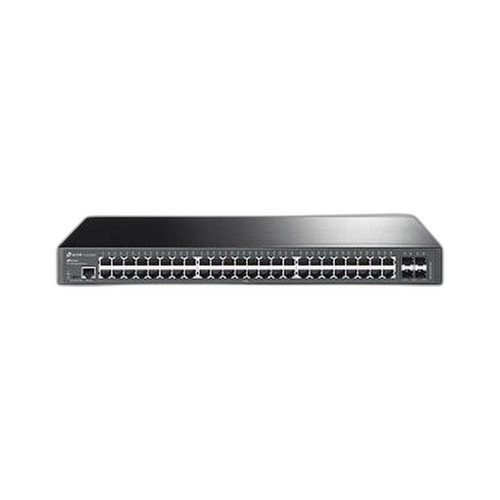
Both the TP-Link TL-SG3452X and SG6654XHP are rack-mount, 48-port gigabit managed switches targeting enterprise and SMB LAN infrastructure, making them genuine cross-shop candidates. The TL-SG3452X is an L2+ JetStream switch with optional PoE++ and 4 SFP+ uplinks, while the SG6654XHP is an L3 Omada stackable switch with full PoE+ on all 48 ports, a dual-core processor, and 6 SFP+ uplinks. The comparison turns on management depth, PoE budget, Layer 3 routing capability, and total cost of ownership.
In This Guide
- How do port count, uplink density, and switching throughput compare between these two switches?
- What are the PoE capabilities and power budgets, and which switch suits higher-density powered-device deployments?
- How do Layer 3 routing, management architecture, and platform integration differ between these two switches?
- Which should you choose: the SG3452X or the SG6654XHP?
- Side-by-Side Specs
- FAQ
How do port count, uplink density, and switching throughput compare between these two switches?
Both switches provide 48 × 10/100/1000 Mbps RJ45 edge ports. The TL-SG3452X offers 4 × 10GE SFP+ uplink slots and a switching capacity of 160 Gbps. The SG6654XHP steps up to 6 × 10G SFP+ slots and a switching capacity of 216 Gbps — a 35% increase in fabric bandwidth and 50% more 10G uplink ports. For deployments aggregating multiple access switches or connecting high-bandwidth servers, the SG6654XHP's additional uplink ports and larger fabric reduce the risk of uplink saturation. The TL-SG3452X's 4-uplink, 160 Gbps fabric is adequate for standard enterprise access-layer roles where 10G uplinks serve as backbone trunks only.
What are the PoE capabilities and power budgets, and which switch suits higher-density powered-device deployments?
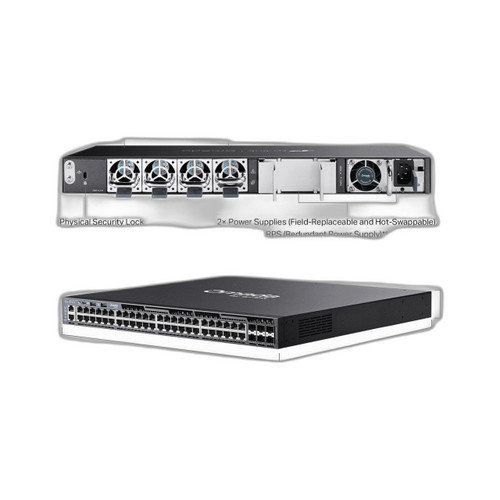
The TL-SG3452X supports 802.3af/at/bt (PoE++) with a stated budget of 200–240 W, depending on configuration. Its per-port PoE spec as provided lists 30 W, consistent with 802.3at (PoE+) rather than the full 90 W of 802.3bt on every port simultaneously. The SG6654XHP supports 802.3af/at (PoE+, up to 30 W per port) with a maximum budget of 812 W when equipped with 2× PSM500-AC modules, or 1,440 W with 2× PSM900-AC modules, and the spec notes perpetual PoE and fast PoE support. For deployments powering 48 cameras, APs, or IP phones simultaneously, the SG6654XHP's 812–1,440 W budget vastly outclasses the TL-SG3452X's 200–240 W. Installers should verify PSU module selection against actual per-port draw requirements.
How do Layer 3 routing, management architecture, and platform integration differ between these two switches?
The TL-SG3452X operates at Layer 2+ — it supports advanced L2 features (VLAN, QoS, IGMP, STP variants) but does not perform inter-VLAN routing or dynamic routing protocols without an upstream router. The SG6654XHP is a full Layer 3 switch with a dual-core ARM processor at 1.5 GHz, 4 GB DDR4 RAM, and 8 GB eMMC storage, enabling hardware-accelerated inter-VLAN routing and richer routing table support. It also integrates with TP-Link's Omada SDN controller platform (standalone or controller-managed modes) and includes 802.1X, ACL, and DoS defense in its encryption/security spec. The TL-SG3452X's management capabilities are not documented at the same controller-integration level in the provided specs. Network architects planning routed access or controller-based campus deployments will find the SG6654XHP's L3 + Omada stack significantly more capable.
Which should you choose: the SG3452X or the SG6654XHP?
Our take: The SG6654XHP is the stronger choice when deploying a high-density PoE+ environment or requiring Layer 3 routing at the access layer. Concretely: its PoE budget reaches up to 1,440 W versus the TL-SG3452X's 200–240 W — a roughly 6× advantage for powering cameras, APs, or VoIP endpoints at scale; its switching fabric is 216 Gbps versus 160 Gbps; and it adds a sixth 10G SFP+ uplink port plus a dual-core ARM CPU with 4 GB DDR4 enabling full L3 inter-VLAN routing. The TL-SG3452X remains a cost-appropriate L2+ access switch for environments where PoE demand is modest (under 240 W total), no on-switch routing is needed, and 4 × 10G uplinks are sufficient. Both units share identical operating temperature ranges (upper bound 45 °C). Platform qualifier: the SG6654XHP is purpose-built for Omada SDN ecosystems; the TL-SG3452X's controller integration is not specified in the provided data.
Side-by-Side Comparison
Spec-for-spec, from manufacturer data.
| Specification | TP-Link SG3452X | TP-Link SG6654XHP |
|---|---|---|
| Switch Model | TL-SG3452X | SG6654XHP |
| Management Layer | L2+ Managed | L3 Managed |
| Edge Ports | 48 × 10/100/1000 Mbps RJ45 | 48 × 10/100/1000 Mbps RJ45 |
| 10G SFP+ Uplinks | 4 slots | 6 slots |
| Switching Capacity | 160 Gbps | 216 Gbps |
| PoE Standard | 802.3af/at/bt (PoE++) | 802.3af/at (PoE+) |
| Max PoE Budget | 200–240 W | 812 W (2× PSM500-AC) / 1,440 W (2× PSM900-AC) |
| Max Per-Port PoE | 30 W (per spec) | 30 W (802.3at) |
| Processor | — | Dual-core ARM @ 1.5 GHz |
| RAM | — | 4 GB DDR4 |
| Flash / Storage | 32 MB | 2× 4 MB NOR + 8 GB eMMC |
| Power Supply Input | 100–240 V AC, 50/60 Hz | 100–240 V AC, 50/60 Hz |
| Max Power Draw | — | 1,440 W (with dual PSM900-AC) |
| Operating Temp | 0 °C to 45 °C | -5 °C to 45 °C |
| Controller Platform | Not specified in provided specs | Omada SDN (standalone or controller) |
| Form Factor | 1U Rack, 440 × 180 × 44 mm | 1U Rack, 440 × 420 × 44 mm |
Frequently Asked Questions
Which should you choose: the SG3452X or the SG6654XHP?
The SG6654XHP is the stronger choice when deploying a high-density PoE+ environment or requiring Layer 3 routing at the access layer. Concretely: its PoE budget reaches up to 1,440 W versus the TL-SG3452X's 200–240 W — a roughly 6× advantage for powering cameras, APs, or VoIP endpoints at scale; its switching fabric is 216 Gbps versus 160 Gbps; and it adds a sixth 10G SFP+ uplink port plus a dual-core ARM CPU with 4 GB DDR4 enabling full L3 inter-VLAN routing. The TL-SG3452X remains a cost-appropriate L2+ access switch for environments where PoE demand is modest (under 240 W total), no on-switch routing is needed, and 4 × 10G uplinks are sufficient. Both units share identical operating temperature ranges (upper bound 45 °C). Platform qualifier: the SG6654XHP is purpose-built for Omada SDN ecosystems; the TL-SG3452X's controller integration is not specified in the provided data.
Is the SG3452X or SG6654XHP better for powering a full floor of IP cameras or wireless APs?
The SG6654XHP is substantially better for high-density PoE deployments. Its PoE budget reaches 812 W with 2× PSM500-AC or 1,440 W with 2× PSM900-AC, supporting heavy simultaneous loads across all 48 ports. The TL-SG3452X caps at 200–240 W, which limits how many powered devices can run concurrently at full draw.
Do I need a separate router if I choose the TL-SG3452X instead of the SG6654XHP?
Yes, in most cases. The TL-SG3452X is an L2+ switch and does not perform inter-VLAN routing or run dynamic routing protocols per the provided specifications. The SG6654XHP is a Layer 3 switch with a dedicated CPU and memory capable of routing between VLANs on-device, reducing the need for a separate router in smaller routed-access designs.
Which switch integrates with TP-Link's Omada SDN controller platform?
The SG6654XHP is explicitly specified as Omada-compatible, supporting both standalone and Omada controller-managed operating modes. The provided specifications for the TL-SG3452X do not document Omada SDN controller integration, so buyers committed to a unified Omada management plane should verify TL-SG3452X compatibility independently before purchasing.
More Network Switch Comparisons
- TP-Link SG6654XHP vs Ubiquiti USW-PRO-MAX-48
- TP-Link SG6654XHP vs Ubiquiti USW-PRO-48
- TP-Link SG6654XHP vs TP-Link SG3452XMPP
- TP-Link SG6654XHP vs TP-Link SG3452XP
- TP-Link SG3452XMPP vs Ubiquiti USW-48
- TP-Link SG3452XMPP vs Ubiquiti USW-PRO-MAX-48
Network Switch Buying Guides
Get a Second Opinion on Your Camera Choice
Share your site layout, coverage goals, and budget. Our team will validate the camera selection, flag anything we would change, and recommend products that match the use case.