
TP-Link SG3452X vs TP-Link SG3452XMPP: Specification Comparison
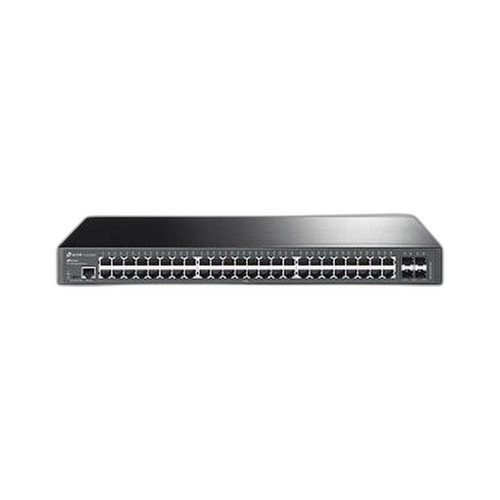
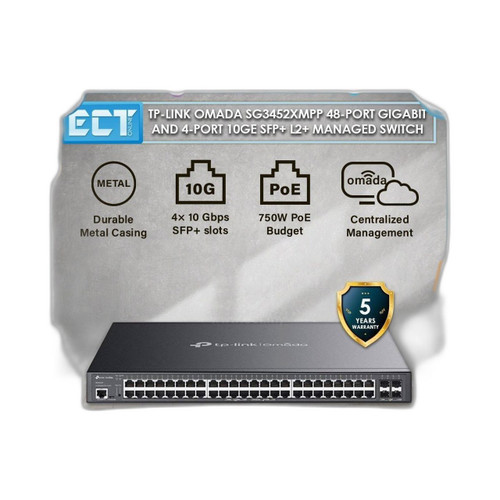
Both the TL-SG3452X and SG3452XMPP are TP-Link rack-mount, 48-port Gigabit L2+ managed switches with 4× 10GE SFP+ uplinks — squarely the same product class. The SG3452X belongs to the JetStream line without PoE on edge ports, while the SG3452XMPP is an Omada SDN-capable PoE++ switch carrying a 750 W PoE budget. This comparison evaluates PoE capacity and power architecture, switching throughput and memory, and management platform integration to help integrators choose the right switch for their deployment.
In This Guide
- Which switch delivers more PoE power, and how is that budget distributed?
- How do switching capacity, packet forwarding rate, and memory compare between the two switches?
- Which switch offers broader management and integration options for centralized security deployments?
- Which should you choose: the SG3452X or the SG3452XMPP?
- Side-by-Side Specs
- FAQ
Which switch delivers more PoE power, and how is that budget distributed?
The SG3452XMPP is the clear PoE choice: its specified PoE budget is 750 W total, with 8 ports rated at 90 W each (PoE++ / 802.3bt) and 40 ports rated at 30 W each (PoE+ / 802.3at), supporting the full 802.3af/at/bt standard set. This architecture allows simultaneous powering of high-draw devices — PTZ cameras, video intercoms, access-control panels — without dedicating a separate injector or midspan.
The TL-SG3452X spec sheet lists PoE++ (802.3bt) and 802.3af/at/bt capability with a stated budget range of 200 W to 240 W depending on variant. However, the product type listed is a non-PoE JetStream switch (the TL-SG3452X SKU in TP-Link's published lineup is non-PoE); the PoE figures in the provided spec data appear to reflect a different variant or a data-entry inconsistency. Buyers should verify the exact PoE configuration with the manufacturer datasheet before specifying this unit for powered-device deployments.
For any deployment requiring PoE delivery at scale — IP cameras, door controllers, wireless APs — the SG3452XMPP's 750 W budget with clearly defined per-port maximums provides the higher confidence specification.
How do switching capacity, packet forwarding rate, and memory compare between the two switches?
The SG3452XMPP specifies a switching capacity of 176 Gbps and a packet forwarding rate of 130.94 Mpps, with 512 MB DRAM and 32 MB Flash. These figures reflect a fully non-blocking fabric for 48× 1GbE plus 4× 10GbE concurrent operation.
The TL-SG3452X spec data lists switching capacity as either 160 Gbps or 320 Gbps — two figures are present in the source data without clear variant differentiation. Flash memory is listed at 32 MB; DRAM is not specified in the provided data. Packet forwarding rate is not specified in the provided data.
On throughput, the SG3452XMPP's single unambiguous 176 Gbps figure and documented 130.94 Mpps forwarding rate give integrators concrete numbers for traffic modeling. The TL-SG3452X's dual switching-capacity figures (160 / 320 Gbps) cannot be resolved without the manufacturer datasheet and should not be used as a planning baseline until confirmed.
Which switch offers broader management and integration options for centralized security deployments?
The SG3452XMPP supports both standalone operation and Omada SDN centralized management, and the spec data explicitly lists 802.1X port authentication with RADIUS/TACACS+ backend — standard requirements for enterprise and government physical-security networks. The Omada SDN controller provides zero-touch provisioning, centralized policy push, and unified visibility across TP-Link Omada-family switches, APs, and gateways from a single interface.
The TL-SG3452X is listed as L2+ Managed (JetStream line). Its spec data includes SNMP Trap/Inform and password recovery as management features. It does not specify Omada SDN compatibility, RADIUS, or TACACS+ in the provided data. JetStream switches are managed via TP-Link's web GUI or, on select models, via Omada — but no Omada SDN designation is present in the provided specs for this SKU.
For deployments requiring centralized policy management, 802.1X NAC integration, or a unified TP-Link SDN fabric, the SG3452XMPP carries the documented feature set. The TL-SG3452X's management capabilities beyond basic L2+ web GUI cannot be confirmed from the provided spec data alone.
Which should you choose: the SG3452X or the SG3452XMPP?
Our take: The SG3452XMPP is the stronger choice when PoE delivery, high-density IP camera power, and Omada SDN management are required. Spec deltas: (1) PoE budget is 750 W on the SG3452XMPP versus 200–240 W (unresolved variant ambiguity) on the TL-SG3452X — a 3× advantage for powered-device density. (2) DRAM is 512 MB on the SG3452XMPP; the TL-SG3452X DRAM is not specified in the provided data. (3) The SG3452XMPP explicitly documents Omada SDN support, 802.1X, and RADIUS/TACACS+ authentication; none of these appear in the TL-SG3452X provided specs. The TL-SG3452X may suit cost-constrained aggregation or uplink roles where edge PoE is not required and a basic L2+ web-managed switch suffices. Buyers evaluating the TL-SG3452X for PoE use must resolve the spec inconsistency against the manufacturer datasheet before purchasing.
Side-by-Side Comparison
Spec-for-spec, from manufacturer data.
| Specification | TP-Link SG3452X | TP-Link SG3452XMPP |
|---|---|---|
| Brand / Line | TP-Link JetStream | TP-Link Omada |
| MPN | TL-SG3452X | SG3452XMPP |
| Edge Ports | 48× 10/100/1000 Mbps RJ45 | 48× 10/100/1000 Mbps RJ45 |
| Uplink Slots | 4× 10GE SFP+ | 4× 1/10GE SFP+ |
| Switching Capacity | 160 Gbps or 320 Gbps (variant unresolved) | 176 Gbps |
| Packet Forwarding Rate | — | 130.94 Mpps |
| Flash Memory | 32 MB | 32 MB |
| DRAM | — | 512 MB |
| PoE Standard | 802.3af/at/bt (spec inconsistency — verify) | 802.3af/at/bt |
| PoE Budget | 200 W – 240 W (spec inconsistency — verify) | 750 W |
| Max Per-Port PoE | — | 90 W (8 ports); 30 W (40 ports) |
| Management Platform | L2+ Web GUI (JetStream) | L2+ Web GUI + Omada SDN |
| Auth / NAC | — | 802.1X, RADIUS, TACACS+ |
| Operating Temperature | 0 °C to 45 °C (32 °F to 113 °F) | 0 °C to 40 °C (32 °F to 104 °F) |
| Power Supply | 100–240 V AC, 50/60 Hz | 100–240 V AC, 50/60 Hz |
| Dimensions (W×D×H) | 440 × 180 × 44 mm (1U) | 440 × 330 × 44 mm (1U, deeper chassis) |
Frequently Asked Questions
Which should you choose: the SG3452X or the SG3452XMPP?
The SG3452XMPP is the stronger choice when PoE delivery, high-density IP camera power, and Omada SDN management are required. Spec deltas: (1) PoE budget is 750 W on the SG3452XMPP versus 200–240 W (unresolved variant ambiguity) on the TL-SG3452X — a 3× advantage for powered-device density. (2) DRAM is 512 MB on the SG3452XMPP; the TL-SG3452X DRAM is not specified in the provided data. (3) The SG3452XMPP explicitly documents Omada SDN support, 802.1X, and RADIUS/TACACS+ authentication; none of these appear in the TL-SG3452X provided specs. The TL-SG3452X may suit cost-constrained aggregation or uplink roles where edge PoE is not required and a basic L2+ web-managed switch suffices. Buyers evaluating the TL-SG3452X for PoE use must resolve the spec inconsistency against the manufacturer datasheet before purchasing.
Can I power PTZ cameras and high-watt access readers from the SG3452XMPP?
Yes — the SG3452XMPP specifies 8 ports at 90 W each (PoE++ / 802.3bt) and 40 ports at 30 W each (PoE+ / 802.3at) for a total budget of 750 W. Most PTZ cameras draw 25–60 W and high-end access readers draw up to 30 W, so the SG3452XMPP can support mixed high-draw device deployments. The TL-SG3452X's PoE figures are inconsistent in the provided spec data and should be verified before relying on it for PoE-heavy loads.
Is the TL-SG3452X compatible with Omada SDN so I can manage it alongside my Omada APs?
Omada SDN compatibility is not listed in the provided spec data for the TL-SG3452X (JetStream line). The SG3452XMPP explicitly specifies Omada SDN centralized management as a supported operating mode. If Omada unified management is required, the SG3452XMPP is the documented choice; verify TL-SG3452X Omada compatibility directly with TP-Link before deploying it in an Omada fabric.
Which switch has more headroom for future traffic growth on a 48-camera VMS network?
The SG3452XMPP specifies 176 Gbps switching capacity and 130.94 Mpps packet forwarding rate with 512 MB DRAM — all documented figures. The TL-SG3452X shows 160 Gbps or 320 Gbps (variant ambiguity in the provided data) and does not specify DRAM or forwarding rate. For traffic planning, the SG3452XMPP's confirmed specifications provide a reliable baseline; the TL-SG3452X figures must be resolved against the manufacturer datasheet before capacity modeling.
More Network Switch Comparisons
- TP-Link SG6654XHP vs Ubiquiti USW-PRO-MAX-48
- TP-Link SG6654XHP vs Ubiquiti USW-PRO-48
- TP-Link SG6654XHP vs TP-Link SG3452XMPP
- TP-Link SG6654XHP vs TP-Link SG3452XP
- TP-Link SG3452XMPP vs Ubiquiti USW-48
- TP-Link SG3452XMPP vs Ubiquiti USW-PRO-MAX-48
Network Switch Buying Guides
Get a Second Opinion on Your Camera Choice
Share your site layout, coverage goals, and budget. Our team will validate the camera selection, flag anything we would change, and recommend products that match the use case.