
TP-Link SG3210X-M2 vs TP-Link S4500-8GP: Specification Comparison
Both the TP-Link SG3210X-M2 and S4500-8GP are 8-port Omada-platform managed switches aimed at small-to-medium surveillance and enterprise edge deployments. However, they diverge sharply in positioning: the SG3210X-M2 is a non-PoE L2+ switch built around 2.5GBASE-T copper uplinks and dual 10G SFP+ fiber slots, while the S4500-8GP is a PoE+ smart switch delivering 62W of power budget over standard Gigabit ports. This comparison evaluates port speed and throughput, PoE capability and power architecture, and management depth.
In This Guide
Which switch delivers higher port speeds and switching throughput?
The SG3210X-M2 provides eight 2.5GBASE-T RJ45 ports running at up to 2.5 Gbps per port, plus two 10 Gbps SFP+ uplink slots, yielding a switching capacity of 80 Gbps and a forwarding rate of 59.52 Mpps. This architecture is well-suited to high-bandwidth endpoints such as 4K/multi-sensor cameras, Wi-Fi 6 access points, or workstations that support 2.5G NICs.
The S4500-8GP offers eight Gigabit (1 Gbps) RJ45 ports with two SFP uplink slots and a switching capacity of 16 Gbps. The per-port ceiling is 1 Gbps and no forwarding rate figure is stated in the provided specs. For most 1080p or 4MP IP cameras the 1G ceiling is adequate, but the SG3210X-M2 has a 5× throughput advantage at the switching fabric level and a 2.5× per-port speed advantage on copper.
Buyers aggregating several high-resolution camera streams or planning for 2.5G-capable edge devices should weight the SG3210X-M2's 80 Gbps fabric heavily; buyers whose entire endpoint fleet runs at 1G or below will not consume that headroom.
Which switch can power cameras, APs, or IP phones over the cable?
The S4500-8GP is the only PoE-capable model of the two. It supports 802.3af and 802.3at (PoE+) with a total PoE budget of 62W sourced from an external 53.5 VDC / 1.31 A adapter. With eight ports and a 62W budget, average per-port allocation is roughly 7.75W, or up to 30W per 802.3at port subject to budget headroom. This makes it viable for powering compact IP cameras, VoIP handsets, or small access points without separate injectors.
The SG3210X-M2 carries no PoE capability whatsoever per the provided specifications. Any powered device attached to it requires an external PoE injector or a separate PoE switch upstream. The SG3210X-M2's power draw is 15.3W maximum for the switch itself, compared to up to 62W for the S4500-8GP under full PoE load.
For cable-runs to cameras where a single-cable install is required, the S4500-8GP is the only viable option in this pair. Sites with existing PoE infrastructure or DC power at the edge would not lose this advantage by choosing the SG3210X-M2.
Which switch offers deeper management, security, and protocol support?
The SG3210X-M2 is rated L2+ Managed with support for Web UI, CLI, SNMP, RMON, and TP-Link's Omada SDN controller. Its feature set includes static routing, QinQ double-tagging, STP/RSTP/MSTP, IGMP snooping v1/v2/v3, ERPS ring protection, ACL, 802.1p/DSCP QoS, LACP port aggregation, Digital Diagnostic Monitoring (DDM) on SFP+ slots, and OAM. Authentication supports 802.1X with RADIUS and TACACS+.
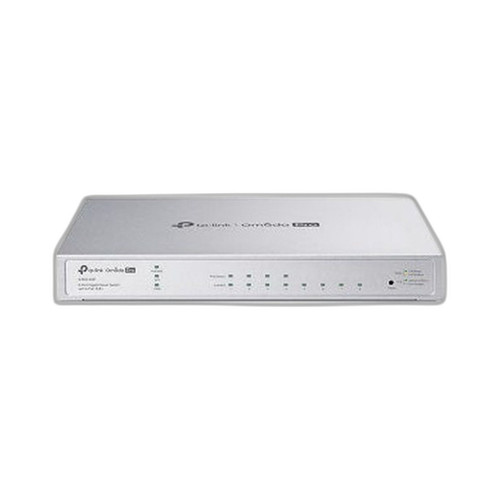
The S4500-8GP is described as Managed (L2+) with Web and CLI management, SNMP Trap/Inform, 802.1X, ACL, DoS Defense, and EEE (Energy Efficient Ethernet). The provided specs do not enumerate RMON, ERPS, QinQ, static routing, LACP, DDM, or TACACS+ for this model.
On documented protocol depth, the SG3210X-M2 carries a substantially longer feature list. Buyers who require ring protection (ERPS), advanced VLAN stacking (QinQ), TACACS+ integration with an existing AAA server, or fiber diagnostics via DDM will find those capabilities specified only on the SG3210X-M2. Both units integrate with the Omada SDN platform, which is a meaningful operational consistency point if the site already runs Omada controllers.
Which should you choose: the SG3210X-M2 or the S4500-8GP?
Our take: The SG3210X-M2 is the stronger choice when endpoint bandwidth, fiber uplink capacity, and management protocol depth are the primary criteria. Its 80 Gbps switching fabric is 5× the S4500-8GP's 16 Gbps, its copper ports run at 2.5 Gbps versus 1 Gbps, and its documented feature set adds ERPS ring protection, QinQ, LACP, DDM, static routing, and TACACS+ — none of which appear in the S4500-8GP specs. The S4500-8GP is the only viable choice when powered endpoints are required, delivering 62W of 802.3at PoE+ budget that the SG3210X-M2 entirely lacks. A site deploying PoE cameras or APs on a single cable run must use the S4500-8GP or add external injectors. Both units share the same chassis dimensions and Omada SDN compatibility. The decision reduces cleanly to one axis: if the installation needs PoE, choose the S4500-8GP; if it needs higher port speeds, fiber uplinks, or richer L2+ protocols, choose the SG3210X-M2.
Side-by-Side Comparison
Spec-for-spec, from manufacturer data.
| Specification | TP-Link SG3210X-M2 | TP-Link S4500-8GP |
|---|---|---|
| Port Count (Copper) | 8× 2.5GBASE-T RJ45 | 8× Gigabit RJ45 |
| Uplink Slots | 2× 10G SFP+ | 2× SFP (speed not specified in provided specs) |
| Switching Capacity | 80 Gbps | 16 Gbps |
| Forwarding Rate | 59.52 Mpps | — |
| PoE Support | None | 802.3af / 802.3at (PoE+) |
| PoE Budget | — | 62W |
| Management Level | L2+ Managed (Web, CLI, SNMP, RMON, Omada SDN) | L2+ Smart Managed (Web, CLI, SNMP Trap/Inform) |
| Static Routing | Yes | — |
| ERPS Ring Protection | Yes | — |
| QinQ (Double VLAN) | Yes | — |
| LACP | Yes | — |
| Authentication | 802.1X, RADIUS, TACACS+ | 802.1X, ACL, DoS Defense |
| Flash / Storage | 32 MB Flash | 32 MB |
| DRAM | 256 MB | — |
| Max Power Consumption | 15.3W (switch only) | 62W (switch + PoE load) |
| Operating Temperature | −5°C to +50°C | Not stated in provided specs |
Frequently Asked Questions
Which should you choose: the SG3210X-M2 or the S4500-8GP?
The SG3210X-M2 is the stronger choice when endpoint bandwidth, fiber uplink capacity, and management protocol depth are the primary criteria. Its 80 Gbps switching fabric is 5× the S4500-8GP's 16 Gbps, its copper ports run at 2.5 Gbps versus 1 Gbps, and its documented feature set adds ERPS ring protection, QinQ, LACP, DDM, static routing, and TACACS+ — none of which appear in the S4500-8GP specs. The S4500-8GP is the only viable choice when powered endpoints are required, delivering 62W of 802.3at PoE+ budget that the SG3210X-M2 entirely lacks. A site deploying PoE cameras or APs on a single cable run must use the S4500-8GP or add external injectors. Both units share the same chassis dimensions and Omada SDN compatibility. The decision reduces cleanly to one axis: if the installation needs PoE, choose the S4500-8GP; if it needs higher port speeds, fiber uplinks, or richer L2+ protocols, choose the SG3210X-M2.
Can the SG3210X-M2 power IP cameras directly?
No. The SG3210X-M2 has no PoE capability per the provided specifications. Cameras requiring inline power must use a separate PoE injector or a PoE-capable upstream switch. The S4500-8GP is the PoE-equipped model in this pair, with a 62W 802.3at budget.
Is the S4500-8GP or SG3210X-M2 better for a high-density 4K camera deployment?
The SG3210X-M2 is better suited for bandwidth-intensive deployments. Its 2.5GBASE-T ports provide up to 2.5 Gbps per endpoint — sufficient headroom for multi-sensor or 4K streams — and its 80 Gbps switching fabric versus the S4500-8GP's 16 Gbps reduces congestion risk. However, if cameras must be powered over the cable, the S4500-8GP's 62W PoE budget is the deciding factor regardless of throughput.
Do both switches work with the TP-Link Omada SDN controller?
Yes. Both the SG3210X-M2 (explicitly listed as Omada SDN compatible) and the S4500-8GP (marketed as Omada Pro) are part of the Omada ecosystem. The SG3210X-M2 specifications also list SNMP, RMON, CLI, and RADIUS/TACACS+ support; the S4500-8GP specifications confirm SNMP Trap/Inform and Web/CLI management, but do not enumerate RMON or TACACS+ in the provided data.
More Network Switch Comparisons
- TP-Link SG2210XMP-M2 vs Ubiquiti USW-FLEX-2.5G-8
- TP-Link SG2210XMP-M2 vs Comnet CNGE8MS
- TP-Link SG2210XMP-M2 vs Lantronix S2220-1014-NA
- TP-Link SG2210XMP-M2 vs TP-Link S4500-8GP
- TP-Link SG2210XMP-M2 vs TP-Link SG2008P
- TP-Link S4500-8GP vs Ubiquiti USW-FLEX-2.5G-8
Network Switch Buying Guides
Get a Second Opinion on Your Camera Choice
Share your site layout, coverage goals, and budget. Our team will validate the camera selection, flag anything we would change, and recommend products that match the use case.