
TP-Link SG2206MP vs Transition Networks SISPM1040-362-LRT: Specification Comparison
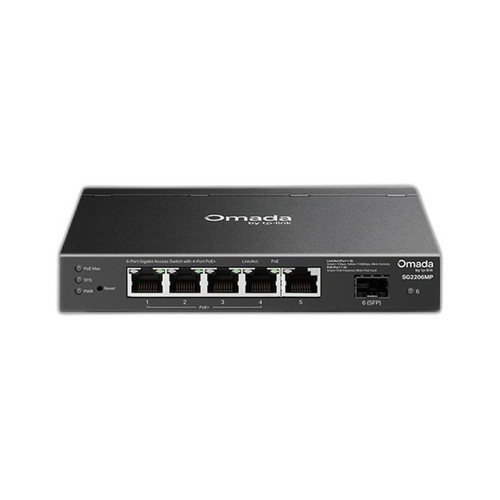
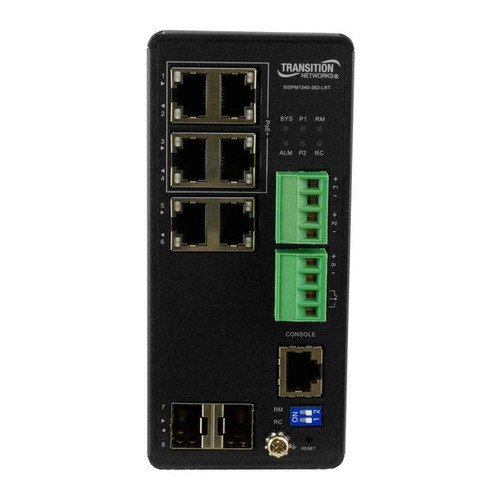
Both the TP-Link SG2206MP and the Transition Networks SISPM1040-362-LRT are 6-port gigabit managed switches with PoE capability, targeting installers who need powered edge switching for IP cameras, access control panels, and other powered devices at remote or distributed sites. The SG2206MP positions itself as a smart-managed SDN switch within TP-Link's Omada ecosystem, while the SISPM1040-362-LRT is a hardened, TAA-compliant Layer 2+ managed switch suited for regulated and demanding deployment environments. This comparison covers PoE architecture, management depth, and physical deployment suitability.
In This Guide
How do the PoE budgets and per-port power delivery compare?
The SG2206MP provides PoE++ (802.3bt) support with a specified total PoE budget of 90W across 4 of its 6 ports, delivering up to 30W per port. This makes it capable of powering high-draw devices such as PTZ cameras and thermal imagers on a single cable run without an external injector. The IEEE 802.3bt standard is confirmed in the specs.
The SISPM1040-362-LRT specifies PoE+ (802.3at) support across all 6 ports, with a maximum per-port output of 30W under 802.3at. However, the total PoE power budget is not stated in the provided specifications. Buyers requiring a confirmed aggregate budget figure will need to consult the product datasheet directly. The card bullets confirm all 6 ports carry PoE+, whereas the SG2206MP limits PoE to 4 of its 6 ports.
What management capabilities and platform integration does each switch offer?
The SG2206MP is classified as smart-managed and integrates with TP-Link's Omada SDN platform, enabling centralized controller-based management. The specs confirm dual-core 880 MHz processor support. Specific Layer 2+ features such as VLAN, QoS, SNMP, and RSTP are not enumerated in the provided specifications for this model.
The SISPM1040-362-LRT is described in the card bullets as a Layer 2+ managed switch supporting VLAN, QoS, and SNMP. An 8K MAC address table is specified. It is not tied to a proprietary SDN ecosystem per the provided specs, which may be advantageous in multi-vendor or open-management environments. TAA compliance is confirmed, making it eligible for U.S. federal procurement.
Which switch is better suited for harsh or regulated deployment environments?
The SG2206MP specifies an 'Industrial' operating temperature rating and wall, ceiling, or rack mount compatibility, along with DIN rail compatibility per the specs. Maximum cable reach is confirmed at 100m. Total power consumption is listed at 15W (excluding PoE delivery). No warranty term is stated in the provided specifications.
The SISPM1040-362-LRT carries a lifetime warranty as specified, which is a significant long-term cost and serviceability differentiator. The SKU suffix '-LRT' typically denotes a hardened or industrial variant, and TAA compliance is confirmed. Physical dimensions are listed as 18" x 16" x 10". Operating temperature range beyond what the SKU implies is not enumerated in the provided specifications. No processor specification is provided for this model.
Which should you choose: the SG2206MP or the SISPM1040-362-LRT?
Our take: The SG2206MP is the stronger choice when deploying within a TP-Link Omada SDN environment and when higher-wattage PoE++ (802.3bt, up to 30W per port confirmed with 90W total budget across 4 ports) is needed for PTZ or thermal cameras. By contrast, the SISPM1040-362-LRT is the stronger choice for regulated, government, or multi-vendor environments: it is TAA-compliant (the SG2206MP is not specified as TAA-compliant), carries a lifetime warranty versus no stated warranty for the SG2206MP, and delivers PoE+ across all 6 ports rather than 4. The SISPM1040-362-LRT also explicitly lists Layer 2+ features including VLAN, QoS, and SNMP, while equivalent features are not enumerated in the SG2206MP's provided specs. Buyers operating outside the Omada ecosystem or under federal procurement rules should favor the SISPM1040-362-LRT; Omada-centric or high-wattage-PoE deployments favor the SG2206MP.
Side-by-Side Comparison
Spec-for-spec, from manufacturer data.
| Specification | TP-Link SG2206MP | Transition Networks SISPM1040-362-LRT |
|---|---|---|
| Total Ports | 6 | 6 |
| PoE Standard | PoE++ (802.3bt) | PoE+ (802.3at) |
| PoE-Enabled Ports | 4 of 6 | All 6 |
| Max Per-Port PoE Power | 30W | 30W (802.3at max) |
| Total PoE Budget | 90W | — |
| Port Speed | 1 Gbps | 10/100/1000 Mbps |
| Management Level | Smart-managed (Omada SDN) | Layer 2+ Managed |
| VLAN / QoS / SNMP | — | Yes (per card bullets) |
| MAC Address Table | — | 8K |
| Processor | Dual-core 880 MHz | — |
| Power Consumption | 15W | — |
| Operating Temperature | Industrial (rated) | — |
| Mount Options | Wall / Ceiling / Rack / DIN Rail | — |
| TAA Compliant | — | Yes |
| Warranty | — | Lifetime |
| Max Cable Reach | 100m | — |
Frequently Asked Questions
Which should you choose: the SG2206MP or the SISPM1040-362-LRT?
The SG2206MP is the stronger choice when deploying within a TP-Link Omada SDN environment and when higher-wattage PoE++ (802.3bt, up to 30W per port confirmed with 90W total budget across 4 ports) is needed for PTZ or thermal cameras. By contrast, the SISPM1040-362-LRT is the stronger choice for regulated, government, or multi-vendor environments: it is TAA-compliant (the SG2206MP is not specified as TAA-compliant), carries a lifetime warranty versus no stated warranty for the SG2206MP, and delivers PoE+ across all 6 ports rather than 4. The SISPM1040-362-LRT also explicitly lists Layer 2+ features including VLAN, QoS, and SNMP, while equivalent features are not enumerated in the SG2206MP's provided specs. Buyers operating outside the Omada ecosystem or under federal procurement rules should favor the SISPM1040-362-LRT; Omada-centric or high-wattage-PoE deployments favor the SG2206MP.
Is the SG2206MP or SISPM1040-362-LRT better for powering PTZ cameras?
The SG2206MP specifies PoE++ (802.3bt) at up to 30W per port with a 90W total PoE budget across its 4 PoE ports, which can power high-draw PTZ cameras. The SISPM1040-362-LRT specifies PoE+ (802.3at) across all 6 ports at up to 30W per port, but its total PoE budget is not stated in the provided specifications. If confirmed aggregate budget and 802.3bt compatibility are required, the SG2206MP has the documented advantage.
Which switch is eligible for U.S. government or federal procurement?
The SISPM1040-362-LRT is specified as TAA-compliant, making it eligible for U.S. federal procurement under the Trade Agreements Act. The SG2206MP's provided specifications do not include a TAA-compliance claim.
Does either switch include a long-term warranty?
The SISPM1040-362-LRT specifies a lifetime warranty. The SG2206MP's provided specifications do not state a warranty term; buyers should verify warranty coverage directly with the manufacturer or distributor before purchasing.
More Network Switch Comparisons
- TP-Link SG2206MP vs Lantronix IES-5200-LRT
- TP-Link SG2206MP vs Lantronix SISPM1040-362-LRT-L1Y3
- TP-Link SG2206MP vs TP-Link DS106GPP
- TP-Link DS106GPP vs Lantronix IES-5200-LRT
- TP-Link DS106GPP vs Lantronix SISPM1040-362-LRT-L1Y3
- TP-Link DS106GPP vs Transition Networks SISPM1040-362-LRT
Network Switch Buying Guides
Get a Second Opinion on Your Camera Choice
Share your site layout, coverage goals, and budget. Our team will validate the camera selection, flag anything we would change, and recommend products that match the use case.