
TP-Link DS106GPP vs Lantronix IES-5200-LRT: Specification Comparison
Both the TP-Link DS106GPP and the Lantronix SI-IES-5200-LRT are 6-port, unmanaged, PoE++ (802.3bt) network switches intended for IP camera and edge-device deployments. Despite sharing port count, PoE standard, and unmanaged operation, they differ sharply on port speed (1G vs 10G), physical form factor, operating environment, and certifications — dimensions that are highly decision-relevant for installers choosing between a cost-effective desktop unit and a ruggedized industrial platform.
In This Guide
- What port speeds and PoE budget does each switch actually deliver?
- Which switch is better suited to harsh or non-standard installation environments?
- How do these switches differ in manageability, compatibility, and deployment integration?
- Which should you choose: the DS106GPP or the IES-5200-LRT?
- Side-by-Side Specs
- FAQ
What port speeds and PoE budget does each switch actually deliver?
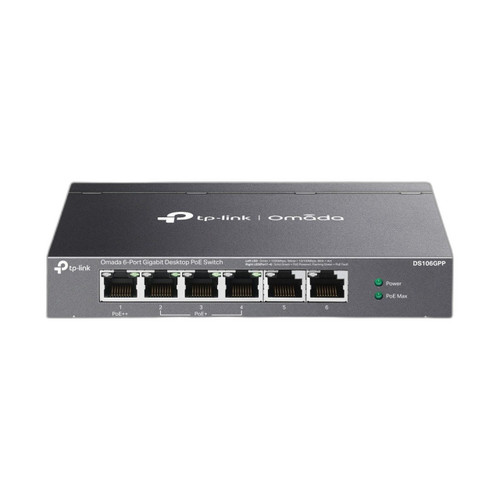
The TP-Link DS106GPP is a 6-port Gigabit (1G) desktop switch. Per the provided specs, Port 1 supports PoE++ at up to 90 W, Ports 2–4 deliver up to 60 W (PoE+) each, and the total PoE budget is specified as 64 W. An Extend Mode stretches PoE reach to 250 m (820 ft) on compatible ports, which is a meaningful field advantage for long cable runs to outdoor cameras.
The Lantronix SI-IES-5200-LRT is a 6-port 10G switch — all ports operate at 10 Gbps per the spec. Its PoE budget is listed as a maximum of 90 W at 56 VDC input. No per-port wattage breakdown is provided in the supplied specifications. Note that a 90 W total budget shared across 10G ports constrains simultaneous high-power device deployments.
The DS106GPP's per-port PoE allocations (90 W on Port 1, up to 60 W on Ports 2–4) are explicitly documented; the IES-5200-LRT's per-port maximums are not stated in the provided specs. Buyers needing verified per-port budgets for the Lantronix unit should consult the datasheet directly.
Which switch is better suited to harsh or non-standard installation environments?
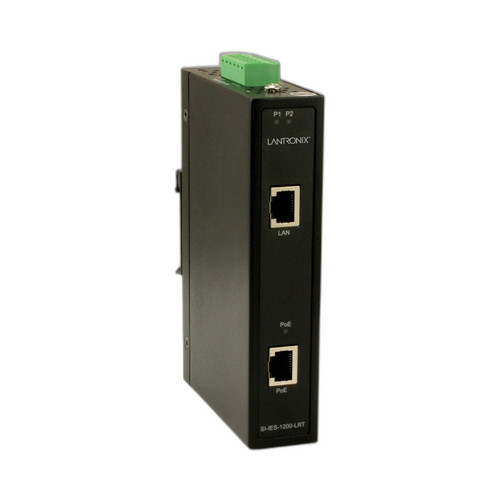
The Lantronix SI-IES-5200-LRT carries an explicit industrial pedigree. Its operating temperature range is stated as -40°C to 75°C (with one spec field noting -25°C to +60°C — the broader -40°C value appears in the primary operating_temp field and is the more conservative claim to verify against the datasheet). It holds an IP31 ingress-protection rating and certifications including UL508, TUV EN60950-1, EN55022 Class B, and EN61000-4-2/3/4/5 — the IEC 61000-4 series covers surge, ESD, and fast-transient immunity relevant to industrial cabinets. It mounts on DIN rail, matching standard industrial panel practice. Dimensions are 2.48" W × 5.26" D × 4.93" H.
The TP-Link DS106GPP is a desktop-class switch. No operating temperature range, IP rating, or industrial certification is provided in the supplied specifications. Mount options listed are Wall, Pole, and Rack — no DIN rail. This positions it firmly as an indoor or sheltered-enclosure device.
For any deployment subject to wide temperature swings, vibration, condensation, or panel-mount requirements, the IES-5200-LRT's documented ratings are directly relevant. The DS106GPP's environmental envelope is unspecified in the provided data and cannot be assumed equivalent.
How do these switches differ in manageability, compatibility, and deployment integration?
Both switches are unmanaged, meaning no CLI, SNMP, or web interface is available on either unit. Configuration is limited to physical operation and, in the DS106GPP's case, hardware-selectable operating modes: Extend Mode (250 m PoE), Port Isolation, and Auto Recovery. These modes are specified in the DS106GPP data; no equivalent operating modes are listed for the IES-5200-LRT in the provided specs.
The DS106GPP's Compatible With field specifies 'Port 1–2,' which the card bullets contextualize as PoE++ on Port 1. The IES-5200-LRT's Compatible With field reads only 'deployment' — no specific compatibility details are present in the provided specs. The Lantronix unit ships with a 2-year warranty; no warranty term is provided for the DS106GPP in the supplied data.
Neither switch lists VMS or NVR platform compatibility in the provided specifications. The DS106GPP carries a TP-Link Omada branding designation, implying potential ecosystem alignment with Omada SDN controllers, though no managed-mode capability is stated for this SKU. No ecosystem affiliation is listed for the Lantronix unit.
Which should you choose: the DS106GPP or the IES-5200-LRT?
Our take: The DS106GPP is the stronger choice when deploying indoor or sheltered IP cameras on Gigabit infrastructure with long cable runs and defined per-port PoE budgets. The IES-5200-LRT is the stronger choice when the installation environment demands industrial-grade resilience or 10G backhaul capacity. Three concrete spec deltas drive this split: (1) port speed — the IES-5200-LRT runs all 6 ports at 10G versus the DS106GPP's 1G, a 10× throughput difference relevant to high-resolution multi-stream aggregation; (2) operating temperature — the IES-5200-LRT is rated to -40°C, while no operating temperature is provided for the DS106GPP; (3) PoE reach — the DS106GPP supports 250 m Extend Mode, not specified on the IES-5200-LRT. Choose the DS106GPP for cost-sensitive indoor deployments needing long PoE runs; choose the IES-5200-LRT for industrial panels, outdoor enclosures, or 10G edge aggregation.
Side-by-Side Comparison
Spec-for-spec, from manufacturer data.
| Specification | TP-Link DS106GPP | Lantronix IES-5200-LRT |
|---|---|---|
| Brand | TP-Link | Lantronix |
| MPN | DS106GPP | SI-IES-5200-LRT |
| Product Class | Desktop Switch | Industrial Switch |
| Total Ports | 6 | 6 |
| Port Speed | 1G (Gigabit) | 10G |
| PoE Standard | PoE++ (802.3bt) | PoE++ (802.3bt) |
| Total PoE Budget | 64 W | 90 W (at 56 VDC input) |
| Max Single-Port PoE | 90 W (Port 1) | — (not specified in provided specs) |
| PoE Extend Range | 250 m (820 ft) | — (not specified in provided specs) |
| Management | Unmanaged | Unmanaged |
| Operating Modes | Extend, Port Isolation, Auto Recovery | — (not specified in provided specs) |
| Mount Type | Wall; Pole; Rack | DIN Rail |
| Operating Temperature | — (not specified in provided specs) | -40°C to 75°C |
| IP Rating | — (not specified in provided specs) | IP31 |
| Certifications | — (not specified in provided specs) | UL508, TUV EN60950-1, EN55022 Class B, EN61000-4-2/3/4/5 |
| Warranty | — (not specified in provided specs) | 2 Years |
Frequently Asked Questions
Which should you choose: the DS106GPP or the IES-5200-LRT?
The DS106GPP is the stronger choice when deploying indoor or sheltered IP cameras on Gigabit infrastructure with long cable runs and defined per-port PoE budgets. The IES-5200-LRT is the stronger choice when the installation environment demands industrial-grade resilience or 10G backhaul capacity. Three concrete spec deltas drive this split: (1) port speed — the IES-5200-LRT runs all 6 ports at 10G versus the DS106GPP's 1G, a 10× throughput difference relevant to high-resolution multi-stream aggregation; (2) operating temperature — the IES-5200-LRT is rated to -40°C, while no operating temperature is provided for the DS106GPP; (3) PoE reach — the DS106GPP supports 250 m Extend Mode, not specified on the IES-5200-LRT. Choose the DS106GPP for cost-sensitive indoor deployments needing long PoE runs; choose the IES-5200-LRT for industrial panels, outdoor enclosures, or 10G edge aggregation.
Which switch can power a high-wattage PTZ or thermal camera on a single port?
Both switches support PoE++ (802.3bt). The DS106GPP explicitly rates Port 1 at up to 90 W and Ports 2–4 at up to 60 W each, against a total 64 W PoE budget — buyers should note the per-port maximums may not be simultaneously achievable within the 64 W aggregate. The IES-5200-LRT lists a maximum PoE power of 90 W total at 56 VDC input; per-port maximums are not stated in the provided specifications and should be confirmed against the Lantronix datasheet before specifying high-wattage single-port loads.
Can either switch be installed in an outdoor or industrial equipment cabinet?
The Lantronix IES-5200-LRT is DIN rail-mountable, operates from -40°C to 75°C per the primary spec field, carries an IP31 rating, and holds UL508 and IEC 61000-4-series industrial certifications — all directly relevant to panel and cabinet installations. The TP-Link DS106GPP provides no operating temperature range, IP rating, or industrial certifications in the supplied specifications, and does not support DIN rail mounting. For industrial or outdoor-enclosure deployments, the IES-5200-LRT is the documented choice.
Do either of these switches support remote management or integration with a VMS platform?
Neither the DS106GPP nor the IES-5200-LRT is a managed switch — both are specified as unmanaged, so neither offers a web UI, CLI, or SNMP interface. The DS106GPP supports hardware-selectable operating modes (Extend Mode, Port Isolation, Auto Recovery) per its spec. No equivalent modes are listed for the IES-5200-LRT in the provided data. Neither unit lists direct VMS or NVR platform integration in the supplied specifications.
More Network Switch Comparisons
- TP-Link SG2206MP vs Lantronix IES-5200-LRT
- TP-Link SG2206MP vs Lantronix SISPM1040-362-LRT-L1Y3
- TP-Link SG2206MP vs Transition Networks SISPM1040-362-LRT
- TP-Link SG2206MP vs TP-Link DS106GPP
- TP-Link DS106GPP vs Lantronix SISPM1040-362-LRT-L1Y3
- TP-Link DS106GPP vs Transition Networks SISPM1040-362-LRT
Network Switch Buying Guides
Get a Second Opinion on Your Camera Choice
Share your site layout, coverage goals, and budget. Our team will validate the camera selection, flag anything we would change, and recommend products that match the use case.