
TP-Link SG2206MP vs Lantronix IES-5200-LRT: Specification Comparison
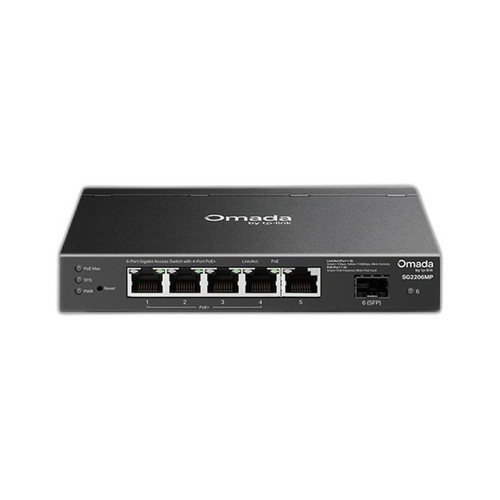
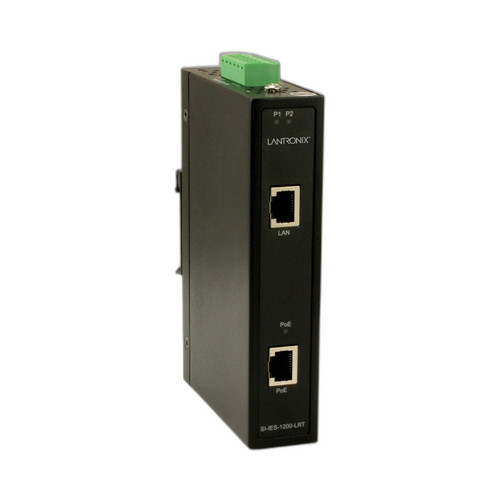
Both the TP-Link SG2206MP and the Lantronix IES-5200-LRT are 6-port PoE++ switches targeting physical-security camera deployments, making them genuine cross-shop candidates for integrators specifying edge switching. They diverge sharply on management model, port throughput, and installation environment: the SG2206MP is a smart-managed gigabit switch built for structured-cabling closets or wall/ceiling mounts, while the IES-5200-LRT is an unmanaged 10 Gbps industrial switch rated for harsh environments on a DIN rail. The comparison below evaluates each across port capacity and throughput, power and operating environment, and management and integration.
In This Guide
- Which switch delivers more throughput and how are the 6 ports allocated?
- Which switch is better suited to industrial or outdoor-adjacent environments?
- How do the two switches differ in management, SDN integration, and ease of deployment?
- Which should you choose: the SG2206MP or the IES-5200-LRT?
- Side-by-Side Specs
- FAQ
Which switch delivers more throughput and how are the 6 ports allocated?
The SG2206MP provides 6 ports at 1 Gbps each, with 4 of those ports designated as PoE+ (the specs list PoE++ / 802.3bt capability). The product name and primary speed specification both confirm 1 Gbps per port; a secondary internal field lists 10G but is inconsistent with all other spec data for this model and is not reflected in the product name or datasheet reference, so 1 Gbps is the used figure here.
The IES-5200-LRT delivers all 6 ports at 10 Gbps, providing ten times the per-port throughput. For high-resolution multi-sensor cameras, video walls, or uplink aggregation scenarios where a single gigabit port becomes a bottleneck, the Lantronix unit has a structural throughput advantage. PoE++ (802.3bt) is specified on both units, and both carry a 90 W total PoE budget — the IES-5200-LRT's figure is explicitly tied to a 56 VDC input requirement, which must be confirmed during power planning.
Which switch is better suited to industrial or outdoor-adjacent environments?
The IES-5200-LRT carries an explicit industrial operating-temperature rating. Specs show a range of -25 °C to +60 °C in one field and -40 °C to +75 °C in another — both fields are present in the provided spec data and conflict; installers should verify against the datasheet before committing to a wide-range deployment. The unit also carries an IP31 ingress-protection rating and certifications including UL508 (industrial control equipment), TUV EN60950-1, EN55022 Class B, and EN61000-4-2/3/4/5 (ESD, radiated immunity, EFT, surge). DIN rail mount is factory-supported.
The SG2206MP is labeled 'Industrial' in its operating-temperature field, but no numeric temperature range is provided in the supplied specifications. Power consumption is stated at 15 W (device-side, excluding PoE delivery). No IP rating or industrial certification is listed in the provided specs. It supports wall, ceiling, and rack mounting and is noted as DIN-rail compatible. Buyers deploying in temperature-extreme, high-EMI, or moisture-adjacent environments should confirm SG2206MP environmental ratings from the datasheet before selection, as the provided specs do not supply them.
How do the two switches differ in management, SDN integration, and ease of deployment?
The SG2206MP is smart-managed, integrating with TP-Link's Omada SDN platform. This enables centralized configuration, VLAN segmentation, QoS, port mirroring, and cloud or on-premises controller management — capabilities relevant to installers managing multiple sites or requiring per-camera VLAN isolation. The processor is specified as dual-core at 880 MHz, which supports the management overhead. Max cable reach is stated at 100 m.
The IES-5200-LRT is unmanaged, operating as a plug-and-play device with no configuration interface, no VLAN support, and no SDN integration. This reduces deployment time and eliminates misconfiguration risk in simple point-to-point or star topologies, but it removes the ability to enforce traffic policies or segment camera streams. A 2-year warranty is stated in the provided specs; no warranty term is listed for the SG2206MP in the supplied data.
Which should you choose: the SG2206MP or the IES-5200-LRT?
Our take: The SG2206MP is the stronger choice when the deployment requires centralized management, VLAN segmentation, or Omada SDN integration in a standard indoor environment. It offers smart-managed control via a dual-core 880 MHz processor, Omada SDN compatibility, and flexible wall/ceiling/rack mounting at 1 Gbps per port with a 90 W PoE budget. The IES-5200-LRT is the stronger choice when throughput, industrial certification, or harsh-environment resilience takes priority: it delivers 10 Gbps on all 6 ports — ten times the SG2206MP's per-port speed — carries UL508 and EN61000-series certifications absent from the SG2206MP's provided specs, and is rated to at least -25 °C (with a second spec field citing -40 °C, pending datasheet confirmation). Choose the SG2206MP for managed, VLAN-segmented camera networks in climate-controlled spaces; choose the IES-5200-LRT for unmanaged, high-throughput backhaul in industrial panels or temperature-extreme enclosures.
Side-by-Side Comparison
Spec-for-spec, from manufacturer data.
| Specification | TP-Link SG2206MP | Lantronix IES-5200-LRT |
|---|---|---|
| Product Type | Smart Managed Switch | Industrial Switch (Unmanaged) |
| Ports (Total) | 6 | 6 |
| Port Speed | 1 Gbps | 10 Gbps |
| PoE Standard | PoE++ (802.3bt) | PoE++ (802.3bt) |
| PoE Budget | 90 W (per product bullets) | 90 W at 56 VDC input |
| PoE-Enabled Ports | 4 | — |
| Management | Smart-managed (Omada SDN) | Unmanaged |
| Processor | Dual-core @ 880 MHz | — |
| Mount Type | Wall / Ceiling / Rack | DIN Rail |
| Operating Temperature | Not specified (numeric range absent) | -25 °C to +60 °C (spec conflict: see -40 °C to +75 °C in secondary field) |
| IP Rating | — | IP31 |
| Certifications | — | UL508, TUV EN60950-1, EN55022 Class B, EN61000-4-2/3/4/5 |
| Max Cable Reach | 100 m | — |
| Device Power Consumption | 15 W | — |
| Warranty | — | 2 years |
| SDN / Controller Support | Omada SDN | None |
Frequently Asked Questions
Which should you choose: the SG2206MP or the IES-5200-LRT?
The SG2206MP is the stronger choice when the deployment requires centralized management, VLAN segmentation, or Omada SDN integration in a standard indoor environment. It offers smart-managed control via a dual-core 880 MHz processor, Omada SDN compatibility, and flexible wall/ceiling/rack mounting at 1 Gbps per port with a 90 W PoE budget. The IES-5200-LRT is the stronger choice when throughput, industrial certification, or harsh-environment resilience takes priority: it delivers 10 Gbps on all 6 ports — ten times the SG2206MP's per-port speed — carries UL508 and EN61000-series certifications absent from the SG2206MP's provided specs, and is rated to at least -25 °C (with a second spec field citing -40 °C, pending datasheet confirmation). Choose the SG2206MP for managed, VLAN-segmented camera networks in climate-controlled spaces; choose the IES-5200-LRT for unmanaged, high-throughput backhaul in industrial panels or temperature-extreme enclosures.
Can either switch handle PTZ cameras that draw close to 90 W on a single port?
Both switches specify PoE++ (802.3bt) and a 90 W total PoE budget. The IES-5200-LRT explicitly ties its 90 W figure to a 56 VDC input, so the correct power supply voltage must be confirmed during installation. The SG2206MP's 90 W total budget appears in product bullet copy and supports up to 30 W per port per the same source. Neither spec set lists a per-port power cap beyond the PoE++ standard maximum of 90 W per port; confirm per-port limits in each product's datasheet before deploying high-draw PTZ or thermal cameras.
Is the IES-5200-LRT manageable, and can it support VLANs for camera network segmentation?
No. The IES-5200-LRT is specified as unmanaged in the provided specs. It has no configuration interface and does not support VLANs, QoS policies, or any SDN integration. For deployments requiring camera-to-VMS traffic isolation or per-port policy enforcement, the SG2206MP's smart-managed Omada SDN platform is the appropriate choice between these two products.
Which switch is better for a deployment in an outdoor cabinet or factory floor enclosure?
The IES-5200-LRT is better suited based on available specs: it lists an IP31 rating, UL508 industrial control certification, EN61000-series electromagnetic immunity certifications, and an operating temperature range reaching at least -25 °C (with a second spec field indicating -40 °C — verify against the datasheet). The SG2206MP carries an 'Industrial' label in one spec field but provides no numeric temperature range, no IP rating, and no industrial certifications in the supplied data. Installers should pull the SG2206MP datasheet to confirm its actual environmental limits before ruling it out.
More Network Switch Comparisons
- TP-Link SG2206MP vs Lantronix SISPM1040-362-LRT-L1Y3
- TP-Link SG2206MP vs Transition Networks SISPM1040-362-LRT
- TP-Link SG2206MP vs TP-Link DS106GPP
- TP-Link DS106GPP vs Lantronix IES-5200-LRT
- TP-Link DS106GPP vs Lantronix SISPM1040-362-LRT-L1Y3
- TP-Link DS106GPP vs Transition Networks SISPM1040-362-LRT
Network Switch Buying Guides
Get a Second Opinion on Your Camera Choice
Share your site layout, coverage goals, and budget. Our team will validate the camera selection, flag anything we would change, and recommend products that match the use case.