
TP-Link DS106GPP vs Transition Networks SISPM1040-362-LRT: Specification Comparison
Both the TP-Link DS106GPP and the Transition Networks SISPM1040-362-LRT are 6-port gigabit PoE desktop/compact switches aimed at small physical-security or edge network deployments. The DS106GPP targets installers needing high single-port wattage for PTZ or thermal cameras with a simple plug-and-play setup, while the SISPM1040-362-LRT targets managed, government, or regulated site deployments requiring VLAN, QoS, and TAA compliance. This comparison covers PoE power delivery, management and feature depth, and deployment environment suitability.
In This Guide
- Which switch delivers more PoE power, and does that matter for your cameras?
- Which switch gives you more network control, and does your deployment need it?
- Which switch is built for harsher conditions or longer service life?
- Which should you choose: the DS106GPP or the SISPM1040-362-LRT?
- Side-by-Side Specs
- FAQ
Which switch delivers more PoE power, and does that matter for your cameras?
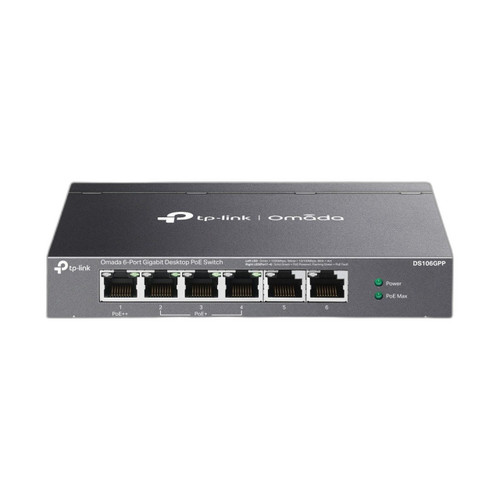
The DS106GPP provides PoE++ (802.3bt) on Port 1, capable of delivering 60–90 W to a single device, and PoE+ (up to 60 W) on Ports 2–4, with a total PoE budget of 64 W. This makes it particularly suited for power-hungry endpoints such as PTZ cameras, thermal cameras, or multi-sensor units that exceed the 30 W ceiling of standard PoE+. The extend mode also stretches PoE reach to 250 m (820 ft) on Port 1–2, well beyond the standard 100 m Ethernet limit — a meaningful advantage for remote or perimeter camera runs.
The SISPM1040-362-LRT is specified as PoE+ (802.3at), which caps per-port output at 30 W. The spec sheet does not state a total PoE budget figure or a per-port wattage ceiling beyond the 802.3at standard. No extended-reach PoE mode is documented. For fixed-dome, bullet, or other standard IP cameras drawing under 15 W, the PoE+ standard is fully adequate; for high-wattage PTZ or dual-sensor cameras, the DS106GPP's 90 W Port 1 headroom is the decisive advantage.
Which switch gives you more network control, and does your deployment need it?
The DS106GPP is specified as unmanaged. It offers three operating modes — Extend Mode (250 m PoE), Port Isolation, and Auto Recovery — selectable presumably via a hardware DIP switch or mode button. There is no VLAN, QoS, SNMP, or remote management capability documented in the provided specs. For small, single-purpose camera drops where simplicity and zero configuration overhead are priorities, this is acceptable; for any deployment requiring network segmentation or remote monitoring, it is a hard limitation.
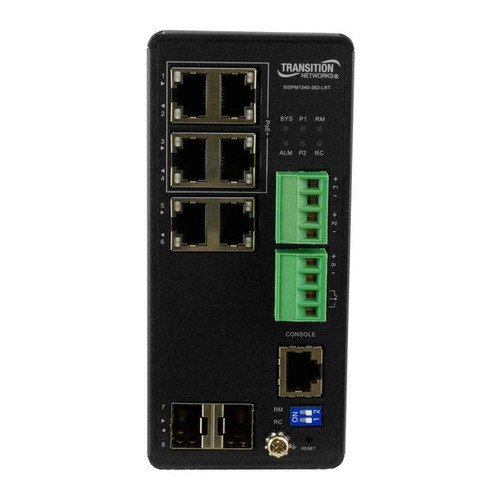
The SISPM1040-362-LRT is a Layer 2+ managed switch. The provided specs confirm VLAN, QoS, and SNMP support, along with an 8K MAC address table. Managed operation enables camera traffic isolation (critical for cybersecurity-conscious end-users), priority queuing for video streams, and remote fault detection — all standard requirements in enterprise, government, and multi-tenant deployments. TAA compliance is explicitly listed, making it eligible for U.S. federal procurement. The DS106GPP carries no TAA claim in its specs.
Which switch is built for harsher conditions or longer service life?
The DS106GPP specs do not document an operating temperature range, ingress protection rating, or any hardened/ruggedized classification. It is described as a desktop switch, implying indoor, conditioned-space installation. Mount options listed include wall, pole, and rack, suggesting some flexibility in placement, but no environmental hardening is claimed. Power consumption is rated at 64 W total (PoE budget included).
The SISPM1040-362-LRT is branded under Transition Networks' 'LRT' line, which the manufacturer markets as hardened for extended temperature and industrial environments; however, the specific operating temperature range is not present in the provided spec data and cannot be stated here. What is documented is a lifetime warranty — versus no warranty term stated for the DS106GPP — which represents a meaningful total-cost-of-ownership advantage for long-lifecycle infrastructure deployments. Dimensions are listed as 18" x 16" x 10", suggesting a larger, rack-friendly form factor compared to the DS106GPP's compact desktop footprint.
Which should you choose: the DS106GPP or the SISPM1040-362-LRT?
Our take: The DS106GPP is the stronger choice when maximum per-port PoE wattage and extended cable reach are the primary constraints. Its 90 W PoE++ on Port 1 and 250 m extend mode are unmatched by the SISPM1040-362-LRT, which caps at 30 W per port (802.3at) with no extended-reach mode documented. However, the SISPM1040-362-LRT decisively wins on network control: it is a Layer 2+ managed switch with VLAN, QoS, and SNMP, while the DS106GPP is unmanaged. The SISPM1040-362-LRT also carries TAA compliance and a lifetime warranty, neither of which appears in the DS106GPP specs. In practice: choose the DS106GPP for simple, high-wattage camera drops in SMB or residential-commercial settings; choose the SISPM1040-362-LRT for government sites, enterprise edge closets, or any deployment requiring traffic segmentation and remote management.
Side-by-Side Comparison
Spec-for-spec, from manufacturer data.
| Specification | TP-Link DS106GPP | Transition Networks SISPM1040-362-LRT |
|---|---|---|
| Port Count | 6 | 6 |
| Port Speed | 1G Gigabit | 10/100/1000 Mbps |
| PoE Standard | PoE++ (802.3bt) on Port 1; PoE+ on Ports 2–4 | PoE+ (802.3at) |
| Max Single-Port PoE Power | 90 W (Port 1) | 30 W (802.3at standard max) |
| Total PoE Budget | 64 W | — |
| Extended PoE Range | 250 m (820 ft) on Ports 1–2 | — |
| Management | Unmanaged | Layer 2+ Managed |
| VLAN Support | — | Yes |
| QoS | — | Yes |
| SNMP | — | Yes |
| MAC Address Table | — | 8K entries |
| TAA Compliant | — | Yes |
| Warranty | — | Lifetime |
| Operating Modes | Extend Mode, Port Isolation, Auto Recovery | — |
| Form Factor | Desktop | Desktop / Rack (18" x 16" x 10") |
| Mount Options | Wall; Pole; Rack | — |
Frequently Asked Questions
Which should you choose: the DS106GPP or the SISPM1040-362-LRT?
The DS106GPP is the stronger choice when maximum per-port PoE wattage and extended cable reach are the primary constraints. Its 90 W PoE++ on Port 1 and 250 m extend mode are unmatched by the SISPM1040-362-LRT, which caps at 30 W per port (802.3at) with no extended-reach mode documented. However, the SISPM1040-362-LRT decisively wins on network control: it is a Layer 2+ managed switch with VLAN, QoS, and SNMP, while the DS106GPP is unmanaged. The SISPM1040-362-LRT also carries TAA compliance and a lifetime warranty, neither of which appears in the DS106GPP specs. In practice: choose the DS106GPP for simple, high-wattage camera drops in SMB or residential-commercial settings; choose the SISPM1040-362-LRT for government sites, enterprise edge closets, or any deployment requiring traffic segmentation and remote management.
Can the DS106GPP or SISPM1040-362-LRT power a high-wattage PTZ camera?
The DS106GPP can: Port 1 supports PoE++ (802.3bt) up to 90 W, which covers virtually all PTZ and thermal cameras on the market. The SISPM1040-362-LRT is rated PoE+ (802.3at), which caps at 30 W per port — sufficient for most fixed cameras but potentially inadequate for high-draw PTZ units that require 60 W or more.
Is the DS106GPP or SISPM1040-362-LRT better for a government or TAA-required deployment?
The SISPM1040-362-LRT. TAA compliance is explicitly listed in its specs. No TAA claim appears anywhere in the DS106GPP's provided specifications, so it cannot be assumed eligible for federal procurement under TAA-restricted contracts.
Which switch should I choose if I need to segment camera VLANs or monitor the switch remotely via SNMP?
The SISPM1040-362-LRT. It is a Layer 2+ managed switch with documented VLAN, QoS, and SNMP support. The DS106GPP is unmanaged; its only configurable behaviors are Extend Mode, Port Isolation, and Auto Recovery. It has no VLAN or SNMP capability listed in its specs.
More Network Switch Comparisons
- TP-Link SG2206MP vs Lantronix IES-5200-LRT
- TP-Link SG2206MP vs Lantronix SISPM1040-362-LRT-L1Y3
- TP-Link SG2206MP vs Transition Networks SISPM1040-362-LRT
- TP-Link SG2206MP vs TP-Link DS106GPP
- TP-Link DS106GPP vs Lantronix IES-5200-LRT
- TP-Link DS106GPP vs Lantronix SISPM1040-362-LRT-L1Y3
Network Switch Buying Guides
Get a Second Opinion on Your Camera Choice
Share your site layout, coverage goals, and budget. Our team will validate the camera selection, flag anything we would change, and recommend products that match the use case.