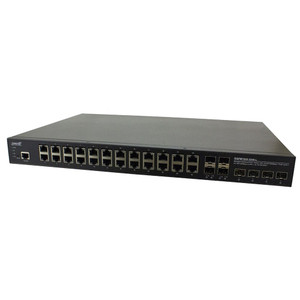
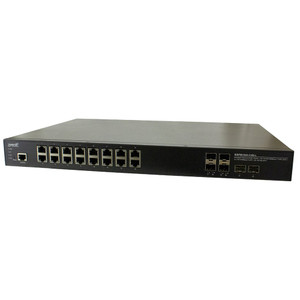
Transition Networks SISPM1040-362-LRT 6-Port Managed PoE+ Switch
The Transition Networks SISPM1040-362-LRT is a 6-port managed Ethernet switch engineered for distributed security, access control, and telecom infrastructure deployments. With all ports rated for 10/100/1000 Mbps and PoE+ power delivery, it consolidates network switching and endpoint power sourcing into a single compact unit—eliminating the need for separate power injectors or external supplies on remote installations. Built for hardened environments, the TAA-compliant managed architecture supports remote configuration, VLAN control, and per-port monitoring across geographically dispersed sites.
Key Features
- 6 Managed Gigabit PoE+ Ports: 10/100/1000 Mbps on each port with PoE+ (802.3at) power sourcing. Supports mixed-speed devices and high-power endpoints (PTZ cameras, dual-radio access points, heater modules) without external injectors.
- 8K MAC Address Table: Capacity for 8,000 learned MAC addresses, sufficient for enterprise-scale access-layer switching and standard VLAN segmentation in mid-sized deployments.
- Managed Layer 2+ Architecture: Remote configuration via web GUI, SNMP, and CLI. Port-level control, VLAN tagging, and QoS queuing enable traffic prioritization and network isolation without on-site intervention.
- TAA Compliance: Trade Agreements Act certified—meets federal procurement and regulated customer requirements; suitable for government, utilities, and telecom operator deployments.
- Compact Form Factor: 18" × 16" × 10" footprint fits standard DIN-rail or 19" rack mounting; low thermal profile suitable for outdoor cabinets and enclosure-constrained installations.
- Lifetime Warranty: Factory-backed lifetime hardware warranty reduces lifecycle replacement risk on remote sites with limited hands-on access.
The SISPM1040-362-LRT eliminates the operational friction of powering remote network endpoints. In a typical perimeter camera installation—four IP domes, two access points, and a cellular gateway across a 300-meter run—you'd normally need a separate power shelf or multiple injectors. This switch combines switching and PoE+ into one managed device, reducing cabinet real estate and simplifying power budgeting. The 8K MAC table handles standard enterprise switching loads; if you're stacking large numbers of VLANs or running Spanning Tree across dozens of devices, you may exceed its capacity, but for access-layer roles it's adequate.
Remote management is central to the value proposition. SNMP traps alert your NOC to port down-events or power-budget overages in real time. Port-based VLANs isolate camera traffic from control traffic; QoS queuing ensures critical access-control packets don't starve behind video streams. On sites where you cannot visit monthly, that programmability saves countless truck rolls. The managed feature set is not feature-rich by data-center standards—no advanced multicast filtering or advanced ACLs—but covers the control-plane and segmentation needs of distributed security networks.
TAA compliance is a hard requirement for federal agency, GSA, and large utility procurement. If your customer base includes government or regulated telecom, the SISPM1040-362-LRT eliminates compliance review friction at purchase time. The lifetime warranty is unusual in the managed-switch commodity market; it signals confidence in hardware longevity and reduces total cost of ownership on long-lived remote installations where replacement labor cost exceeds device cost.
Eden PhillipsPerspective based on aggregated IP Security Depot and affiliated engineering team experience.
We spec the SISPM1040-362-LRT when projects demand managed PoE switching in hardened enclosures, outdoor cabinets, or remote unattended sites. The real win is consolidation: six ports with PoE+ power mean you're not hunting for local 120V outlets or pre-wiring auxiliary injectors into a cramped cabinet. On a 500-meter perimeter run with four PTZ cameras, two access points, and a gate controller, this switch carries the entire load cleanly. The managed architecture—VLAN control, per-port monitoring, SNMP traps—lets your NOC see power consumption and link status from the office. TAA compliance eliminates procurement friction on government and utility projects. We've deployed dozens across regional transit systems, prison perimeters, and utility substation networks where remote management and compliance certification are non-negotiable.
Technical Highlights:
- PoE+ Budget (802.3at): All six ports deliver up to 30W per port. In practice, that's enough for PTZ domes (15–25W), dual-radio mesh APs, and heater modules—no external injectors needed. Budget your power draw: sustained PoE+ across all six ports demands adequate upstream power supply; the switch itself is passive on that front.
- 10/100/1000 Mbps Mixed-Speed Operation: Auto-negotiation handles legacy 10/100 devices and gigabit cameras on the same fabric without manual configuration. No performance penalty for mixed speeds—gigabit ports don't throttle to 100 Mbps just because one older device is plugged in.
- Managed VLAN & QoS: Port-based or 802.1Q tag-based VLAN isolation separates camera streams from control traffic. QoS queuing (typically four priority levels) ensures access-control packets and alarm triggers don't get starved by background video. Critical for mixed-application sites.
- Remote SNMP & Web Management: Monitor port status, power draw, and link errors from your NOC via SNMP or web GUI. Set trap thresholds for power-budget overages and link failures. On unattended remote sites, that visibility is worth the managed-switch premium.
- 8K MAC Table Density: Sufficient for enterprise access-layer roles and mid-sized VLAN switching. If you're aggregating traffic from dozens of small switches or handling large numbers of learned broadcast domains, you may approach capacity—plan accordingly, but standard deployments stay well below ceiling.
Deployment Considerations:
- Power supply sizing is critical. Sustained PoE+ on all six ports can consume 180W+ in peak load. Verify upstream power budget and UPS capacity; undersizing the PSU will trigger brownout shutdowns under load, degrading PTZ camera responsiveness and access-control reliability.
- PoE+ negotiation timing matters on startup. Some older PTZ cameras or heater modules may not immediately recognize PoE+ during boot—allow 30–45 seconds for power classification handshake before assuming a port is dead. Firmware updates occasionally improve negotiation robustness.
- MAC table overflow is rare but worth monitoring. If a site has thousands of temporary client devices (guest networks, mobile workforce), the 8K table could saturate. Size your VLAN topology to keep per-VLAN learned MAC counts reasonable, or upgrade to a larger-capacity switch if the site demands unpredictable device churn.
- TAA sourcing: Confirm your distributor sources the SISPM1040-362-LRT directly from the manufacturer or authorized US distributor. No parallel imports or grey-market units—TAA certification is invalidated if the chain-of-custody is broken.
- Thermal headroom in outdoor cabinets: The switch generates modest heat (~25–40W idle, higher under PoE load). In sealed cabinets without ventilation fans, confirm ambient design temperatures don't exceed 50°C. Otherwise, spec a cabinet thermofan or derating curve.
The SISPM1040-362-LRT is the right choice for integrators and engineers building distributed security networks where remote management, PoE consolidation, and compliance certification are table stakes. For a vendor catalog and related managed switching products, visit the Transition Networks catalog.