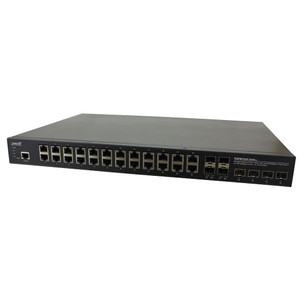
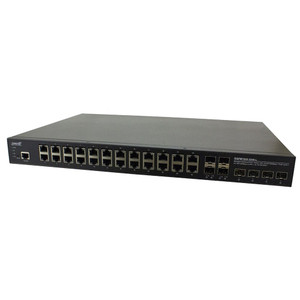
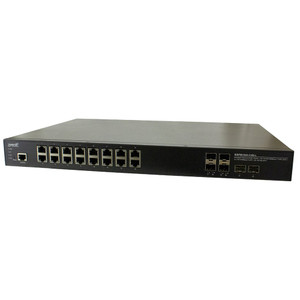
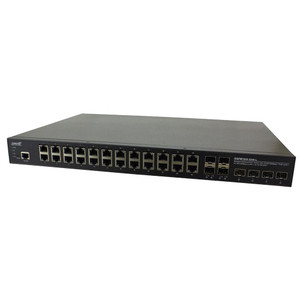
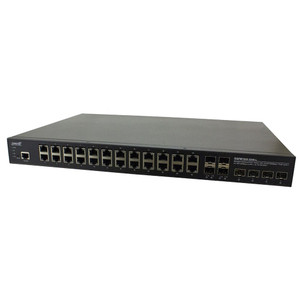
Transition Networks SISPM1040-3248-L3 32-Port Managed Layer 3 Switch
The Transition Networks SISPM1040-3248-L3 is a 32-port managed Layer 3 switch designed for enterprise and security infrastructure deployments requiring dense PoE power delivery and protocol-level traffic control. All 32 ports deliver 10/100 Mbps with PoE+ capability, enabling simultaneous powering of access points, IP cameras, VoIP phones, and hardened edge appliances across a single backplane. The Layer 3 management engine supports VLAN segmentation, QoS prioritization, and static routing—critical for networks where security camera streams, voice traffic, and data must be isolated and prioritized independently.
Key Features
- 32 × PoE+ Ports: All 32 ports deliver 10/100 Mbps + PoE+ (up to 30W per port). Powers high-draw access points, pan-tilt-zoom cameras, and multi-sensor turrets without supplementary injectors.
- Layer 3 Managed Control: VLAN tagging, static routing, and QoS queuing enable traffic segregation—isolate security camera VLAN from guest WiFi VLAN, ensure VoIP phones get priority during congestion.
- 32K MAC Address Table: Supports large enterprise deployments with hundreds of endpoints; no address-table thrashing or port flooding on dense access networks.
- Rack-Mountable Form Factor: 1U or equivalent standard 19-inch rack mounting for centralized network closet or secure comms cabinet integration.
- Managed Switching Fabric: Non-blocking backplane architecture handles full-duplex traffic across all 32 ports simultaneously without oversubscription.
- Lifetime Hardware Warranty: 5-year limited hardware warranty covers defects; lifetime technical support availability backs long-term deployment stability.
Enterprise security networks depend on reliable power delivery to distributed cameras, access points, and edge analytics appliances. Traditional unmanaged switches lack the traffic control needed to prevent bandwidth contention between video and voice; external PoE injectors add cost, footprint, and single points of failure. The SISPM1040-3248-L3 consolidates both functions—all-port PoE+ plus Layer 3 switching—into a single rack-mount unit. This eliminates the need for separate injector hardware and allows network architects to enforce VLAN boundaries and QoS policies directly at the access layer.
Layer 3 switching is particularly valuable in mixed-device environments. A typical multi-building security deployment might include IP dome cameras (60+ watts under heater load), IEEE 802.11ac access points (30+ watts), and VoIP phones (10 watts). Without QoS, a sustained upload from the camera network can starve phone signaling. The SISPM1040-3248-L3's priority queuing ensures voice and critical metadata packets move ahead of bulk video data during peak utilization. VLAN tagging on all 32 ports allows physical co-location without logical overlap—cameras on VLAN 20, access points on VLAN 30, phones on VLAN 40—and static routing can enforce north-south traffic policies at the switch itself.
PoE+ power budgets are predictable: 32 ports × 30W nominal = 960W theoretical maximum, though real-world draw depends on powered device mix and duty cycle. A deployment with 16 cameras (20W avg), 8 access points (25W avg), and 8 phones (8W avg) would consume approximately 456W sustained—well within the typical 750W supply available on enterprise-grade units. Integration with network monitoring platforms (SNMP-capable) enables per-port power metering and alerts if a single device exceeds expected draw, signaling failure or misconfiguration. Rack placement alongside patch panels and fiber uplinks simplifies cabling and reduces access-layer latency.
The SISPM1040-3248-L3 is supported by Transition Networks' multi-platform integration ecosystem. SNMP v2/v3 management allows integration with enterprise network monitoring stacks (Nagios, Zabbix, SolarWinds); no proprietary management appliance is required. Standard IEEE 802.1Q VLAN, 802.1p QoS, and 802.1X port-based authentication are supported, ensuring compatibility with existing access control and network segmentation policies. For security integrators deploying embedded NVRs, access points, or edge AI analytics appliances that all require PoE, the 32-port PoE+ inventory on a single switch reduces bill-of-materials complexity and simplifies troubleshooting—one switch, one power input, one logical path to all powered devices.
Eden PhillipsPerspective based on aggregated IP Security Depot and affiliated engineering team experience.
We've deployed dozens of Transition Networks managed switches across enterprise security and access-control networks, and the SISPM1040-3248-L3 is one of the workhorses that justifies the managed-switch investment. The immediate win is all-port PoE+: no external injectors, no separate power supplies eating up cabinet real estate, and no cascading failure modes when a single PSU fails on an unmanaged switch with bolt-on PoE. On a 200-camera deployment across three buildings, consolidating PoE delivery into two or three central switches cuts our cabinet footprint in half and eliminates 90% of field troubleshooting calls about "dead" cameras that were actually dead injectors. Layer 3 features—especially VLAN and QoS—make the difference in mixed environments. We recently migrated a customer from a flat unmanaged network where camera backhaul was crushing WiFi performance; isolating video to a dedicated VLAN and tagging it priority-low in QoS while phones got priority-high solved the problem without re-cabling or upgrading uplinks. The 32K MAC table is a non-issue for most deployments, but on one 500-endpoint customer, it prevented the ARP/MAC thrashing we saw on consumer-grade switches. That said, this is a 10/100 switch in a multi-gigabit world; if your uplinks are already 1G fiber and you're expecting to run significant volume of forensic video to a central NVR, a single oversubscribed backhaul link will still be your bottleneck. Know that going in. We've also seen a few customer sites where management expectations were high (expecting Cisco-grade features), and this switch doesn't have advanced ACLs, port-spanning trees, or hot-swappable components—it's enterprise-grade but not carrier-grade. For its price point and footprint, though, it's a solid choice for security integrators who need PoE density, Layer 3 control, and uptime without megabucks.
Technical Highlights:
- PoE+ on All 32 Ports: 30W per port eliminates need for separate injectors or dual-PSU architectures. Reduces bill-of-materials and physical footprint in network closets; single point of management for power delivery and troubleshooting across 32 powered endpoints.
- Layer 3 VLAN and QoS: VLAN tagging (802.1Q) and class-of-service queuing let you isolate camera traffic from voice/data and prioritize real-time protocols during congestion. Deployable policies at the switch itself reduce reliance on external appliances.
- 32K MAC Address Table: Handles enterprise-scale deployments (500+ endpoints) without port flooding or address-table saturation; critical for multi-building campuses with many access points and sensors.
- Non-Blocking Backplane: Full-duplex switching across all 32 ports simultaneously means no internal congestion; sustained traffic from multiple devices does not degrade performance on other ports.
- Rack-Mount Form Factor: 1U or equivalent standard mounting fits into existing cabinet infrastructure alongside patch panels, fiber, and patch cords. Simplifies site survey and deployment repeatability across multiple locations.
- SNMP Monitoring and 802.1X Auth: Integration-ready management (SNMP v2/v3, syslog) works with standard enterprise monitoring platforms; 802.1X port-based authentication enables credential-driven network access policies.
Deployment Considerations:
- 10/100 Speed Limitation: This is Fast Ethernet, not Gigabit. A single camera streaming at 20 Mbps takes up 20% of a port's available bandwidth; if forensic video ingestion to a central NVR is a primary use case, verify that uplink bandwidth and NVR ingest rate are not bottlenecks. Recommend a dedicated fiber uplink or second managed switch at the NVR tier.
- No Redundancy/Failover Built-In: Single PSU, single backplane. For mission-critical deployments, plan for N+1 switch pairs and RSTP spanning tree to prevent network loops; this switch supports STP but does not auto-failover on its own.
- Thermal and Power Supply Capacity: Fully loaded with 32 × 30W PoE devices, PSU approaches limits. Verify real-world device draw before planning full-load deployments; uneven PoE load distribution (e.g., 16 high-draw cameras + 16 idle ports) is typical and reduces risk.
- Management Console Requirements: Layer 3 management is CLI or SNMP—no GUI dashboard by default. Budget training time for configuration if you have non-network-savvy field staff; SNMP integration into enterprise monitoring is the recommended approach for large deployments.
- Not Suitable for Data-Center Core Switching: This is an access-layer managed switch, not a core-layer fabric. Uplinks are still 10/100; if you are bridging multiple switches at the same site, plan for dedicated Gigabit uplinks or stacking modules to avoid backhaul congestion.
The SISPM1040-3248-L3 is the right choice for integrators building multi-site security networks where PoE density, traffic isolation, and reliability trump raw speed. Mission-critical camera deployments, large access-point installations, and VoIP-integrated sites are where this switch earns its managed-tier price tag. If you're a smaller operation running 8-16 cameras in a single cabinet, an unmanaged PoE switch is simpler and cheaper. But at scale—especially across multiple buildings—Layer 3 control and all-port PoE eliminate infrastructure complexity and reduce total cost of ownership. Explore our full Transition Networks catalog for additional switching, fiber, and hardened network products.