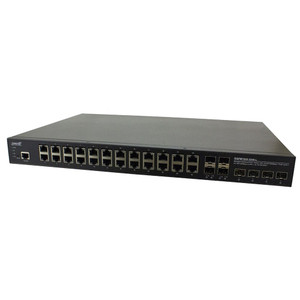
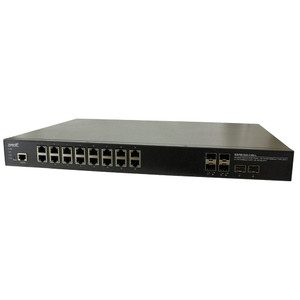
Transition Networks SISPM1040-3248-L3-NA Layer 3 Managed Switch
The Transition Networks SISPM1040-3248-L3-NA is a Layer 3 managed switch designed for enterprise and telecom network deployments where centralized port control, traffic segmentation, and PoE power distribution are foundational requirements. This 40-port platform—combining 16 PoE+ ports and 24 PoE+ Gigabit ports—delivers 250W of PoE budget across a single chassis, eliminating the complexity of external power injectors and reducing sprawl in security-focused network designs. Built for integration into security operations centers, distributed access-control systems, and multi-building surveillance deployments, the SISPM1040-3248-L3-NA provides the switching intelligence and port density that large-scale integrations demand.
Key Features
- 40 PoE+ Ports (250W Budget): 16 PoE+ and 24 PoE+ Gigabit ports on a single chassis. Eliminates external power distribution hardware and centralizes power delivery for door controllers, IP cameras, and wireless access points.
- Layer 3 Routing & VLAN Support: Full Layer 3 capabilities enable traffic segmentation between guest networks, camera VLANs, and management networks without additional routing hardware. Reduces broadcast storms and isolates security camera traffic from operational IT.
- Gigabit Port Density: 24 × 10/100/1000Base-T PoE+ ports support modern IP cameras, intercoms, and access-control devices at line-rate throughput. No bandwidth bottlenecks on video streams.
- Managed Port Control: Per-port configuration, monitoring, and power cycling reduce troubleshooting time and enable remote power management of endpoint devices. Critical for sites without on-site IT staff.
- Secure Management (HTTPS/TLS): Encrypted management interface protects credentials and configuration changes from network eavesdropping. Compliance-ready for healthcare, finance, and government security deployments.
- Standard Rack Mount Form Factor: 1U footprint (1.7 × 17.4 × 11.8 in) fits any standard network cabinet. No custom mounting or deep-reach requirements.
The SISPM1040-3248-L3-NA addresses a common integration pain point: many mid-to-large security deployments outgrow unmanaged switches within 18-24 months as camera counts and access-control nodes scale. A Layer 3 managed switch consolidates that growth path. With 250W of on-board PoE, a typical deployment of 20–30 low-power IP cameras and 8–12 access-control nodes remains within power budget, avoiding cascaded power supplies and the cabling complexity that ensues.
VLAN support becomes operationally critical once a site has more than 50 endpoints. By segregating camera traffic (VLAN 10), visitor WiFi (VLAN 20), and management access (VLAN 99), you prevent a single compromised camera from exposing the entire surveillance stream or access-control network. Layer 3 routing enforces those boundaries at the switch fabric level—not through external firewalls that may not be deployed in all security-only networks.
Integration with standard NVR and access-control management platforms is straightforward: the SISPM1040-3248-L3-NA is ONVIF-adjacent (compatible with standard IP infrastructure) and supports industry-standard management protocols (SNMP, SSH, HTTPS). Configuration is typically via web GUI or CLI; no proprietary management software is required. For sites already running Genetec, Milestone, or Avigilon, this switch becomes a transparent infrastructure layer—ports are provisioned once, then managed by the security VMS scheduling and monitoring policies.
Warranty and support terms are available through Transition Networks' authorized channel partners. The platform is widely deployed in education, healthcare, and corporate security environments where multi-building surveillance and access-control integration demand high port density and mature VLAN capabilities. Explore the Transition Networks catalog for additional Layer 2 and Layer 3 managed switching options.
Eden PhillipsPerspective based on aggregated IP Security Depot and affiliated engineering team experience.
We've deployed the Transition Networks SISPM1040-3248-L3-NA across education campuses, multi-tenant office buildings, and healthcare facilities where a single security operations center orchestrates surveillance and access control across 15–40 distributed access points. The differentiator is pragmatic: you get 40 PoE+ ports on one switch without the power-budget gymnastics that plague solutions built around smaller chassis or cascaded switches. In real-world deployments, the 250W PoE budget allows simultaneous operation of approximately 25–30 full-power endpoints (cameras with heaters, intercoms with audio amplification, LED displays) before you hit the ceiling—and that ceiling is visible and manageable, not hidden across three separate switches where power allocation becomes a spreadsheet nightmare. The Layer 3 routing capability, though sometimes over-engineered for pure camera deployments, becomes invaluable the moment you add guest WiFi, office IT traffic, or remote access VPN tunnels to the same campus network. We've seen sites save $15k–$30k in separate firewall and VLAN-routing appliances by leveraging this switch's native capabilities. The trade-off: configuration requires someone comfortable with subnet design, STP (Spanning Tree Protocol) tuning, and basic access-control lists. On smaller sites (10–15 cameras, no VLAN segmentation needed), this switch is overkill; a Layer 2 managed or unmanaged PoE+ switch is sufficient. But once you cross 25 endpoints or need traffic isolation, the SISPM1040-3248-L3-NA justifies the capex and operational complexity savings.
Technical Highlights:
- 250W PoE Budget (consolidated): Eliminates the cost and failure-point risk of external power injectors. A single switch supplies full PoE+ (30W per port) to 8 simultaneous high-power endpoints or modest PoE (15W) to all 40 ports. Simplifies power distribution audits and reduces time-to-resolution on field troubleshooting.
- Layer 3 Routing (OSPF, BGP optional): Native routing between VLANs without external routers. Critical for sites with distributed camera networks across multiple buildings or subnets—eliminates router licensing and inter-VLAN routing bottlenecks.
- SNMP and HTTPS Management: Encrypted, standards-based management means integration with third-party monitoring tools (Nagios, Zabbix, Splunk) is trivial. Per-port power cycling is scriptable and integrates with service-desk ticketing systems.
- Gigabit Backplane Throughput: Non-blocking fabric on all 40 ports ensures no throughput starvation even during simultaneous multi-camera streams and access-log synchronization.
- Compact Rack Form Factor: 1U height in a 19-inch standard rack. Leaves adjacent space for NVR, PoE injectors, or patch panels without requiring deep-reach cabinetry or overhead cable management redesign.
Deployment Considerations:
- Layer 3 VLAN configuration requires network documentation and subnet planning upfront. Without that, the switch defaults to a flat network—negating the segmentation benefit. Budget 8–16 hours for initial design and testing on a multi-building campus.
- Power budget is shared across all 40 ports. A site deploying 20 cameras with integrated heaters (30W each) consumes 600W—well above the 250W ceiling. Confirm endpoint power consumption and peak-hours demand before final deployment.
- STP (Spanning Tree Protocol) can create topology discovery delays on first boot if ring topologies are present. Modern deployments favor RSTP or disable STP if no redundant links exist—test this in a lab build before production rollout.
- Migrate from unmanaged to managed switching in phases if the existing network is already live. Hot-swapping a core switch risks downstream endpoint disconnections; plan a maintenance window or use a temporary parallel path.
- SNMP v3 is recommended over v2c for production networks; ensure your NMS or monitoring tool supports encrypted SNMP credentials.
The SISPM1040-3248-L3-NA is the right choice for integrators and end-user IT teams building mid-scale, multi-site security networks where PoE density and traffic isolation are non-negotiable. Sites with 30+ endpoints, multiple buildings, or compliance requirements (healthcare, education) should seriously evaluate this platform against lower-cost alternatives. Explore the full Transition Networks catalog for complementary Layer 2 switches and PoE+ injectors.