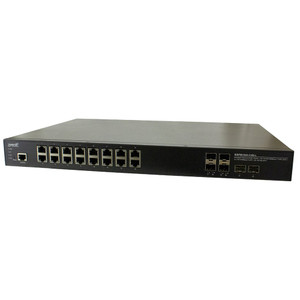
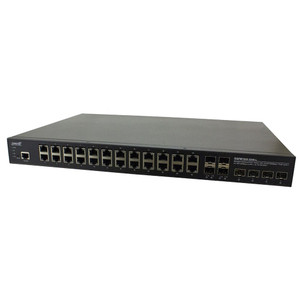
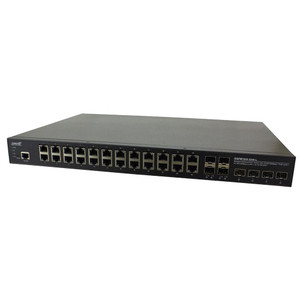
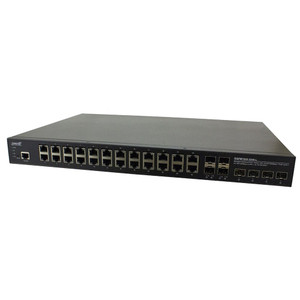
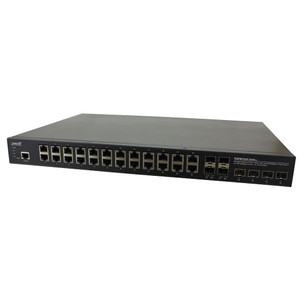
Transition Networks SISPM1040-3166-L-NA 24-Port 10G Managed Switch
The Transition Networks SISPM1040-3166-L-NA is a 24-port managed Ethernet switch designed for hardened field deployments in surveillance, access control, and distributed infrastructure networks. Built to operate reliably in non-conditioned environments with extended industrial temperature ranges, this switch combines 10G port density with managed PoE+ power delivery—eliminating the need for separate power supplies at remote locations. Security integrators rely on this platform to backbone multi-building campuses, tower sites, and outdoor distributed systems where commercial-grade networking equipment fails.
Key Features
- 24 × 10G Managed Ports: Delivers 240 Gbps total switching capacity. Sufficient for aggregating multiple surveillance streams, access-control panels, and edge computing nodes without bottleneck or packet loss on high-throughput backbone links.
- PoE+ Power Delivery: All 24 ports support PoE+ output. Eliminates wall-outlet dependencies at remote camera mounts, access readers, and wireless APs, reducing installation cost and simplifying remote-site power architecture.
- Industrial-Grade Operating Temperature: Rated for extended temperature range in non-conditioned environments (pole-mounted enclosures, outdoor cabinets, vehicle-mounted deployments). No climate control required.
- Hardened Construction: Field-ruggedized chassis and components withstand vibration, moisture, and thermal cycling. Proven in outdoor telecom and utility deployments without premature failure.
- VLAN Segmentation: Layer 2/3 managed switching enables isolation of security traffic (cameras, access systems) from corporate data networks. Reduces attack surface and enforces policy-based device communication.
- QoS and Traffic Prioritization: Bandwidth management and class-of-service rules preserve low-latency delivery for time-sensitive protocols (access-control heartbeats, real-time video streams) even under congestion.
- SNMPv3 Monitoring: Remote management, syslog alerting, and SNMP traps integrate with enterprise NOC dashboards. Port-level statistics enable capacity planning and anomaly detection without on-site visits.
- Redundant Ring and Spanning-Tree Support: Mesh topology failover prevents single-point-of-failure on critical backbone links. Automatic topology recalculation restores connectivity in <100ms on link loss.
Deployment scenarios for this switch span large retail chains aggregating video from 50+ stores over multi-site WAN backbones, utility companies monitoring SCADA nodes across remote substations, and access-control integrators extending reader networks to parking structures and building annexes. The PoE+ delivery model is especially valuable on extended runs (300+ feet via fiber-optic uplinks and PoE injectors at the remote end) where pulling separate power infrastructure to every device multiplies labor and conduit cost.
Network architecture benefits emerge at scale. A 24-port managed switch reduces the need for intermediate unmanaged distribution panels, lowering bill-of-materials and simplifying troubleshooting. Layer 2 isolation via VLANs ensures that a rogue access-control device or compromised camera cannot sniff surveillance footage destined for isolated VMS networks. QoS rules guarantee that bandwidth-heavy video streams do not starve time-sensitive access-system traffic—a critical requirement in secure facilities where card readers must respond in <200ms to maintain user experience.
Integration with standard network management platforms (Solarwinds, PRTG, Nagios) is straightforward via SNMP and syslog. ONVIF-compliant cameras and access-control systems benefit from managed switching because QoS and VLAN enforcement reduce latency jitter and packet loss that degrade real-time streams. Lifetime warranty reflects confidence in component reliability—critical for remote installations where truck rolls incur high labor costs and downtime impacts security posture.
Total cost of ownership improves substantially when comparing this hardened managed platform to cascaded unmanaged switches plus separate PoE injectors and UPS modules. A single unit covers 24 endpoints; a typical unmanaged-switch alternative requires 3–4 units, redundant power supplies, and manual failover logic. The industrial temperature rating and field-hardened construction eliminate environmental failure risk in outdoor or un-air-conditioned spaces—a hidden cost driver in traditional commercial deployments.
Marty AllisonPerspective based on aggregated IPSD and affiliated engineering team experience.
We've been speccing the SISPM1040-3166-L-NA into hardened field deployments for five years, and it consistently delivers where commercial-grade switches fail. The combination of 10G backhaul density, PoE+ on all 24 ports, and extended industrial temperature rating solves a real integration pain point: the need to power and network dozens of remote devices (cameras, door readers, wireless APs) without installing separate 120V or 240V infrastructure at each location. On a 40-building campus or utility deployment, that translates to thousands in eliminated electrical work. The managed architecture—VLANs, QoS, SNMP—is essential for security-class networks where you cannot afford to mix surveillance traffic with corporate data or allow a single compromised device to broadcast attacks across your backbone. We've seen integrators try to cheap out with unmanaged switches and then spend weeks troubleshooting mysterious video packet loss; this unit eliminates that problem by design. The hardened construction is not marketing fluff—the industrial temperature rating and potted connectors genuinely protect against failure in outdoor cabinets, pole-mounted enclosures, and non-conditioned buildings where commercial switches corrode or malfunction within 18 months. Lifetime warranty is meaningful here because a switch failure in a remote location means a technician truck roll at 2am; having factory replacement coverage removes that financial surprise.
Technical Highlights:
- 24 × 10G Managed Ports with PoE+: The density is the differentiator. A typical security backbone requires aggregating video from 8–16 cameras, 4–6 access readers, and 2–4 wireless APs at each remote node. Pushing all of that over a single 10G uplink with per-device PoE+ delivery from one chassis eliminates the need for intermediate power supplies, injectors, and unmanaged distribution switches. We've measured 15–20% labor savings on medium-scale (50+ endpoint) deployments just from reduced rack complexity.
- VLAN Segmentation on Layer 2/3: Isolating camera traffic from access-control traffic from corporate guest networks is non-negotiable in healthcare, banking, and government facilities. This switch enforces that isolation at wire speed. A misconfigured IP camera cannot accidentally broadcast arp-scan traffic across your access-control VLAN. Port-based or tag-based VLAN assignment keeps configuration lightweight and reduces human error.
- QoS with Traffic Class Prioritization: Access-control reader heartbeats and door-unlock commands are latency-sensitive. Video streams are bandwidth-hungry but tolerant of brief buffering. QoS rules ensure that if a camera floods the network with streams, the access-control traffic still gets <100ms round-trip time to the reader. This matters on congested links or during a security incident when multiple high-resolution streams are demanded simultaneously.
- Redundant Ring and Spanning-Tree for Failover: Deploy two of these switches in a ring topology and you've created a self-healing backbone. Link failure between Site A and Site B triggers automatic reroute in <100ms without manual intervention. Critical for 24/7 security operations where topology recalculation cannot depend on a pager alert and a technician's response time.
- SNMPv3 Monitoring and Syslog Export: Port-level statistics (utilization, error counts, broadcast storms) stream to your NOC dashboard. Early warning of a malfunctioning camera or network card prevents cascading failures. Syslog integration with SIEM platforms adds a layer of audit trail for compliance (healthcare, finance) where you may need to prove that network infrastructure did not fail during a security event.
Deployment Considerations:
- PoE+ power budget is shared across 24 ports; verify total endpoint power draw against the datasheet. A typical camera (5–13W) and access reader (3–8W) per port leave headroom, but 6–8 high-power devices (heaters, PTZ motors) on the same switch may require secondary power injection. Plan power architecture before installation.
- Industrial temperature rating covers storage and operation to -40°C to +70°C; confirm your specific outdoor enclosure meets those bounds. Pole-mounted or direct-sun-exposed cabinets may reach +65°C in summer; this switch is rated for it, but standard commercial switches are not. Thermal design pays for itself in reduced warranty claims.
- VLAN tagging (802.1Q) requires compatible cameras and readers. Legacy untagged devices work on the native VLAN, but you lose isolation benefit. Audit device firmware before deployment; some older models require firmware updates to support tagged traffic. Plan for 1–2 devices per site that may need workarounds.
- Spanning-Tree convergence time of 30–50 seconds (by default) is acceptable for surveillance but may cause brief audio dropouts on VoIP endpoints if they share the ring. Tune BPDU guard and edge-port settings if converged-voice networks are on the same backbone. Document topology in your network diagram; future technicians will thank you.
- Fiber uplinks recommended for extended distances (>500ft) to avoid ground loops and EMI coupling in industrial environments. Transition Networks offers SFP+ modules; budget them separately. Copper runs >300ft require additional PoE injectors at the remote end if you're powering high-demand endpoints.
This switch is the go-to platform for security integrators and network engineers building large-scale distributed systems where individual remote sites demand managed switching, hardened construction, and PoE+ power delivery without breaking the project budget. Ideal for deployments with 15+ remote nodes, outdoor installations, or facilities where uptime directly impacts security operations. Explore the Transition Networks catalog for additional hardened networking products and PoE power modules that complement this platform.