
TP-Link SG2008P vs Ubiquiti USW-FLEX-2.5G-8: Specification Comparison
Both the TP-Link SG2008P and the Ubiquiti USW-FLEX-2.5G-8 are 8-port managed network switches aimed at small-to-medium deployments, making them genuine cross-shop candidates for installers evaluating edge switching for IP camera or unified networking environments. The comparison spans port speed and switching fabric, power input and operating envelope, and management ecosystem and physical deployment flexibility — three axes that most directly drive purchase decisions in this switch class.
In This Guide
- Which switch delivers more bandwidth and fabric capacity for dense camera or data workloads?
- Which switch better fits the power budget and environmental conditions of a physical-security installation?
- How do the management platforms and physical deployment options compare for ongoing operations?
- Which should you choose: the SG2008P or the USW-FLEX-2.5G-8?
- Side-by-Side Specs
- FAQ
Which switch delivers more bandwidth and fabric capacity for dense camera or data workloads?
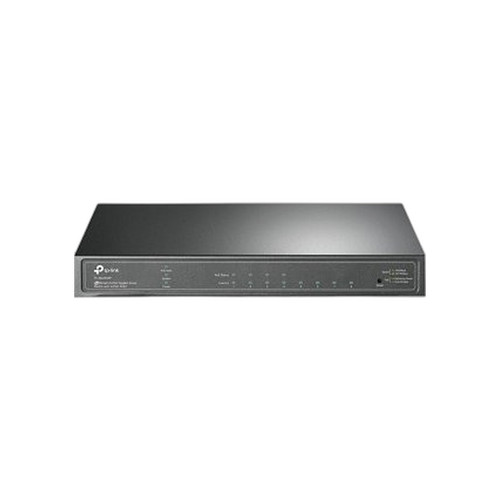
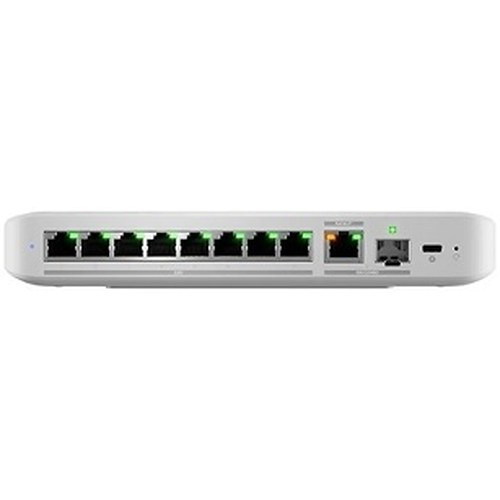
The USW-FLEX-2.5G-8 provides eight 2.5GbE data ports plus a hybrid 10G uplink (RJ45/SFP+), yielding a 60 Gbps switching capacity and 30 Gbps non-blocking throughput at 45 Mpps forwarding rate. Every access port runs at 2.5× Gigabit, which materially benefits high-bitrate cameras, NVRs, or workstations that saturate a 1G link.
The SG2008P offers eight Gigabit (1GbE) ports with a 16 Gbps switching capacity. No uplink speed beyond 1GbE is specified, and no forwarding rate (Mpps) figure is provided in the supplied specs. For standard 1080p or 4K-30 single-stream cameras the 16 Gbps fabric is non-blocking at 1G line rate, but aggregate headroom is substantially lower than the Ubiquiti unit.
For installations where future-proofing to 2.5G NICs, multi-gigabit NVRs, or 10G backbone uplinks matters, the USW-FLEX-2.5G-8 has a decisive fabric advantage. For pure 1GbE edge deployments today, the SG2008P's 16 Gbps fabric is adequate.
Which switch better fits the power budget and environmental conditions of a physical-security installation?
The SG2008P carries an 802.3af/at PoE budget of 62 W across its eight ports, powered by an external 53.5 VDC/1.31 A adapter. This lets it directly power IP cameras, access-control readers, or VoIP devices without a separate injector. Its operating temperature range is −40 °C to 60 °C, making it suitable for unconditioned closets, outdoor enclosures, or cold-climate installations.
The USW-FLEX-2.5G-8 draws a maximum of 14 W total system power via USB-C (5 V/3 A) or PoE+ input; it does not provide PoE output to downstream devices. Its operating temperature is rated −20 °C to 45 °C. The narrower thermal window and absence of PoE output mean cameras or access-control devices must be powered separately or via upstream PoE injection.
For installations that need on-switch PoE delivery or must operate below −20 °C, the SG2008P is the only option of the two. The Ubiquiti unit's 14 W consumption ceiling makes it well-suited as a powered edge node where an upstream PoE+ switch or USB-C supply is available and endpoint devices are separately powered.
How do the management platforms and physical deployment options compare for ongoing operations?
The SG2008P integrates into TP-Link's Omada SDN ecosystem, which provides centralised cloud or on-premises controller management, VLAN configuration, QoS, and remote monitoring. The supplied specs confirm managed operation via Omada SDN. Flash storage of 32 MB is noted. VLAN count and specific Layer 2/3 feature depth are not enumerated in the provided specs. Mount options are wall and rack.
The USW-FLEX-2.5G-8 is managed via the UniFi Network controller (spec field 'Management: Ethernet'), supports 256 VLANs with QoS per the provided specs, and is NDAA compliant. Physical mounting options include wall, DIN-rail, and magnetic surface in a fanless 395 g polycarbonate enclosure. No rack-mount option is specified.
Ecosystem lock-in is the dominant factor here: an existing Omada deployment favours the SG2008P; an existing UniFi deployment favours the USW-FLEX-2.5G-8. The Ubiquiti unit's DIN-rail and magnetic mount options and NDAA compliance add flexibility for industrial panels and government-adjacent projects. The SG2008P's rack-mount option suits traditional IDF/MDF closets.
Which should you choose: the SG2008P or the USW-FLEX-2.5G-8?
Our take: The SG2008P is the stronger choice when the installation requires on-switch PoE delivery and/or operation in extreme temperatures. Its 62 W PoE+ budget directly powers up to eight 802.3af/at endpoints with no ancillary injectors, whereas the USW-FLEX-2.5G-8 provides zero PoE output and a 14 W system-consumption ceiling. The SG2008P also operates down to −40 °C versus the Ubiquiti's −20 °C floor. Conversely, the USW-FLEX-2.5G-8 is the stronger choice for bandwidth-intensive or future-proofed deployments: its 60 Gbps switching capacity is 3.75× larger, each port runs at 2.5 GbE, and the hybrid 10G uplink (RJ45/SFP+) supports both copper and fibre backbones — none of which the SG2008P matches. The decision ultimately hinges on ecosystem and role: choose the SG2008P for a PoE-dependent Omada edge switch in a thermally challenging site; choose the USW-FLEX-2.5G-8 as a high-throughput UniFi edge node where PoE is sourced upstream and bandwidth headroom matters.
Side-by-Side Comparison
Spec-for-spec, from manufacturer data.
| Specification | TP-Link SG2008P | Ubiquiti USW-FLEX-2.5G-8 |
|---|---|---|
| Port Count | 8 × 1GbE | 8 × 2.5GbE + 1 × 10G hybrid uplink |
| Switching Capacity | 16 Gbps | 60 Gbps |
| Non-Blocking Throughput | — | 30 Gbps |
| Forwarding Rate | — | 45 Mpps |
| PoE Output | Yes — 62 W (802.3af/at) | No PoE output |
| PoE Budget | 62 W | — |
| System Power Consumption | 62 W (max) | 14 W (max) |
| Power Input | External adapter 53.5 VDC / 1.31 A | USB-C 5 V/3 A or PoE+ input |
| Operating Temperature | −40 °C to 60 °C | −20 °C to 45 °C |
| VLAN Support | — | 256 VLANs |
| Management Platform | Omada SDN | UniFi Network (Ethernet) |
| Mount Options | Wall; Rack | Wall; DIN-rail; Magnetic |
| Form Factor / Enclosure | — | Polycarbonate, fanless, 395 g |
| Dimensions | 11.6 × 7.1 × 1.7 in | 212.9 × 76 × 33.5 mm |
| NDAA Compliant | — | Yes |
| Flash / Memory | 32 MB | — |
Frequently Asked Questions
Which should you choose: the SG2008P or the USW-FLEX-2.5G-8?
The SG2008P is the stronger choice when the installation requires on-switch PoE delivery and/or operation in extreme temperatures. Its 62 W PoE+ budget directly powers up to eight 802.3af/at endpoints with no ancillary injectors, whereas the USW-FLEX-2.5G-8 provides zero PoE output and a 14 W system-consumption ceiling. The SG2008P also operates down to −40 °C versus the Ubiquiti's −20 °C floor. Conversely, the USW-FLEX-2.5G-8 is the stronger choice for bandwidth-intensive or future-proofed deployments: its 60 Gbps switching capacity is 3.75× larger, each port runs at 2.5 GbE, and the hybrid 10G uplink (RJ45/SFP+) supports both copper and fibre backbones — none of which the SG2008P matches. The decision ultimately hinges on ecosystem and role: choose the SG2008P for a PoE-dependent Omada edge switch in a thermally challenging site; choose the USW-FLEX-2.5G-8 as a high-throughput UniFi edge node where PoE is sourced upstream and bandwidth headroom matters.
Can either switch power IP cameras directly without a separate PoE injector?
Only the SG2008P provides PoE output — 62 W shared across its eight ports under 802.3af/at. The USW-FLEX-2.5G-8 accepts power via USB-C or PoE+ input for its own operation but does not supply PoE to downstream devices, so cameras or other PoE endpoints would require a separate injector or upstream PoE switch.
Is either switch suitable for outdoor or unheated-closet installation in cold climates?
The SG2008P is rated from −40 °C to 60 °C, which covers most outdoor enclosure and unheated-space scenarios. The USW-FLEX-2.5G-8 is rated from −20 °C to 45 °C, which is adequate for many indoor environments but excludes the coldest outdoor conditions. Neither model's ingress-protection (IP) rating is provided in the supplied specs, so suitability for direct moisture or dust exposure cannot be confirmed from the data available.
Which switch is better if I am already running a UniFi or Omada network?
Ecosystem alignment is the deciding factor. The USW-FLEX-2.5G-8 is managed through the UniFi Network controller and integrates natively into an existing UniFi deployment. The SG2008P is managed through TP-Link's Omada SDN platform and integrates into an existing Omada deployment. Running either switch outside its native controller is not addressed in the provided specs, so cross-ecosystem management capability cannot be confirmed.
More Network Switch Comparisons
- TP-Link SG2210XMP-M2 vs Ubiquiti USW-FLEX-2.5G-8
- TP-Link SG2210XMP-M2 vs Comnet CNGE8MS
- TP-Link SG2210XMP-M2 vs Lantronix S2220-1014-NA
- TP-Link SG2210XMP-M2 vs TP-Link S4500-8GP
- TP-Link SG2210XMP-M2 vs TP-Link SG2008P
- TP-Link S4500-8GP vs Ubiquiti USW-FLEX-2.5G-8
Network Switch Buying Guides
Get a Second Opinion on Your Camera Choice
Share your site layout, coverage goals, and budget. Our team will validate the camera selection, flag anything we would change, and recommend products that match the use case.