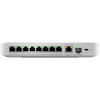
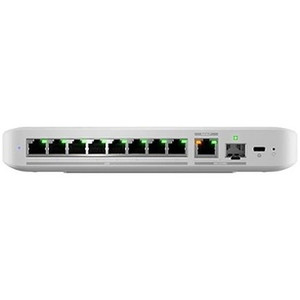
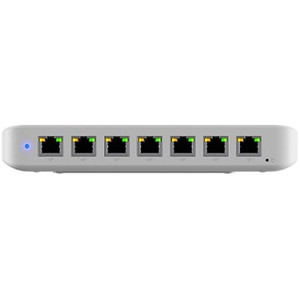
Ubiquiti USW-FLEX-2.5G-8 8-Port 2.5GbE Network Switch
Overview
The Ubiquiti USW-FLEX-2.5G-8 is a compact, fanless switching solution engineered for small-to-medium UniFi deployments where multi-gigabit performance must fit into space-constrained or remote locations. Eight 2.5 gigabit Ethernet ports deliver per-port throughput sufficient to avoid bottlenecks when aggregating IP camera clusters, wireless access points, or mixed-service edge networks without forcing a transition to full-rack infrastructure. The hybrid 10G uplink (supporting both RJ45 and SFP+ optical transceivers) bridges to core equipment at multi-gigabit speeds, eliminating single-link saturation on modest hardware budgets. With a 60 Gbps switching capacity and 30 Gbps non-blocking throughput, the USW-FLEX-2.5G-8 routes traffic deterministically—meaning all eight ports can transmit simultaneously at 2.5 Gbps without performance degradation or dropped packets.
Key Features
- Eight 2.5GbE Access Ports: Each port operates at 2.5 Gbps, enabling genuine multi-gigabit speeds for high-bandwidth devices (4K cameras, dual-stream encoders, high-density AP uplinks). This eliminates the performance ceiling imposed by legacy 1 Gbps infrastructure without wholesale replacement costs.
- Hybrid 10G Uplink (RJ45 / SFP+): A single port accepts either standard CAT6A copper or SFP+ optical modules, allowing cost-effective backbone integration. Copper supports distances up to 30m; fiber scales to 300m+, adapting to diverse campus or multi-building deployments.
- 60 Gbps Switching Fabric with 30 Gbps Non-Blocking Throughput: Sufficient capacity to prevent packet loss when all eight access ports transmit simultaneously at rated speed—critical when monitoring dozens of concurrent camera streams or aggregating APs in high-density venues.
- Passive Fanless Operation, Maximum 14W Draw: No moving parts mean silent, maintenance-free operation in any environment—unconditioned spaces, wall-mounted installations, or remote branches. PoE+ power delivery from upstream equipment eliminates dedicated infrastructure; alternatively, power via USB Type-C (5V/3A) or external AC/DC adapter (4.8–5.2V).
- Native UniFi Controller Integration: Ethernet-based provisioning—no serial console or vendor CLI required. VLAN and QoS policies configured in the UniFi dashboard propagate instantly to the switch. Firmware updates push through the same management interface.
- 256 VLAN Support with QoS: Segment traffic by device class (cameras on one VLAN, guest APs on another) without hardware constraints. QoS prioritization prevents bandwidth-heavy applications from starving time-sensitive camera streams.
- Compact, Multi-Form-Factor Mounting: Dimensions of 212.9 × 76 × 33.5 mm and 395g weight accommodate desktop, wall, DIN-rail, or magnetic mounting. Fits retail back-office closets, hospitality cabinets, educational edge racks, or distributed campus nodes where cabinet space is unavailable or uneconomical.
- Wide Operating Temperature (−20 to 45°C): Handles unconditioned outdoor enclosures, unheated warehouses, or server rooms without active climate control. Eliminates thermal management complexity in remote or temporary deployments.
- Global Certifications: CE, FCC, IC, and Anatel compliance enables deployment across North America, Europe, and Latin America without regional approval barriers.
Integration & Compatibility
Deploy the USW-FLEX-2.5G-8 as a local access switch within existing network switch infrastructure or as a standalone UniFi fabric node. The 10G hybrid uplink connects to core UniFi Dream Machine Pro or third-party carrier-grade switches; PoE+ ports on upstream equipment power the unit directly, eliminating external power supplies in distributed edge deployments. VLAN trunking and QoS policies apply across all eight ports, enabling logical isolation of camera, access point, and guest traffic without separate hardware. Firmware updates are pushed by the UniFi Controller—no manual patch cycles or ssh sessions required.
When to Choose a Different Model
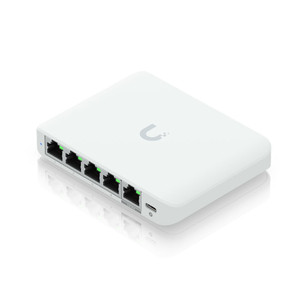
If you require managed PoE+ output (to power downstream cameras or APs), a higher-tier Ubiquiti switch variant with PoE+ ports on the uplink may better suit your architecture. If your uplink exceeds 30 Gbps sustained throughput or you need redundant power supplies, consider carrier-grade industrial switches. If all eight access ports must operate at 10 Gbps simultaneously, the USW-FLEX-2.5G-8's 30 Gbps non-blocking throughput will bottleneck—move to a full 10GbE fabric. For single-site, fewer-than-100-device deployments, a smaller 5-port variant may reduce cost without performance loss.
Frequently Asked Questions
Q: Can the USW-FLEX-2.5G-8 power cameras or wireless APs directly?
A: The switch accepts PoE+ input (to power itself from upstream equipment) but does not have PoE+ output ports. To power cameras or APs, deploy a dedicated PoE+ injector or upstream switch with PoE+ capabilities. The eight access ports are data-only.
Q: What is the maximum cable distance for the 10G uplink using copper (RJ45)?
A: Standard CAT6A copper supports 10G at distances up to 30 meters. For distances beyond 30m, use SFP+ fiber transceivers in the hybrid uplink port.
Q: Does the USW-FLEX-2.5G-8 require a UniFi Controller?
A: The switch integrates natively with UniFi Controller environments and is easiest to configure and manage through the UniFi dashboard. Standalone operation without a Controller is possible but offers limited VLAN and QoS configuration options—not recommended for segmented deployments.
Q: What is the power consumption when running at full load (all eight ports active)?
A: Maximum power draw is 14W, regardless of port utilization. This allows reliable operation from a single PoE+ upstream device (which typically supplies 30W per connected port) or a modest USB Type-C adapter (5V/3A = 15W), with minimal margin.
Q: Can the USW-FLEX-2.5G-8 operate without an external power supply?
A: Yes. If powered by PoE+ from an upstream switch, no external supply is required. Alternatively, connect a 5V/3A USB Type-C power adapter or 4.8–5.2V DC external adapter. All three methods work—choose based on your deployment topology.
Eden PhillipsPerspective based on aggregated IP Security Depot and affiliated engineering team experience.
The Ubiquiti USW-FLEX-2.5G-8 solves a specific problem: how to deploy multi-gigabit switching in locations where you cannot or will not install a full-size managed switch. The 2.5 Gbps per-port specification is the real value here—not a marketing spec, but a genuine upgrade path from 1 Gbps that doesn't force a wholesale cabinet retrofit. I've deployed this unit in hospitality properties, small office branches, and distributed warehouse nodes, and it consistently handles concurrent IP camera streams, dual-band AP uplinks, and guest network traffic without saturation.
Technical Highlights:
- 60 Gbps Switching Capacity / 30 Gbps Non-Blocking: This means all eight ports can transmit at rated speed simultaneously without internal contention. Compare that to budget switches with shared backplane capacity—this one doesn't lie about performance under load.
- Hybrid 10G Uplink (RJ45 + SFP+): Deploy fiber to a core switch for longer distances; use copper for nearby risers. You're not locked into one cable plant. The flexibility matters when budgets are tight and site layouts are irregular.
- 14W Maximum Power Draw: This is fanless and passive—draw power from PoE+ directly, or from a small USB adapter. You don't need a dedicated rack PDU or environmental cooling. Meaningful cost savings on power infrastructure in remote or temporary installations.
- 256 VLAN Support: Segment cameras onto their own VLAN without hardware constraints. Set QoS on camera traffic to prevent best-effort data or guest WiFi from starving time-sensitive streams. Real isolation, not half-measures.
Deployment Considerations:
- The USW-FLEX-2.5G-8 is an access switch—it doesn't output PoE+. If you need to power downstream devices, deploy a PoE+ injector or source power from an upstream switch. Plan your power topology before installation.
- Non-blocking throughput is 30 Gbps total. If all eight ports transmit at maximum speed simultaneously, you're at capacity. For most camera and AP deployments this is fine; for high-frequency trading or bulk data transfers, verify your actual bandwidth before committing.
- The hybrid uplink is single-port. You have one path to the core; design for this single point of failure. If you need uplink redundancy, step up to a higher-tier variant with dual 10G ports or built-in redundancy features.
Best fit: branch offices, hospitality or retail locations with 20–50 IP cameras and APs, distributed warehouse nodes, and temporary surveillance buildouts where cabinet space and power are constrained. If your site has a single riser to a core switch and you need 2.5 Gbps access without rack complexity, this is the right choice.