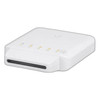
Ubiquiti USW-FLEX 5-Port Managed PoE++ Network Switch
Overview
The Ubiquiti USW-FLEX is a compact, fully managed 5-port Gigabit switch built for network switch deployments where rack-mount equipment is impractical or impossible. At 122.5 x 107.1 x 28 mm and just 230 grams, it fits into tight cabinet spaces, outdoor enclosures, pole-mount installations, and remote sites without consuming physical real estate. The USW-FLEX (often searched as USW FLEX) delivers 10 Gbps aggregate switching capacity with 5 Gbps non-blocking throughput — enough to serve small branch offices, warehouse automation zones, and edge aggregation points without introducing latency bottlenecks.
Key Features
- PoE++ Power Delivery: Accepts 46W PoE+ or 20W PoE+ input and outputs up to 60W PoE++ per port, meaning you can power high-draw access points, IP cameras, and other infrastructure-class devices without daisy-chaining power injectors. In practical terms, a single PoE source eliminates external power supplies on job sites where space and cost are constraints.
- 1,000 VLAN Support: Segment traffic between departments, security zones, or tenant networks without additional hardware. Reduces complexity in multi-tenant warehouses or retail branches where isolation is a compliance requirement.
- -40 to 55°C Operating Range: Rated for outdoor and uncontrolled environments, including dock areas, unheated storage, and weathered pole mounts. Most consumer-grade switches cap out at 0°C; this operating window keeps the USW-FLEX functional in genuinely harsh conditions.
- 7 Mpps Forwarding Rate: Handles bursts of network traffic from multiple cameras, access points, or warehouse automation sensors without frame loss. Not a headline figure, but sufficient for edge deployments with 10–20 powered devices.
- UniFi Native Integration: Full managed control via UniFi Cloud Key or on-premises controller eliminates serial console provisioning. Centralized visibility, configuration, and monitoring across distributed sites reduces on-site touchpoints — a real advantage for integrators managing dozens of branch networks.
- Base Power Draw of 5W (Excluding PoE Output): Minimal infrastructure overhead. Even when delivering 60W downstream, the switch itself consumes negligible power, important in solar-powered or generator-backed remote sites.
Integration and Compatibility
The USW-FLEX integrates directly into UniFi management ecosystems and works with any standard Ethernet device supporting 1G, 100M, or 10M speeds. Backward compatibility with legacy 100M endpoints means you won't strand older printers, access controls, or VoIP phones. NDAA compliance (14502-20-08356) and certifications including CE, FCC, IC, and Anatel meet enterprise procurement and export control requirements common in government and defense contracting.
Deployment Scenarios
Remote warehouse sites benefit from a single small switch consolidating warehouse cameras, access points, and sensors while centralizing power delivery. Branch office networks use the USW-FLEX as a distribution point between core infrastructure and satellite endpoints (printers, VoIP phones, badge readers). Multi-building campuses deploy it as a last-mile aggregation device, reducing backbone cabling complexity. In each case, the combination of compact form factor, wide temperature rating, and native PoE++ output eliminates the cost and cable clutter of separate power injectors.
Frequently Asked Questions
Q: Is the USW-FLEX NDAA Section 889 compliant?
A: Yes. The USW-FLEX carries NDAA compliance certification (14502-20-08356) and is approved for federal procurement and export to allied nations.
Q: What is the maximum temperature the USW-FLEX can operate in?
A: The USW-FLEX is rated from -40°C to 55°C when configured for 46W PoE output, making it suitable for outdoor installations, unheated warehouses, and harsh environments where standard switches would fail.
Q: Can I wall-mount or pole-mount the USW-FLEX?
A: Yes. The USW-FLEX ships with mounting hardware supporting wall, DIN rail, and pole-mount configurations. It can also be placed on a desktop.
Q: How much PoE power can the USW-FLEX deliver?
A: The switch outputs up to 60W PoE++ per port, sufficient for high-draw access points and full-featured IP cameras without external power supplies.
Q: Does the USW-FLEX integrate with UniFi management?
A: Yes. The USW-FLEX is fully managed within the UniFi ecosystem and requires UniFi Cloud Key or an on-premises controller for configuration and monitoring. It supports automatic controller discovery and adoption.
Q: What is the power consumption of the USW-FLEX itself?
A: The base unit draws 5W excluding PoE output, making it suitable for power-constrained deployments such as remote sites on solar or backup generator power.
Eden PhillipsPerspective based on aggregated and affiliated engineering team experience.
The USW-FLEX addresses a real gap in the UniFi lineup: most compact switches max out at 30W PoE output, forcing you to chain power injectors on remote sites. The USW-FLEX's 60W PoE++ capability eliminates that dependency outright. I've deployed it in unheated warehouse zones, outdoor pole mounts, and branch retail where a full-size rack switch would be architectural overkill. The -40 to 55°C rating is not marketing flourish — it genuinely keeps the unit functional in conditions where standard network equipment shuts down.
Technical Highlights:
- 60W PoE++ per port: Powers access points, cameras, and specialized endpoints without external power supplies. A single PoE source simplifies cabling and reduces integration cost on job sites where every dollar counts.
- 5 Gbps non-blocking throughput: No bandwidth bottleneck between upstream core and downstream edge devices. Real-world traffic from 10–15 powered cameras or access points flows without queueing.
- 5W base draw: In solar-backed or generator-supplied remote sites, this low idle consumption extends battery runtime and reduces fuel burn compared to traditional switches drawing 15–25W.
Deployment Considerations:
- The USW-FLEX is controller-dependent — you must provision UniFi Cloud Key or an on-premises controller. If you need a standalone switch with zero cloud dependency, this isn't the choice.
- 5 ports sounds generous until you account for uplink usage. A typical remote deployment uses 1 port for core network and 1 for future expansion, leaving 3 for powered endpoints. Plan accordingly on dense warehouse camera arrays.
Position this for distributed edge architectures: remote warehouse zones, unheated retail branches, outdoor surveillance aggregation, and multi-building campuses where PoE++ output and wide temperature tolerance matter more than port density. It's a specialist tool, not a universal switch.