
TP-Link SG108-M2 vs Ubiquiti USW-FLEX-2.5G-8: Specification Comparison
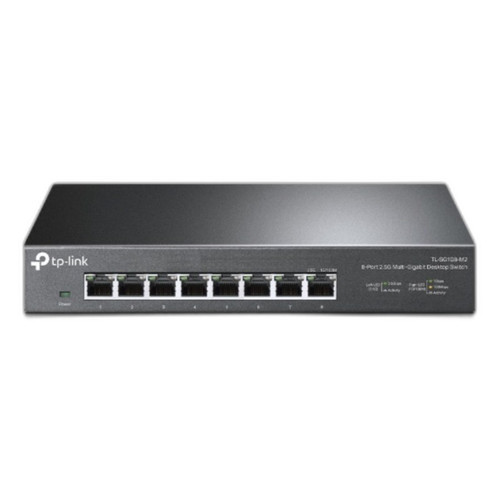
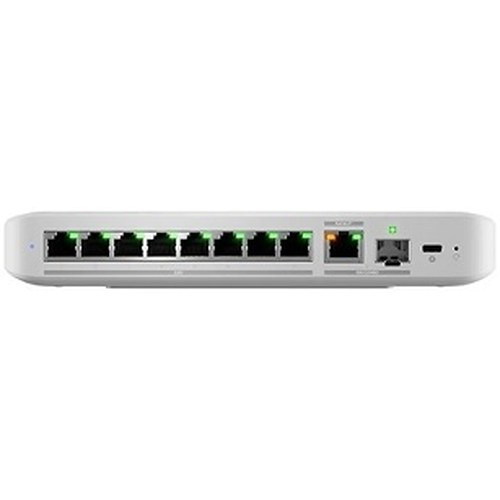
Both the TP-Link TL-SG108-M2 and the Ubiquiti USW-FLEX-2.5G-8 are 8-port 2.5GbE desktop switches targeting the same access-layer upgrade market — replacing legacy gigabit hardware where NVRs, Wi-Fi 6 APs, or high-throughput edge devices demand more than 1 Gbps per port. The key differences lie in uplink architecture, management capability, operating environment, and ecosystem affiliation. This comparison covers switching performance and port density, power input and environmental ratings, and management and integration to help installers and IT buyers match the right unit to their deployment.
In This Guide
- Which switch delivers more switching capacity and uplink flexibility for high-density 2.5GbE deployments?
- How do the two switches differ in power input options and operating temperature range?
- Which switch offers better management, VLAN support, and ecosystem integration for ongoing network administration?
- Which should you choose: the SG108-M2 or the USW-FLEX-2.5G-8?
- Side-by-Side Specs
- FAQ
Which switch delivers more switching capacity and uplink flexibility for high-density 2.5GbE deployments?
The TL-SG108-M2 provides 8 × 2.5GbE access ports with a stated switching capacity of 40 Gbps and a packet forwarding rate of 29.8 Mpps. There is no dedicated uplink port beyond the eight access ports, meaning all upstream bandwidth must share the same 2.5GbE port pool.
The USW-FLEX-2.5G-8 also delivers 8 × 2.5GbE access ports but adds a ninth hybrid 10G port (RJ45/SFP+) as a dedicated uplink, yielding a switching capacity of 60 Gbps and a forwarding rate of 45 Mpps — 50% more capacity and roughly 51% higher forwarding throughput than the TP-Link unit. The 10G hybrid uplink allows connection to either a copper 10GBASE-T backbone or a fiber SFP+ run without an additional transceiver adapter, a meaningful flexibility advantage in mixed-media infrastructure.
For deployments where the eight access ports will be simultaneously active at or near 2.5 Gbps — dense camera clusters, multi-AP wireless backhaul, or NVR aggregation — the Ubiquiti's higher switching headroom and dedicated 10G uplink reduce the risk of internal fabric congestion.
How do the two switches differ in power input options and operating temperature range?
The TL-SG108-M2 is powered by an external 12 V DC adapter (either 1 A or 1.5 A, per the spec listing). It does not support PoE power input; a wall outlet and the included adapter are required. The operating temperature range is 0 °C to 40 °C, limiting deployment to climate-controlled indoor environments.
The USW-FLEX-2.5G-8 accepts power via USB Type-C (5 V/3 A) or via PoE+ (802.3at) input, and an external 15 W AC/DC adapter is also listed. The PoE-in option allows the switch to be powered from an upstream PoE-capable switch or injector with no separate power run — a significant advantage for low-voltage installers who want to avoid AC outlet placement. Its operating range of −20 °C to 45 °C is substantially wider than the TP-Link's 0–40 °C window, making it suitable for unheated enclosures, outdoor-rated cabinets, or cold-storage environments where the TP-Link is not rated to operate.
For installations in conditioned server rooms or under-desk deployments with guaranteed AC access, the TP-Link's adapter-only power is straightforward. For flexible mounting locations — DIN-rail panels, exterior-rated enclosures, or any site where running AC power is costly — the Ubiquiti's PoE-in and broader thermal range are concrete operational advantages.
Which switch offers better management, VLAN support, and ecosystem integration for ongoing network administration?
The TL-SG108-M2 is an unmanaged switch. The specs provide no evidence of VLAN support, QoS configuration, remote monitoring, or software integration. Setup is plug-and-play with zero configuration overhead, which is appropriate for isolated edge segments where traffic policy is unnecessary.
The USW-FLEX-2.5G-8 supports 256 VLANs with QoS and is designed for integration into the Ubiquiti UniFi ecosystem (managed via the UniFi Network application). While the spec field labels management as 'Ethernet' rather than specifying a cloud-key or controller requirement, the product's UniFi lineage means it is intended to operate under the UniFi controller for full feature access, including VLAN tagging, traffic policies, port-level statistics, and firmware management.
For a flat, single-segment access layer with no policy requirements, the TP-Link's unmanaged simplicity is a feature, not a limitation. For any deployment requiring VLAN segmentation — isolating camera traffic from corporate LAN, segregating IoT devices, or enforcing QoS for voice or video — the Ubiquiti's 256-VLAN support and managed feature set are necessary capabilities the TP-Link cannot provide. Buyers already operating a UniFi infrastructure will gain native dashboard visibility; those without a UniFi controller will need to factor in that dependency.
Which should you choose: the SG108-M2 or the USW-FLEX-2.5G-8?
Our take: The USW-FLEX-2.5G-8 is the stronger choice when the deployment demands a dedicated 10G uplink, PoE-powered installation, wide operating temperature range, or VLAN/QoS management within a UniFi environment. Concretely: its switching capacity is 60 Gbps vs the TP-Link's 40 Gbps, its forwarding rate is 45 Mpps vs 29.8 Mpps, and its operating range of −20 °C to 45 °C substantially exceeds the TP-Link's 0 °C to 40 °C floor. The TL-SG108-M2 is the appropriate selection for budget-sensitive, unmanaged flat-network edge segments in climate-controlled spaces where a simple AC-powered plug-and-play unit suffices and no upstream UniFi controller is present — its lower component count and adapter-only power model reduce deployment complexity for straightforward use cases.
Side-by-Side Comparison
Spec-for-spec, from manufacturer data.
| Specification | TP-Link SG108-M2 | Ubiquiti USW-FLEX-2.5G-8 |
|---|---|---|
| Product Type | Unmanaged Desktop Switch | Managed Compact Switch |
| Access Ports | 8 × 2.5GbE | 8 × 2.5GbE |
| Uplink Port | — | 1 × 10G hybrid (RJ45/SFP+) |
| Switching Capacity | 40 Gbps | 60 Gbps |
| Forwarding Rate | 29.8 Mpps | 45 Mpps |
| Non-Blocking Throughput | — | 30 Gbps |
| VLAN Support | — | 256 VLANs with QoS |
| Management | None (unmanaged) | UniFi (Ethernet-managed) |
| Power Input | 12 V DC adapter (1 A or 1.5 A) | USB-C 5V/3A, PoE+ input, or 15W AC/DC adapter |
| Max Power Consumption | — | 14 W |
| Operating Temp | 0 °C to 40 °C | −20 °C to 45 °C |
| Storage Temp | −40 °C to 70 °C | — |
| Dimensions (mm) | 226 × 131 × 35 | 212.9 × 76 × 33.5 |
| Weight | — | 395 g (0.87 lb) |
| Mount Options | Wall | Desktop, wall, DIN-rail, magnetic |
| NDAA Compliant | — | Yes |
Frequently Asked Questions
Which should you choose: the SG108-M2 or the USW-FLEX-2.5G-8?
The USW-FLEX-2.5G-8 is the stronger choice when the deployment demands a dedicated 10G uplink, PoE-powered installation, wide operating temperature range, or VLAN/QoS management within a UniFi environment. Concretely: its switching capacity is 60 Gbps vs the TP-Link's 40 Gbps, its forwarding rate is 45 Mpps vs 29.8 Mpps, and its operating range of −20 °C to 45 °C substantially exceeds the TP-Link's 0 °C to 40 °C floor. The TL-SG108-M2 is the appropriate selection for budget-sensitive, unmanaged flat-network edge segments in climate-controlled spaces where a simple AC-powered plug-and-play unit suffices and no upstream UniFi controller is present — its lower component count and adapter-only power model reduce deployment complexity for straightforward use cases.
Can I power the USW-FLEX-2.5G-8 from an existing PoE switch instead of running a new AC outlet?
Yes. The USW-FLEX-2.5G-8 spec lists PoE+ (802.3at) as a valid power input alongside USB-C (5 V/3 A) and an external AC/DC adapter. No equivalent PoE-in capability is specified for the TL-SG108-M2, which requires its 12 V DC wall adapter.
Is the TL-SG108-M2 or USW-FLEX-2.5G-8 better suited for a camera-dense NVR aggregation closet that also needs VLAN isolation?
The USW-FLEX-2.5G-8 is the appropriate choice in that scenario. It supports 256 VLANs with QoS and provides a dedicated 10G hybrid uplink (RJ45/SFP+) to the core switch, keeping camera traffic off the access ports. The TL-SG108-M2 is unmanaged with no VLAN support specified, making traffic isolation impossible without external hardware.
Which switch can be installed in an unheated equipment cabinet that may drop below freezing in winter?
Only the USW-FLEX-2.5G-8 is rated for sub-zero conditions: its specified operating range is −20 °C to 45 °C. The TL-SG108-M2's operating range starts at 0 °C, so it is not specified for use in environments that may fall below freezing.
More Network Switch Comparisons
- TP-Link SG2210XMP-M2 vs Ubiquiti USW-FLEX-2.5G-8
- TP-Link SG2210XMP-M2 vs Comnet CNGE8MS
- TP-Link SG2210XMP-M2 vs Lantronix S2220-1014-NA
- TP-Link SG2210XMP-M2 vs TP-Link S4500-8GP
- TP-Link SG2210XMP-M2 vs TP-Link SG2008P
- TP-Link S4500-8GP vs Ubiquiti USW-FLEX-2.5G-8
Network Switch Buying Guides
Get a Second Opinion on Your Camera Choice
Share your site layout, coverage goals, and budget. Our team will validate the camera selection, flag anything we would change, and recommend products that match the use case.