
TP-Link SG108-M2 vs Lantronix S2220-1014-NA: Specification Comparison
This comparison examines two 8-port Ethernet access switches suited for security infrastructure deployments — the TP-Link TL-SG108-M2, an unmanaged 2.5G multi-gigabit desktop switch, and the Lantronix S2220-1014-NA, a Layer 2 managed Gigabit switch with fiber uplink capability. Both offer 8 copper RJ45 ports and target edge-of-network roles such as IP camera aggregation and access-layer connectivity. The key trade-offs center on port speed, management depth, and connectivity flexibility.
In This Guide
- How do port speed and throughput capacity compare between these two switches?
- Which switch offers greater management, VLAN, and network control capabilities?
- How do connectivity options, physical build, and operating environment differ?
- Which should you choose: the SG108-M2 or the S2220-1014-NA?
- Side-by-Side Specs
- FAQ
How do port speed and throughput capacity compare between these two switches?
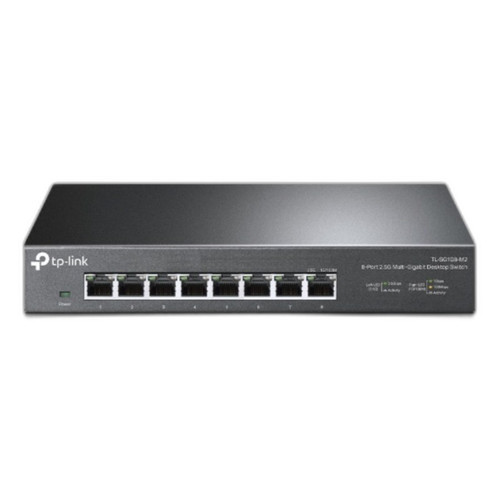
The TP-Link TL-SG108-M2 delivers 2.5G multi-gigabit speeds across all 8 RJ45 ports, with a switching capacity of 40 Gbps and a packet forwarding rate of 29.8 Mpps. This throughput headroom is substantial for an 8-port unmanaged switch and supports high-bandwidth IP cameras or workstations equipped with 2.5GBASE-T NICs.
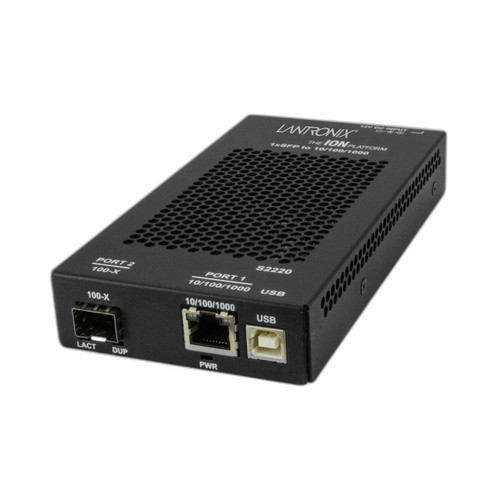
The Lantronix S2220-1014-NA operates at standard Gigabit (10/100/1000BASE-T) across its 8 copper ports, with a maximum per-port speed of 1 Gbps. No switching capacity figure or packet forwarding rate is provided in the available specifications for the S2220-1014-NA. Buyers requiring throughput beyond 1 Gbps per device will find the TL-SG108-M2 significantly more capable at the port level, while the S2220-1014-NA is adequate for standard 1G IP cameras and access points.
Which switch offers greater management, VLAN, and network control capabilities?
The Lantronix S2220-1014-NA is a Layer 2 managed switch supporting VLAN segmentation, traffic prioritization (QoS), and remote monitoring. These features allow network administrators to isolate camera traffic onto dedicated VLANs, apply bandwidth policies, and monitor port status remotely — capabilities that are standard requirements in enterprise and mid-market physical security installations.
The TP-Link TL-SG108-M2 is explicitly unmanaged. It provides no VLAN support, no QoS configuration, no remote monitoring, and no CLI or web interface. It performs plug-and-play switching only. Installers who need to segment traffic between cameras, access control panels, and a corporate LAN will find the TL-SG108-M2 insufficient for those requirements without an upstream managed switch handling the segmentation.
How do connectivity options, physical build, and operating environment differ?
The TP-Link TL-SG108-M2 uses 8 RJ45 copper ports only. It is a desktop/wall-mount form factor measuring 226 × 131 × 35 mm, powered by a 12 V/1 A or 12 V/1.5 A external adapter. Operating temperature is rated 0 °C to 40 °C (32 °F to 104 °F), and storage temperature extends from -40 °C to 70 °C. The spec sheet lists PoE as a feature, though no PoE budget or standard (802.3af/at/bt) is specified.
The Lantronix S2220-1014-NA combines 8 RJ45 copper ports with a 100BASE-LX10 single-mode fiber uplink via SC connector, supporting distances up to 10 km. This fiber uplink is a meaningful differentiator for connecting to an upstream fiber backbone or a distant distribution switch without a separate media converter. Physical dimensions, power supply type, operating temperature, and PoE capability are not listed in the available specifications for the S2220-1014-NA. A 2-year warranty is included.
Which should you choose: the SG108-M2 or the S2220-1014-NA?
Our take: The S2220-1014-NA is the stronger choice when the deployment requires network segmentation, remote monitoring, or a fiber uplink to a backbone switch — its Layer 2 management with VLAN and QoS support, combined with a 100BASE-LX10 single-mode SC fiber port rated to 10 km, addresses enterprise physical-security requirements that an unmanaged switch cannot meet. The TL-SG108-M2 is the stronger choice when raw throughput is the priority: its 2.5G multi-gigabit ports and 40 Gbps switching capacity versus the S2220-1014-NA's 1 Gbps per-port maximum represent a 2.5× speed advantage per port. Three concrete spec deltas: (1) port speed 2.5 Gbps vs. 1 Gbps, (2) switching capacity 40 Gbps vs. not disclosed, (3) management depth — none vs. Layer 2 with VLAN, QoS, and remote monitoring. For small unmanaged deployments with high-bandwidth cameras or NVRs on a flat network, the TL-SG108-M2 is the appropriate platform; for segmented, remotely monitored, or fiber-connected installations, the S2220-1014-NA is the correct tool.
Side-by-Side Comparison
Spec-for-spec, from manufacturer data.
| Specification | TP-Link SG108-M2 | Lantronix S2220-1014-NA |
|---|---|---|
| Brand | TP-Link | Lantronix |
| MPN | TL-SG108-M2 | S2220-1014-NA |
| Device Type | Unmanaged Desktop Switch | Layer 2 Managed Switch |
| Copper Ports | 8 x RJ45 | 8 x RJ45 (10/100/1000BASE-T) |
| Port Speed | 2.5G Multi-Gigabit | 1G (10/100/1000BASE-T) |
| Switching Capacity | 40 Gbps | — |
| Packet Forwarding Rate | 29.8 Mpps | — |
| Management | None (unmanaged) | Layer 2 managed |
| VLAN Support | — | Yes |
| QoS / Traffic Prioritization | — | Yes |
| Remote Monitoring | — | Yes |
| Fiber Uplink | — | 100BASE-LX10 single-mode, SC, 10 km |
| PoE | Listed (budget/standard not specified) | — |
| Power Supply | 12 V/1 A or 12 V/1.5 A adapter | — |
| Dimensions | 226 x 131 x 35 mm | — |
| Operating Temperature | 0 °C to 40 °C (32 °F to 104 °F) | — |
| Warranty | — | 2 years |
Frequently Asked Questions
Which should you choose: the SG108-M2 or the S2220-1014-NA?
The S2220-1014-NA is the stronger choice when the deployment requires network segmentation, remote monitoring, or a fiber uplink to a backbone switch — its Layer 2 management with VLAN and QoS support, combined with a 100BASE-LX10 single-mode SC fiber port rated to 10 km, addresses enterprise physical-security requirements that an unmanaged switch cannot meet. The TL-SG108-M2 is the stronger choice when raw throughput is the priority: its 2.5G multi-gigabit ports and 40 Gbps switching capacity versus the S2220-1014-NA's 1 Gbps per-port maximum represent a 2.5× speed advantage per port. Three concrete spec deltas: (1) port speed 2.5 Gbps vs. 1 Gbps, (2) switching capacity 40 Gbps vs. not disclosed, (3) management depth — none vs. Layer 2 with VLAN, QoS, and remote monitoring. For small unmanaged deployments with high-bandwidth cameras or NVRs on a flat network, the TL-SG108-M2 is the appropriate platform; for segmented, remotely monitored, or fiber-connected installations, the S2220-1014-NA is the correct tool.
Does either switch support PoE to power IP cameras directly?
The TL-SG108-M2 lists PoE in its specification, but no PoE budget, wattage per port, or PoE standard (802.3af/at/bt) is provided in the available data — buyers should verify the PoE specification with TP-Link before assuming camera-powering capability. The S2220-1014-NA has no PoE specification listed in the available data and should be treated as non-PoE unless confirmed otherwise by Lantronix.
Can either switch segment camera traffic onto a separate VLAN from the corporate network?
Only the Lantronix S2220-1014-NA supports VLAN configuration, as it is a Layer 2 managed switch with documented VLAN support. The TP-Link TL-SG108-M2 is unmanaged and has no VLAN capability in any form. For VLAN segmentation of camera traffic, the S2220-1014-NA is the only viable option between these two.
Which switch is better for connecting to a fiber backbone across a large building or campus?
The Lantronix S2220-1014-NA includes a 100BASE-LX10 single-mode fiber uplink via SC connector rated for distances up to 10 km, making it directly suitable for fiber backbone connections without a separate media converter. The TP-Link TL-SG108-M2 has no fiber port and is copper-only; connecting it to a fiber backbone would require an external media converter or an SFP-capable uplink switch.
More Network Switch Comparisons
- TP-Link SG2210XMP-M2 vs Ubiquiti USW-FLEX-2.5G-8
- TP-Link SG2210XMP-M2 vs Comnet CNGE8MS
- TP-Link SG2210XMP-M2 vs Lantronix S2220-1014-NA
- TP-Link SG2210XMP-M2 vs TP-Link S4500-8GP
- TP-Link SG2210XMP-M2 vs TP-Link SG2008P
- TP-Link S4500-8GP vs Ubiquiti USW-FLEX-2.5G-8
Network Switch Buying Guides
Get a Second Opinion on Your Camera Choice
Share your site layout, coverage goals, and budget. Our team will validate the camera selection, flag anything we would change, and recommend products that match the use case.