
TP-Link SG108-M2 vs Comnet CNGE8MS: Specification Comparison
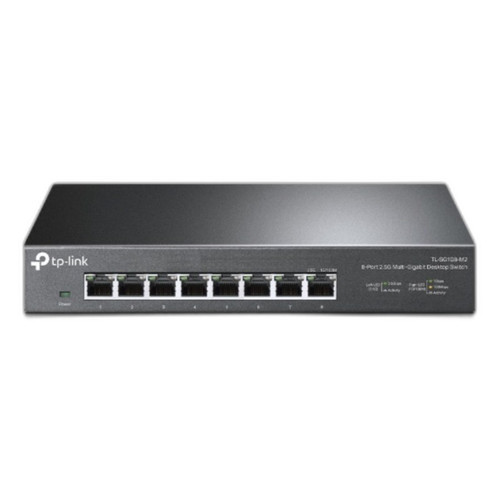
Both the TP-Link TL-SG108-M2 and the Comnet CNGE8MS are 8-port Ethernet switches, but they target meaningfully different deployment tiers: one is an unmanaged desktop device for office or edge use, the other a managed, hardened industrial unit for DIN-rail installation in harsh environments. Despite sharing an 8-port count, buyers cross-shopping these are evaluating very different capability and environmental profiles — speed tier, manageability, and ruggedness are all divergent. This comparison presents the spec-derived facts on each axis so integrators and IT buyers can align the right unit to their actual site requirements.
In This Guide
- Which switch delivers more bandwidth and throughput per port?
- Which unit is built to withstand demanding physical and electrical environments?
- Which switch offers the network management and protocol support needed for a managed infrastructure?
- Which should you choose: the SG108-M2 or the CNGE8MS?
- Side-by-Side Specs
- FAQ
Which switch delivers more bandwidth and throughput per port?
The TL-SG108-M2 provides 8 × 2.5 Gbps RJ-45 ports, yielding a switching capacity of 40 Gbps and a packet-forwarding rate of 29.8 Mpps. Every port runs at 2.5G Multi-Gigabit, giving 2.5× the per-port throughput of a standard gigabit switch — a direct advantage for bandwidth-intensive edge workloads such as NVR uplinks, high-density Wi-Fi 6 backhaul, or warehouse automation endpoints.
The CNGE8MS tops out at 1000 Mbps (1G) per port across all 8 ports, with a switching bandwidth of 16 Gbps and a switching latency of 7 µs. Four ports are RJ-45 copper and four are SFP combo slots, enabling fiber uplinks — a capability absent from the TP-Link. On raw per-port speed and aggregate switching capacity the TL-SG108-M2 (40 Gbps) leads the CNGE8MS (16 Gbps) by 2.5×, though the CNGE8MS's fiber combo ports address reach and isolation requirements the TP-Link cannot.
Which unit is built to withstand demanding physical and electrical environments?
The TL-SG108-M2 is a desktop-form-factor switch rated for 0 °C to 40 °C operating temperature, powered by a 12 V/1 A or 12 V/1.5 A external AC adapter. It is wall-mountable but is fundamentally a commercial-grade indoor unit with no stated humidity hardening, no redundant power input, and a supply-voltage tolerance matched to a standard power brick.
The CNGE8MS is explicitly hardened: it operates from -40 °C to +75 °C — a 115 °C wider operating window — and stores to +85 °C. It accepts dual DC inputs from 12 to 48 VDC, providing both voltage-range flexibility and redundant-power capability critical for industrial and surveillance infrastructure. Power consumption is 25 W typical with the supply included. The unit mounts on DIN-rail or wall and weighs under 3 lbs. The operating-temperature delta alone (-40 °C vs 0 °C lower bound) disqualifies the TP-Link for outdoor enclosures, transit hubs, factory floors, or any unheated space.
Which switch offers the network management and protocol support needed for a managed infrastructure?
The TL-SG108-M2 is unmanaged — it is plug-and-play with no configuration interface, no VLAN support, no QoS controls, no SNMP, and no redundancy protocols. This makes deployment trivially simple but removes it from any managed-network architecture that requires traffic segmentation, loop protection, or remote monitoring.
The CNGE8MS is a fully managed switch supporting 4096 VLANs (802.1Q), 802.1p QoS, 802.1x port-based authentication, 802.1AB (LLDP), LACP (802.3ad), and an 8,192-entry MAC table. Critically for physical-security rings, it supports C-Ring, Legacy Ring, and C-RSTP redundancy protocols, enabling sub-50 ms failover in ring topologies — a standard requirement in hardened surveillance and industrial control networks. No equivalent management or redundancy capability is specified for the TP-Link.
Which should you choose: the SG108-M2 or the CNGE8MS?
Our take: The CNGE8MS is the stronger choice when the deployment demands managed network control, industrial-temperature hardening, or fiber uplink capability. The three decisive spec deltas: (1) operating temperature range -40 °C to +75 °C vs 0 °C to 40 °C — the Comnet survives environments that would immediately exceed the TP-Link's rated limits; (2) managed vs unmanaged — the CNGE8MS supports 4,096 VLANs, 802.1x authentication, LACP, and C-Ring/C-RSTP redundancy that the TL-SG108-M2 entirely lacks; (3) fiber uplinks — four SFP combo ports on the CNGE8MS vs copper-only on the TP-Link. Conversely, the TL-SG108-M2 wins on per-port speed (2.5G vs 1G) and aggregate throughput (40 Gbps vs 16 Gbps) for indoor, climate-controlled edge deployments where raw bandwidth to endpoints matters more than manageability. Choose the TL-SG108-M2 for unmanaged, high-throughput desktop edge use; choose the CNGE8MS for any hardened, managed, or ring-topology physical-security or industrial network.
Side-by-Side Comparison
Spec-for-spec, from manufacturer data.
| Specification | TP-Link SG108-M2 | Comnet CNGE8MS |
|---|---|---|
| Port Count | 8 | 8 |
| Port Types | 8 × RJ-45 | 4 × RJ-45, 4 × SFP Combo |
| Max Port Speed | 2.5 Gbps | 1 Gbps |
| Switching Capacity | 40 Gbps | 16 Gbps |
| Packet Forwarding Rate | 29.8 Mpps | — |
| Switching Latency | — | 7 µs |
| Managed | No (unmanaged) | Yes |
| VLAN Support | — | 4096 (802.1Q) |
| MAC Table Size | — | 8,192 entries |
| Ring Redundancy Protocols | — | C-Ring, Legacy Ring, C-RSTP |
| Operating Temperature | 0 °C to 40 °C | -40 °C to +75 °C |
| Storage Temperature | -40 °C to 70 °C | -40 °C to +85 °C |
| Power Input | 12 V DC adapter (1 A or 1.5 A) | Dual DC 12–48 VDC |
| Power Consumption | — | 25 W typical |
| Mounting | Wall (desktop form factor) | DIN-Rail or Wall |
| Warranty | — | Lifetime |
Frequently Asked Questions
Which should you choose: the SG108-M2 or the CNGE8MS?
The CNGE8MS is the stronger choice when the deployment demands managed network control, industrial-temperature hardening, or fiber uplink capability. The three decisive spec deltas: (1) operating temperature range -40 °C to +75 °C vs 0 °C to 40 °C — the Comnet survives environments that would immediately exceed the TP-Link's rated limits; (2) managed vs unmanaged — the CNGE8MS supports 4,096 VLANs, 802.1x authentication, LACP, and C-Ring/C-RSTP redundancy that the TL-SG108-M2 entirely lacks; (3) fiber uplinks — four SFP combo ports on the CNGE8MS vs copper-only on the TP-Link. Conversely, the TL-SG108-M2 wins on per-port speed (2.5G vs 1G) and aggregate throughput (40 Gbps vs 16 Gbps) for indoor, climate-controlled edge deployments where raw bandwidth to endpoints matters more than manageability. Choose the TL-SG108-M2 for unmanaged, high-throughput desktop edge use; choose the CNGE8MS for any hardened, managed, or ring-topology physical-security or industrial network.
Can I use either switch in an outdoor enclosure or unheated cabinet?
Only the CNGE8MS is rated for that environment. Its operating temperature range of -40 °C to +75 °C covers outdoor enclosures and unheated spaces. The TL-SG108-M2 is rated only to 0 °C at the low end, making it unsuitable for installations where ambient temperatures may drop below freezing.
Which switch should I use if I need VLANs to segment camera traffic from corporate LAN?
The CNGE8MS supports up to 4,096 IEEE 802.1Q VLANs and includes 802.1p QoS prioritization. The TL-SG108-M2 is unmanaged and provides no VLAN or QoS capability. For any traffic-segmentation requirement, only the CNGE8MS qualifies.
If I need to connect a switch to a fiber backbone, which unit supports that?
The CNGE8MS has four RJ-45/SFP combo ports that accept SFP fiber transceivers, enabling fiber uplinks to a backbone or long-distance runs. The TL-SG108-M2 provides eight RJ-45 copper ports only — no fiber interface is specified — so it cannot connect natively to a fiber backbone without an external media converter.
More Network Switch Comparisons
- TP-Link SG2210XMP-M2 vs Ubiquiti USW-FLEX-2.5G-8
- TP-Link SG2210XMP-M2 vs Comnet CNGE8MS
- TP-Link SG2210XMP-M2 vs Lantronix S2220-1014-NA
- TP-Link SG2210XMP-M2 vs TP-Link S4500-8GP
- TP-Link SG2210XMP-M2 vs TP-Link SG2008P
- TP-Link S4500-8GP vs Ubiquiti USW-FLEX-2.5G-8
Network Switch Buying Guides
Get a Second Opinion on Your Camera Choice
Share your site layout, coverage goals, and budget. Our team will validate the camera selection, flag anything we would change, and recommend products that match the use case.