
TP-Link SG1005P vs Axis T8504-E: Specification Comparison
Both the TP-Link TL-SG1005P and the Axis T8504-E are 5-port-class Gigabit PoE switches with 4 PoE-capable data ports and 10 Gbps switching capacity, placing them in the same general product family. However, they diverge sharply on management capability, operating environment, PoE budget, and intended deployment context — making a direct spec-by-spec comparison highly relevant for installers choosing between a cost-sensitive indoor edge switch and a ruggedized outdoor managed switch for surveillance infrastructure.

In This Guide
- How do the port counts, PoE power delivery, and throughput compare?
- Which switch is built for harsher operating environments and more demanding power conditions?
- What management, security, and platform-integration capabilities does each switch provide?
- Which should you choose: the SG1005P or the T8504-E?
- Side-by-Side Specs
- FAQ
How do the port counts, PoE power delivery, and throughput compare?
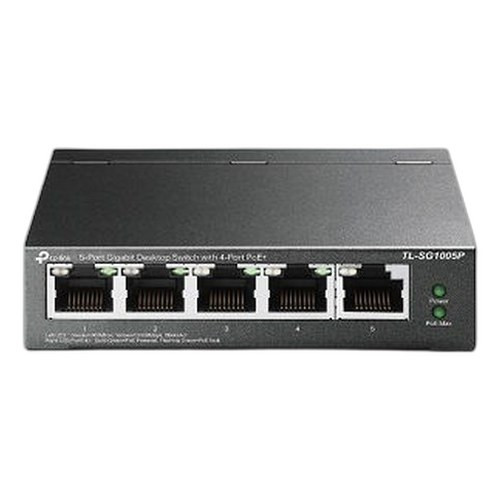
Both switches provide 4 PoE-capable RJ45 Gigabit ports plus one uplink, reaching 10 Gbps switching capacity. The TP-Link TL-SG1005P uses its fifth port as a standard Gigabit copper uplink, delivering PoE on ports 1–4 under IEEE 802.3af (PoE, up to 15.4 W per port) with a 65 W total PoE budget. The Axis T8504-E steps up to IEEE 802.3at Type 2 Class 4 (PoE+), allocating 60 W each to ports 1–2 and 30 W each to ports 3–4, for a 150 W stated total PoE budget across the four PoE ports.
The T8504-E's fifth port is an SFP fiber uplink rather than copper, enabling fiber backhaul to a head-end switch — a critical capability for distributed outdoor camera networks where copper runs exceed 100 m. The TL-SG1005P's fifth port is copper-only, limiting backhaul to in-building distances. Throughput is specified at 7.44 Mpps on the T8504-E; no equivalent Mpps figure is provided for the TL-SG1005P. Both share the same 10 Gbps switching fabric. The TL-SG1005P does list an Extend mode (10 Mbps, 250 m PoE range) not present in the T8504-E specs.
Which switch is built for harsher operating environments and more demanding power conditions?
The Axis T8504-E is purpose-built for outdoor deployment: its aluminum casing carries a NEMA 4X / Type 4X rating and an operating temperature range of −40 °C to 60 °C (spec sheet) or −40 °C to 50 °C (card spec — the more conservative figure should be treated as the installation ceiling until the datasheet is consulted). It draws from 100–240 V AC mains input and integrates 6 kV surge protection on all four network ports and all AC input lines — a stated spec, not a marketing claim. Weight is 2.9 kg in an aluminum enclosure rated for pole mounting.
The TP-Link TL-SG1005P is a desktop-form-factor device rated for 0 °C to 40 °C operation, housed in an unspecified material (no ingress or NEMA rating appears in the provided specs). It is powered by an external DC power adapter. No surge protection specification is stated in the provided data. Dimensions are 99.8 × 98 × 25 mm at roughly 0.3 kg (weight not explicitly stated). Storage temperature for the TL-SG1005P shows conflicting values in the provided specs (−30 °C to 70 °C and −40 °C to 70 °C appear in different fields); buyers should verify against the datasheet.
What management, security, and platform-integration capabilities does each switch provide?
The Axis T8504-E is a fully managed switch. Specified management features include VLAN, SNMP (v1/v2c/v3 per the card spec), RADIUS/TACACS authentication, HTTPS encryption, SSH, password protection, and native integration with AXIS Device Manager — Axis's unified device management platform used across cameras, recorders, and network accessories. Supported network protocols include IPv4, IPv6, HTTP, HTTPS, SSH, SNMP, DNS, TCP, and UDP. MAC address table depth is 8,000 entries; jumbo frames are supported up to 10 KB. The T8504-E carries a 5-year stated warranty and lists FCC, ICES, VCCI, RCM, EAC, UL/IEC 60950-1, and IEC 62368-1 approvals.
The TP-Link TL-SG1005P is explicitly unmanaged — no VLAN, no SNMP, no authentication, no management software, and no remote access capability appear in the provided specifications. It is plug-and-play with zero configuration overhead by design. No regulatory approval certifications are listed in the provided spec data, and no software platform integration is described. Warranty terms are not stated in the provided specifications.
Which should you choose: the SG1005P or the T8504-E?
Our take: The TL-SG1005P is the stronger choice when the deployment is indoor, budget-constrained, and requires only plug-and-play PoE for a small number of standard PoE devices — its 65 W budget and zero-configuration operation suit a desktop or closet install with no infrastructure complexity. The T8504-E is the correct specification for any outdoor or harsh-environment installation: its operating range of −40 °C to 60 °C versus the TL-SG1005P's 0 °C to 40 °C, its 6 kV surge protection (not specified on the TP-Link), and its 150 W asymmetric PoE+ budget (vs. 65 W) enable it to simultaneously power two high-draw PTZ cameras on ports 1–2 alone. The SFP fiber uplink on the T8504-E further differentiates it for distributed campus or perimeter networks. Buyers standardizing on AXIS Device Manager will find the T8504-E natively integrated; the TL-SG1005P offers no equivalent management hook.
Side-by-Side Comparison
Spec-for-spec, from manufacturer data.
| Specification | TP-Link SG1005P | Axis T8504-E |
|---|---|---|
| Product Type | Unmanaged desktop Gigabit PoE switch | Managed outdoor Gigabit PoE+ switch |
| PoE Ports | 4x RJ45 (PoE) | 4x RJ45 (PoE+) |
| Uplink Port | 1x Gigabit copper (RJ45) | 1x SFP fiber |
| Total Ports | 5 | 5 (4x RJ45 + 1x SFP) |
| PoE Standard | IEEE 802.3af | IEEE 802.3at Type 2 Class 4 |
| Total PoE Budget | 65 W | 150 W |
| Per-Port PoE Power | Not individually specified | Ports 1–2: 60 W; Ports 3–4: 30 W |
| Switching Capacity | 10 Gbps | 10 Gbps |
| Throughput (Mpps) | — | 7.44 Mpps |
| MAC Table | — | 8,000 entries |
| Management | Unmanaged | Managed (VLAN, SNMP, SSH, HTTPS, RADIUS/TACACS) |
| Management Software | — | AXIS Device Manager |
| Surge Protection | — | 6 kV (all network ports and AC input) |
| Operating Temperature | 0 °C to 40 °C | −40 °C to 60 °C |
| Environment Rating | Indoor / desktop | Outdoor, NEMA 4X |
| Warranty | — | 5 years |
| Enclosure | — | Aluminum, white, pole-mountable |
| Approvals | — | FCC, ICES, VCCI, RCM, EAC, UL/IEC 60950-1, IEC 62368-1 |
Frequently Asked Questions
Which should you choose: the SG1005P or the T8504-E?
The TL-SG1005P is the stronger choice when the deployment is indoor, budget-constrained, and requires only plug-and-play PoE for a small number of standard PoE devices — its 65 W budget and zero-configuration operation suit a desktop or closet install with no infrastructure complexity. The T8504-E is the correct specification for any outdoor or harsh-environment installation: its operating range of −40 °C to 60 °C versus the TL-SG1005P's 0 °C to 40 °C, its 6 kV surge protection (not specified on the TP-Link), and its 150 W asymmetric PoE+ budget (vs. 65 W) enable it to simultaneously power two high-draw PTZ cameras on ports 1–2 alone. The SFP fiber uplink on the T8504-E further differentiates it for distributed campus or perimeter networks. Buyers standardizing on AXIS Device Manager will find the T8504-E natively integrated; the TL-SG1005P offers no equivalent management hook.
Can the TL-SG1005P power PTZ cameras or high-wattage PoE+ devices?
The TL-SG1005P is specified with IEEE 802.3af (PoE, up to 15.4 W per port) and a 65 W total budget. Many PTZ cameras and high-draw PoE+ devices require IEEE 802.3at (PoE+, up to 30 W per port). The provided specs do not confirm 802.3at per-port support on the TL-SG1005P. The Axis T8504-E is explicitly rated IEEE 802.3at Type 2 Class 4, with ports 1–2 delivering 60 W each — verify your camera's power class against each switch's per-port spec before selecting.
Is the TL-SG1005P or T8504-E better for an outdoor surveillance installation?
Based on the provided specifications, the T8504-E is the only option suited to outdoor installation. It carries a NEMA 4X rating, operates from −40 °C to 60 °C, and provides 6 kV surge protection on all ports and AC lines. The TL-SG1005P is rated for 0 °C to 40 °C with no stated ingress protection or surge protection rating, making it unsuitable for unprotected outdoor use per the specifications provided.
Does either switch support VLANs or remote management for a multi-camera network?
Only the Axis T8504-E supports VLANs, SNMP, HTTPS/SSH remote access, RADIUS/TACACS authentication, and integration with AXIS Device Manager. The TL-SG1005P is an unmanaged switch: no VLANs, no SNMP, and no remote management capability are present in its specifications. For any deployment requiring network segmentation, centralized monitoring, or security policy enforcement, the T8504-E is the specified choice.
More Network Switch Comparisons
- Vivotek GET-083A-120 vs TP-Link SG1005P
- Vivotek GET-083A-120 vs Axis T8504-E
- Vivotek GET-083A-120 vs Axis D8004
- Vivotek GET-083A-120 vs Ubiquiti N-SW
- TP-Link SG1005P vs Axis D8004
- TP-Link SG1005P vs Ubiquiti N-SW
Network Switch Buying Guides
Get a Second Opinion on Your Camera Choice
Share your site layout, coverage goals, and budget. Our team will validate the camera selection, flag anything we would change, and recommend products that match the use case.