
TP-Link SG1005P vs Ubiquiti N-SW: Specification Comparison
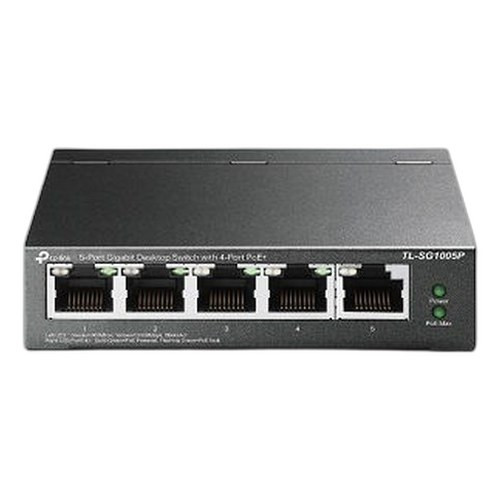
Both the TP-Link TL-SG1005P and the Ubiquiti N-SW are unmanaged Gigabit PoE switches aimed at small edge deployments, making them a legitimate cross-shop for installers powering a handful of cameras or wireless radios. The TP-Link is a 5-port indoor desktop unit with four PoE+ output ports and a self-contained 65 W budget. The Ubiquiti is a 4-port outdoor-rated unit that accepts a single passive 24 V PoE input and passes power through to three downstream devices at up to 24 W total. The comparison centers on port count, PoE standard and budget, and environmental suitability.

In This Guide
- How do port count, PoE standard, and total power budget compare?
- Which switch is built for the installation environment — indoor desktop or outdoor field deployment?
- How do switching throughput, management capability, and device compatibility stack up?
- Which should you choose: the SG1005P or the N-SW?
- Side-by-Side Specs
- FAQ
How do port count, PoE standard, and total power budget compare?
The TL-SG1005P provides five Gigabit ports, four of which are PoE+ output ports rated to IEEE 802.3af/at, backed by a 65 W total PoE budget and a per-port maximum of 30 W. This means the switch can simultaneously power four 802.3af/at devices — IP cameras, access points, or intercoms — without an external PoE injector.
The N-SW provides four Gigabit ports: one PoE input (passive 24 V, 2-pair, sourced from an external injector such as the POE-24-30W-G-W, not included) and three PoE passthrough output ports. Total passthrough power is 24 W across those three ports, capped at approximately 1 A per port (~24 V × 1 A = 24 W shared). The N-SW does not support IEEE 802.3af/at; it uses Ubiquiti passive 24 V PoE, which is incompatible with 802.3af/at endpoints without an adapter.
For raw powered-port capacity, the TL-SG1005P leads: four 802.3af/at ports at 65 W total versus three passive-24 V ports at 24 W total. Installers mixing standard PoE cameras from multiple brands must note the N-SW's passive-only power standard.
Which switch is built for the installation environment — indoor desktop or outdoor field deployment?
The TL-SG1005P is a desktop form factor (99.8 × 98 × 25 mm) with wall-mount holes, rated for 0–40 °C operating temperature. Its storage temperature range extends to −40–70 °C, but operating use is limited to 0 °C minimum. It is not specified as weatherproof or outdoor-rated. Power comes from an included AC adapter; the unit draws approximately 56 W at the wall under full PoE load.
The N-SW is housed in a weatherproof polycarbonate enclosure rated for −30 to 70 °C operating temperature and 5–95 % non-condensing humidity. It supports wall and pole mounting and includes ±24 kV ESD/EMP protection on its ports — a meaningful field-hardening spec for rooftop or tower deployments. It draws only 1.5 W typical for its own consumption. Country of origin is listed as CN; certifications are CE, FCC, and IC.
For any outdoor, pole-mount, or temperature-extreme scenario (below 0 °C or above 40 °C), the N-SW is the only unit here with specified environmental ratings. The TL-SG1005P is strictly an indoor appliance per its operating temperature spec.
How do switching throughput, management capability, and device compatibility stack up?
The TL-SG1005P has a switching capacity of 10 Gbps and operates in two modes: Standard mode (10/100/1000 Mbps, 100 m PoE range) and Extend mode (10 Mbps, up to 250 m PoE range). It is fully unmanaged — plug-and-play with no configuration interface. It is compatible with any IEEE 802.3af/at PoE device.
The N-SW achieves 4 Gbps non-blocking throughput across its four ports. It is also unmanaged. Its PoE passthrough is passive 24 V only, making it natively compatible with Ubiquiti UISP/airMAX/UniFi radios and cameras that accept passive 24 V. Use with 802.3af/at devices requires a passive-to-active PoE adapter not included or specified in these specs.
The TL-SG1005P's 10 Gbps switching fabric is 2.5× the N-SW's 4 Gbps, though at five 1 Gbps ports the wire-speed theoretical maximum is the same 5 Gbps full-duplex — the 10 Gbps figure reflects the aggregate duplex sum. The N-SW's 4 Gbps non-blocking claim covers its four ports at wire speed. Neither switch offers management, VLANs, or QoS. Extend mode (250 m at 10 Mbps) on the TL-SG1005P is a differentiating feature absent from the N-SW spec sheet.
Which should you choose: the SG1005P or the N-SW?
Our take: The TL-SG1005P is the stronger choice when powering standard IEEE 802.3af/at devices indoors in a temperature-controlled environment. It delivers four PoE+ ports at a combined 65 W budget versus the N-SW's 24 W across three passive-24 V ports — a 2.7× power budget advantage — and its 802.3af/at compliance ensures broad multi-brand camera and access-point compatibility without adapters. It also adds a fifth data-only uplink port and an Extend mode reaching 250 m at 10 Mbps, a spec absent from the N-SW. The N-SW is the correct choice for outdoor, pole-mount, or cold-climate installations (rated to −30 °C versus 0 °C minimum for the TL-SG1005P) where weatherproof enclosure, ±24 kV surge protection, and wall/pole mounting matter more than PoE wattage or standard compliance. Buyers committed to Ubiquiti passive-24 V ecosystems (UISP radios, airMAX) will find the N-SW a natural fit; mixed-brand or camera-forward installs should default to the TL-SG1005P.
Side-by-Side Comparison
Spec-for-spec, from manufacturer data.
| Specification | TP-Link SG1005P | Ubiquiti N-SW |
|---|---|---|
| Product Type | Unmanaged desktop Gigabit PoE+ switch | Unmanaged outdoor Gigabit PoE passthrough switch |
| Total Ports | 5 (4 PoE+, 1 uplink) | 4 (1 PoE in, 3 PoE passthrough) |
| PoE Standard | IEEE 802.3af/at (PoE+) | Passive 24 V, 2-pair (non-802.3af/at) |
| Total PoE Budget | 65 W | 24 W (passthrough) |
| Max Per-Port PoE Power | 30 W | ~8 W per port (1 A at 24 V, 3 ports shared 24 W) |
| Switching Capacity | 10 Gbps | 4 Gbps non-blocking |
| Port Speed | 10/100/1000 Mbps | 1 Gbps |
| Operating Temperature | 0–40 °C | −30 to 70 °C |
| Outdoor / Weatherproof Rating | Not specified | Weatherproof polycarbonate enclosure, 5–95% RH non-condensing |
| ESD/EMP Protection | — | ±24 kV air/contact |
| Mounting | Desktop; wall-mount holes | Wall; pole |
| Max PoE Range | 100 m (standard); 250 m at 10 Mbps (Extend mode) | — |
| Power Input | Included AC adapter | Passive PoE injector (e.g. POE-24-30W-G-W, not included) |
| Typical Power Consumption (switch only) | — | 1.5 W |
| Certifications | — | CE, FCC, IC |
| Form Factor | Desktop (99.8 × 98 × 25 mm) | Outdoor box (196.4 × 93.5 × 32.4 mm) |
Frequently Asked Questions
Which should you choose: the SG1005P or the N-SW?
The TL-SG1005P is the stronger choice when powering standard IEEE 802.3af/at devices indoors in a temperature-controlled environment. It delivers four PoE+ ports at a combined 65 W budget versus the N-SW's 24 W across three passive-24 V ports — a 2.7× power budget advantage — and its 802.3af/at compliance ensures broad multi-brand camera and access-point compatibility without adapters. It also adds a fifth data-only uplink port and an Extend mode reaching 250 m at 10 Mbps, a spec absent from the N-SW. The N-SW is the correct choice for outdoor, pole-mount, or cold-climate installations (rated to −30 °C versus 0 °C minimum for the TL-SG1005P) where weatherproof enclosure, ±24 kV surge protection, and wall/pole mounting matter more than PoE wattage or standard compliance. Buyers committed to Ubiquiti passive-24 V ecosystems (UISP radios, airMAX) will find the N-SW a natural fit; mixed-brand or camera-forward installs should default to the TL-SG1005P.
Can the Ubiquiti N-SW power standard PoE cameras from brands like Axis or Hikvision?
Based on the provided specs, the N-SW uses passive 24 V PoE (2-pair), not IEEE 802.3af/at. Most Axis, Hikvision, and similar IP cameras require 802.3af/at. The N-SW spec sheet does not list 802.3af/at compliance, so powering those cameras directly is not supported per spec. A passive-to-802.3af/at adapter would be required, and none is listed as included.
Is the TL-SG1005P or N-SW better for a rooftop camera installation in cold climates?
Per the provided specs, the N-SW is rated for outdoor operation from −30 to 70 °C with a weatherproof polycarbonate enclosure, ±24 kV ESD/EMP protection, and pole/wall mounting. The TL-SG1005P's operating temperature is specified as 0–40 °C and it is a desktop form factor with no outdoor or weatherproof rating. For rooftop or cold-climate installs, the N-SW is the only unit here with the relevant environmental specs.
Does either switch support VLANs or remote management for segmenting camera traffic?
Neither switch supports VLANs or remote management per the provided specifications. Both are unmanaged units — the TL-SG1005P is described as 'plug-and-play with no configuration overhead' and the N-SW carries no management interface in its spec sheet. Installers requiring network segmentation or centralized management should consider a managed switch outside this comparison.
More Network Switch Comparisons
- Vivotek GET-083A-120 vs TP-Link SG1005P
- Vivotek GET-083A-120 vs Axis T8504-E
- Vivotek GET-083A-120 vs Axis D8004
- Vivotek GET-083A-120 vs Ubiquiti N-SW
- TP-Link SG1005P vs Axis T8504-E
- TP-Link SG1005P vs Axis D8004
Network Switch Buying Guides
Get a Second Opinion on Your Camera Choice
Share your site layout, coverage goals, and budget. Our team will validate the camera selection, flag anything we would change, and recommend products that match the use case.