
TP-Link SG1005P vs Axis D8004: Specification Comparison
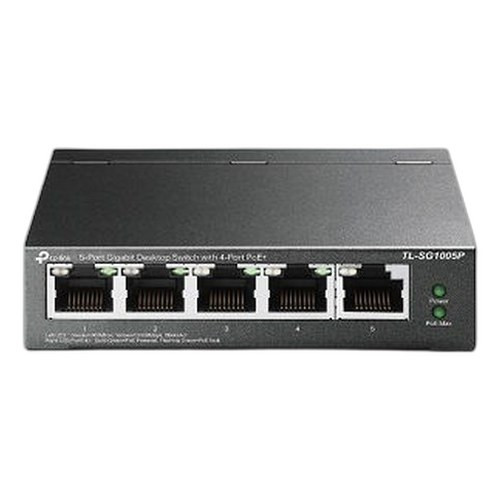
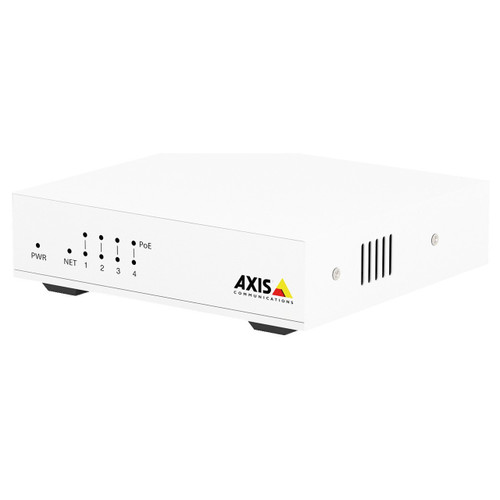
Both products are unmanaged desktop Gigabit PoE switches targeting small IP-camera installations — a class where buyers weigh port count, PoE budget, operating range, and physical form factor. The TP-Link TL-SG1005P offers five ports (four PoE+) at a 65 W budget in a compact desktop chassis. The Axis D8004 provides four PoE ports (plus one non-PoE uplink) at a 60 W budget in a metal enclosure designed specifically for Axis camera ecosystems. Both are plug-and-play with no management interface required.
In This Guide
- How do port count, PoE standard, and total power budget compare between the SG1005P and D8004?
- Which switch is better suited to harsher or more demanding physical environments?
- How do ecosystem fit, included accessories, and warranty support differ between the two switches?
- Which should you choose: the SG1005P or the D8004?
- Side-by-Side Specs
- FAQ
How do port count, PoE standard, and total power budget compare between the SG1005P and D8004?
The TL-SG1005P delivers five total ports: four PoE+ (802.3af) and one standard uplink, all at Gigabit speed, with a declared PoE budget of 65 W and a switching capacity of 10 Gbps. Its specs also list a 30 W per-port wattage figure and an Extend mode that stretches PoE range to 250 m at 10 Mbps.
The Axis D8004 provides five total ports as well: four PoE/PoE+ (802.3af/at) and one 10BASE-T/100BASE-TX uplink (note: the uplink is Fast Ethernet, not Gigabit, per the connector spec '1x RJ45 10BASE-T/100BASE-TX'). Its PoE budget is 60 W total, drawn from a 62 W AC input. The D8004 explicitly supports both 802.3af (15 W) and 802.3at (30 W) per port, while the SG1005P spec lists only 802.3af on the PoE Power field despite the product name referencing PoE+. Buyers powering 30 W devices should verify per-port delivery on the SG1005P against its datasheet.
Which switch is better suited to harsher or more demanding physical environments?
The TL-SG1005P spec carries conflicting temperature figures: one field states 0–40°C operating, another states −30°C to 70°C, and storage is listed as −40°C to 70°C. The most conservative operating range from the spec set is 0–40°C. Casing material is not specified in the provided data.
The Axis D8004 specifies a metal white casing, an operating range of 0–50°C, and storage of −10°C to 50°C at 5–95% RH non-condensing. It carries CE, FCC Part 15 Class B, RoHS, and WEEE approvals. Weight is 172 g. The D8004's upper operating limit (50°C) exceeds the SG1005P's most conservative figure (40°C) by 10°C, and its metal casing offers greater physical durability. Neither unit is rated for outdoor use.
How do ecosystem fit, included accessories, and warranty support differ between the two switches?
The TL-SG1005P is a generic unmanaged switch suitable for any PoE device. Package contents are the switch, a power adapter, and a user guide. No warranty term is stated in the provided specs. Its Extend mode (250 m at 10 Mbps) is a noteworthy feature for long cable runs in small installations where reduced bandwidth is acceptable.
The Axis D8004 is positioned within the Axis product ecosystem and ships with an installation guide, power cord, adapter, feet, and mounting brackets — accessory breadth that simplifies physical installation. Axis provides a stated 3-year warranty, which is not matched by any warranty figure in the SG1005P spec data. The D8004's approvals package (CE, FCC, RoHS, WEEE) is explicitly documented; the SG1005P's approvals are not listed in the provided specs.
Which should you choose: the SG1005P or the D8004?
Our take: The SG1005P is the stronger choice when cable-run length and raw PoE budget are the primary concerns, offering a 65 W budget (vs. 60 W on the D8004), an Extend mode reaching 250 m at 10 Mbps, and a marginally higher port-level wattage ceiling — though buyers should confirm 802.3at delivery against the full datasheet given the spec inconsistency. The D8004 is the stronger choice for installers prioritizing build quality, environmental tolerance, and support assurance: its metal casing, 50°C operating ceiling (10°C above the SG1005P's conservative 40°C figure), explicit CE/FCC/RoHS approvals, and a documented 3-year warranty all favor it for professional deployments. Note the D8004's uplink port is Fast Ethernet (100 Mbps), not Gigabit, which could bottleneck aggregated camera traffic in dense streams. Platform buyers already standardized on Axis hardware will find the D8004's ecosystem fit and warranty commitment compelling; budget-constrained or range-limited installs favor the SG1005P.
Side-by-Side Comparison
Spec-for-spec, from manufacturer data.
| Specification | TP-Link SG1005P | Axis D8004 |
|---|---|---|
| Product Type | Unmanaged desktop Gigabit PoE switch | Unmanaged desktop Gigabit PoE switch |
| Total Ports | 5 (4x PoE + 1x uplink) | 5 (4x PoE + 1x uplink) |
| PoE Standard | 802.3af (spec field; name states PoE+) | 802.3af/at (15 W or 30 W per port) |
| PoE Budget | 65 W | 60 W |
| Uplink Speed | 1 Gbps (Gigabit) | 100 Mbps (Fast Ethernet per connector spec) |
| Switching Capacity | 10 Gbps | — |
| Operating Temperature | 0–40°C (conservative field; conflicting fields present) | 0–50°C |
| Storage Temperature | -40°C to 70°C | -10°C to 50°C |
| Extend / Long-Range Mode | 250 m at 10 Mbps | — |
| Casing Material | — | Metal |
| Dimensions | 99.8 x 98 x 25 mm | 90 x 80 x 21 mm |
| Weight | — | 172 g (0.38 lb) |
| AC Input | — | 100–240 V AC, 50–60 Hz, 62 W |
| Regulatory Approvals | — | CE, FCC Part 15 Class B, RoHS, WEEE |
| Included Accessories | Power adapter, user guide | Power cord, adapter, feet, brackets, installation guide |
| Warranty | — | 3 years |
Frequently Asked Questions
Which should you choose: the SG1005P or the D8004?
The SG1005P is the stronger choice when cable-run length and raw PoE budget are the primary concerns, offering a 65 W budget (vs. 60 W on the D8004), an Extend mode reaching 250 m at 10 Mbps, and a marginally higher port-level wattage ceiling — though buyers should confirm 802.3at delivery against the full datasheet given the spec inconsistency. The D8004 is the stronger choice for installers prioritizing build quality, environmental tolerance, and support assurance: its metal casing, 50°C operating ceiling (10°C above the SG1005P's conservative 40°C figure), explicit CE/FCC/RoHS approvals, and a documented 3-year warranty all favor it for professional deployments. Note the D8004's uplink port is Fast Ethernet (100 Mbps), not Gigabit, which could bottleneck aggregated camera traffic in dense streams. Platform buyers already standardized on Axis hardware will find the D8004's ecosystem fit and warranty commitment compelling; budget-constrained or range-limited installs favor the SG1005P.
Is the SG1005P or D8004 better for powering PTZ cameras that draw close to 30 W?
The D8004 explicitly supports 802.3at (PoE+, up to 30 W per port) per its spec. The SG1005P's PoE Power field lists only 802.3af (up to 15.4 W per port) despite the product name including 'PoE+'. Buyers powering 30 W devices should verify the SG1005P's per-port delivery against its full datasheet before relying on it for high-draw PTZ cameras.
Which switch is easier to mount in a cabinet or on a wall?
The D8004 ships with feet and brackets included, and its spec explicitly lists mounting hardware in the accessory contents. The SG1005P spec references mounting holes but does not list mounting hardware in its package contents. For clean panel or wall installations, the D8004 has a documented installation kit out of the box.
Does either switch carry a stated warranty, and does it matter for a commercial install?
The Axis D8004 carries a stated 3-year warranty per its spec data. No warranty term is listed in the provided SG1005P specs. For commercial or institutional installations where maintenance agreements and liability coverage matter, the D8004's documented 3-year warranty is a concrete differentiator; the SG1005P's warranty terms should be confirmed directly with the distributor before procurement.
More Network Switch Comparisons
- Vivotek GET-083A-120 vs TP-Link SG1005P
- Vivotek GET-083A-120 vs Axis T8504-E
- Vivotek GET-083A-120 vs Axis D8004
- Vivotek GET-083A-120 vs Ubiquiti N-SW
- TP-Link SG1005P vs Axis T8504-E
- TP-Link SG1005P vs Ubiquiti N-SW
Network Switch Buying Guides
Get a Second Opinion on Your Camera Choice
Share your site layout, coverage goals, and budget. Our team will validate the camera selection, flag anything we would change, and recommend products that match the use case.