
TP-Link S4500-8GP vs TP-Link SG2008P: Specification Comparison
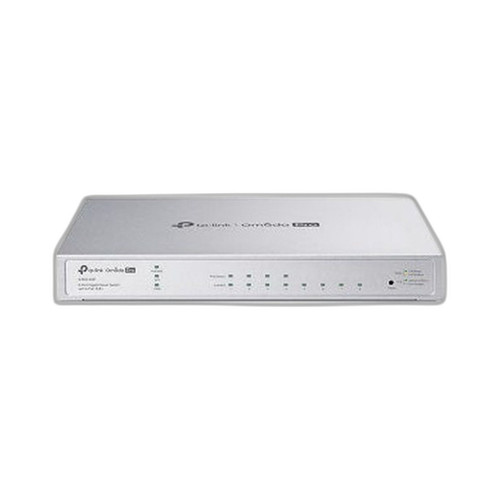
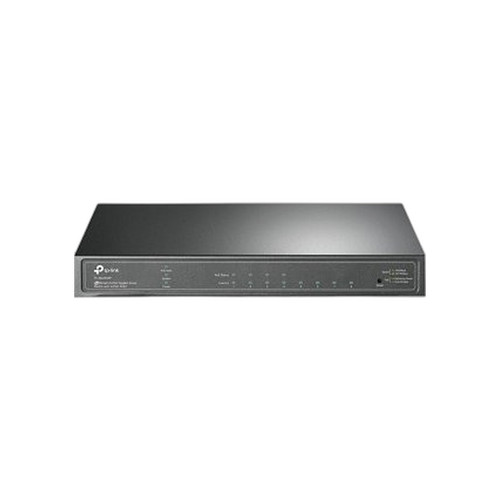
Both the TP-Link S4500-8GP and SG2008P are 8-port gigabit smart managed switches in the Omada ecosystem, each offering PoE capability, 16 Gbps switching capacity, and wall/rack mounting. They target small-to-medium deployments — IP camera fleets, wireless APs, and IP phones. This comparison examines the three dimensions most relevant to a security integrator or IT buyer choosing between them: PoE standard and port-level power delivery, management tier and feature depth, and physical/environmental specifications.
In This Guide
Which switch delivers more capable PoE power to edge devices?
Both switches share a 62W total PoE budget and support 802.3af/at on their PoE ports. However, the specs draw a meaningful distinction in the PoE standard headline: the S4500-8GP is explicitly listed as PoE+ (802.3at), while the SG2008P's primary 'Poe Power' field lists only PoE (802.3af). 802.3af delivers up to 15.4W per port, whereas 802.3at (PoE+) delivers up to 30W per port. If a device such as a PTZ camera or a dual-radio AP requires more than 15.4W, the S4500-8GP's PoE+ designation is the safer selection. Both units share the same power supply spec: 53.5 VDC / 1.31A external adapter, and both cap total power consumption at 62W. The SG2008P's 802.3af/at notation does appear in secondary fields, creating some ambiguity, but the primary classification differentiates the two.
How do the management tiers and security feature sets compare?
The S4500-8GP carries an explicit 'Omada Pro' designation and is classified as L2+ managed. Its spec sheet lists SNMP Trap/Inform, EEE (Energy Efficient Ethernet), 802.1X port-based authentication, ACL (Access Control Lists), and DoS Defense as documented features. It also specifies Web and CLI managed operating modes. The SG2008P is classified as Omada SDN managed but does not carry the 'Pro' label. Its spec data does not enumerate SNMP, ACL, DoS Defense, or CLI management as discrete line items. For deployments requiring granular security policy enforcement, port-level authentication, or scripted CLI configuration, the S4500-8GP's documented feature set is more complete based on the provided specs. Both switches integrate with the Omada SDN platform for centralized controller-based management.
Do the physical form factor and operating environment specs differ between models?
Both switches share identical physical dimensions of 11.6 × 7.1 × 1.7 inches and support both wall and rack mounting. Both include 32 MB of storage and the same external power adapter. The SG2008P explicitly documents an operating temperature range of -40°C to 60°C (-40°F to 140°F), which is a notably wide range suitable for unconditioned or outdoor-adjacent enclosures. The S4500-8GP does not list an operating temperature range in the provided specs. For installations in environments where temperature extremes are a concern — utility closets, outdoor enclosures, or unheated spaces — the SG2008P's documented thermal tolerance is a distinguishing data point. SFP slots are referenced (2 slots) only in the S4500-8GP's spec data; the SG2008P does not list SFP expansion in the provided specifications.
Which should you choose: the S4500-8GP or the SG2008P?
Our take: The S4500-8GP is the stronger choice when per-port power headroom, management depth, and uplink flexibility are priorities. It is explicitly rated PoE+ (802.3at) at the primary specification level — supporting up to 30W per PoE port — while the SG2008P's primary classification lists only 802.3af (up to 15.4W per port). The S4500-8GP also documents SNMP Trap/Inform, ACL, DoS Defense, 802.1X, and CLI management, none of which appear in the SG2008P's provided specs. Additionally, 2 SFP slots are listed for the S4500-8GP, enabling fiber uplinks; no SFP slots are documented for the SG2008P. Conversely, the SG2008P explicitly documents a -40°C to 60°C operating range, making it the documented choice for thermally challenging installations where the S4500-8GP's thermal tolerance is unknown. Both are Omada SDN-compatible. Choose the S4500-8GP for PoE+ device support, enterprise-adjacent security features, and fiber uplinks; consider the SG2008P where the rated operating temperature range is a hard requirement.
Side-by-Side Comparison
Spec-for-spec, from manufacturer data.
| Specification | TP-Link S4500-8GP | TP-Link SG2008P |
|---|---|---|
| Product Line | Omada Pro | Omada SDN |
| Total Ports | 8 | 8 |
| Port Speed | Gigabit | Gigabit |
| PoE Standard (Primary) | PoE+ (802.3at) | PoE (802.3af) |
| PoE Budget | 62W | 62W |
| Switching Capacity | 16 Gbps | 16 Gbps |
| SFP Uplink Slots | 2 | — |
| Management Level | L2+ Managed | Managed (Omada SDN) |
| SNMP Trap/Inform | Yes | — |
| ACL / DoS Defense | Yes | — |
| 802.1X Port Auth | Yes | — |
| CLI Management | Yes | — |
| EEE (Energy Efficient Ethernet) | Yes | — |
| Operating Temperature | — | -40°C to 60°C |
| Storage | 32 MB | 32 MB |
| Power Supply | 53.5 VDC / 1.31A External | 53.5 VDC / 1.31A External |
| Dimensions | 11.6 × 7.1 × 1.7 in | 11.6 × 7.1 × 1.7 in |
| Mount Type | Wall / Rack | Wall / Rack |
Frequently Asked Questions
Which should you choose: the S4500-8GP or the SG2008P?
The S4500-8GP is the stronger choice when per-port power headroom, management depth, and uplink flexibility are priorities. It is explicitly rated PoE+ (802.3at) at the primary specification level — supporting up to 30W per PoE port — while the SG2008P's primary classification lists only 802.3af (up to 15.4W per port). The S4500-8GP also documents SNMP Trap/Inform, ACL, DoS Defense, 802.1X, and CLI management, none of which appear in the SG2008P's provided specs. Additionally, 2 SFP slots are listed for the S4500-8GP, enabling fiber uplinks; no SFP slots are documented for the SG2008P. Conversely, the SG2008P explicitly documents a -40°C to 60°C operating range, making it the documented choice for thermally challenging installations where the S4500-8GP's thermal tolerance is unknown. Both are Omada SDN-compatible. Choose the S4500-8GP for PoE+ device support, enterprise-adjacent security features, and fiber uplinks; consider the SG2008P where the rated operating temperature range is a hard requirement.
Can either switch power a PTZ camera or dual-radio AP that needs more than 15W?
Based on the provided specs, the S4500-8GP is explicitly rated PoE+ (802.3at), which supports up to 30W per PoE port and is suited for higher-draw devices. The SG2008P's primary spec lists PoE (802.3af), which caps at 15.4W per port. If your device requires more than 15.4W, the S4500-8GP is the documented option. Both switches share a 62W total PoE budget.
Is the S4500-8GP or SG2008P better for a deployment in an unconditioned or cold environment?
The SG2008P is the only model with a documented operating temperature range in the provided specs: -40°C to 60°C. The S4500-8GP does not list an operating temperature specification in the data provided. For environments with significant temperature variation, the SG2008P has a verifiable thermal rating; the S4500-8GP's tolerance cannot be confirmed from the available specs.
Do both switches support fiber uplinks for connecting to a core switch or NVR over distance?
SFP slots (2) are listed in the S4500-8GP's specifications, indicating support for fiber or SFP-based uplinks. The SG2008P does not list SFP slots in the provided spec data. If fiber uplinks or extended copper uplinks via SFP transceivers are required, the S4500-8GP is the documented choice based on available information.
More Network Switch Comparisons
- TP-Link SG2210XMP-M2 vs Ubiquiti USW-FLEX-2.5G-8
- TP-Link SG2210XMP-M2 vs Comnet CNGE8MS
- TP-Link SG2210XMP-M2 vs Lantronix S2220-1014-NA
- TP-Link SG2210XMP-M2 vs TP-Link S4500-8GP
- TP-Link SG2210XMP-M2 vs TP-Link SG2008P
- TP-Link S4500-8GP vs Ubiquiti USW-FLEX-2.5G-8
Network Switch Buying Guides
Get a Second Opinion on Your Camera Choice
Share your site layout, coverage goals, and budget. Our team will validate the camera selection, flag anything we would change, and recommend products that match the use case.