
TP-Link DS110GMP vs TP-Link SG1210PP: Specification Comparison
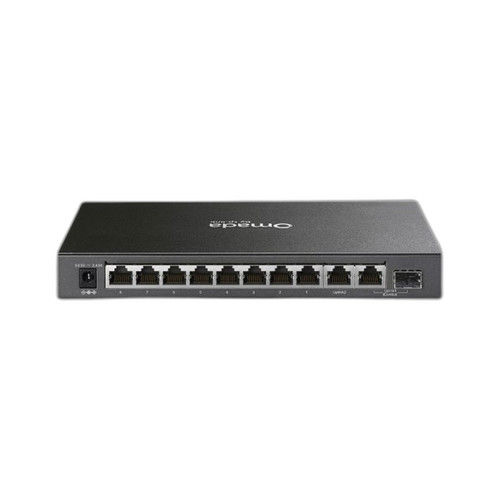
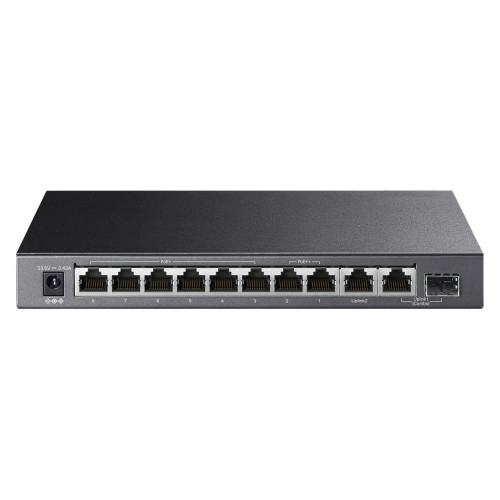
Both the TP-Link DS110GMP and the TP-Link TL-SG1210PP are 10-port gigabit desktop PoE switches aimed at small-to-medium surveillance and wireless deployments. Each ships with a 123 W PoE budget, one SFP combo slot for fiber or copper uplink, and the same trio of smart operating modes—Priority, Isolation, and PoE Auto Recovery—without requiring a full management interface. This comparison examines port-level PoE capability, physical installation footprint, and feature set to help installers and IT buyers determine which unit better fits their project requirements.
In This Guide
- How do the PoE port count, per-port power, and total budget differ between the DS110GMP and the TL-SG1210PP?
- Which switch offers better verified throughput and standards compliance for a structured cabling environment?
- What are the mounting, dimensional, and operating-environment differences that affect installation planning?
- Which should you choose: the DS110GMP or the SG1210PP?
- Side-by-Side Specs
- FAQ
How do the PoE port count, per-port power, and total budget differ between the DS110GMP and the TL-SG1210PP?
Both switches carry an identical 123 W total PoE budget and a single SFP combo slot, but they diverge in the number and standard of PoE-capable ports. The DS110GMP is specified with 8 PoE+ ports governed by IEEE 802.3at/af, delivering up to 30 W per port—sufficient to power high-draw devices such as PTZ cameras, dual-band APs, or video intercoms from any of those eight positions.
The TL-SG1210PP's specification lists 8 PoE ports but does not explicitly state a per-port wattage ceiling or confirm 802.3at compliance; the product type field references '6-Po,' and the extend-mode range (250 m) is limited to ports 1–4, suggesting a tiered port architecture. With the same 123 W shared pool and no per-port wattage confirmed, installers powering high-draw devices on the TL-SG1210PP should verify compatibility before deploying.
Which switch offers better verified throughput and standards compliance for a structured cabling environment?
The DS110GMP publishes a switching capacity of 20 Gbps (non-blocking) and carries explicit IEEE certifications covering 802.3i, 802.3u, 802.3ab, 802.3x, 802.3af, 802.3at, 802.1p, and 802.3z. Idle power draw is documented at 7.93 W, rising to 123 W under full PoE load. These figures give integrators a concrete baseline for power-budget calculations and standards audits.
The TL-SG1210PP specification does not list a switching capacity figure, idle power draw, or explicit IEEE certification set. Power consumption is recorded only as the maximum 123 W. The absence of these data points makes direct throughput comparison impossible from the provided specifications alone, and installers relying on standards documentation for compliance sign-off will need to consult the manufacturer datasheet directly.
What are the mounting, dimensional, and operating-environment differences that affect installation planning?
The DS110GMP provides verified physical dimensions of 8.2 × 4.9 × 1.0 in (209 × 126 × 26 mm) and an operating temperature range of 0 °C to 40 °C (32 °F to 104 °F), with storage rated to −40 °C to 70 °C. Wall-mount capability is listed for both units, making either suitable for IDF closets, camera head-end enclosures, or on-wall desktop installations.
The TL-SG1210PP specification does not include physical dimensions or an operating temperature range. For installations where thermal environment or rack-space planning matters—outdoor-adjacent enclosures, tight equipment rooms, or deployments alongside UPS units—the DS110GMP's published data provides a planning advantage. Both units share a wall-mount form factor and 250 m extend-mode reach, though the TL-SG1210PP restricts extend mode to ports 1–4 versus a broader scope implied on the DS110GMP.
Which should you choose: the DS110GMP or the SG1210PP?
Our take: The DS110GMP is the stronger choice when per-port power delivery, throughput documentation, and standards compliance are decision criteria. It explicitly confirms 8 × 802.3at/af PoE+ ports at up to 30 W each against the same 123 W shared budget, whereas the TL-SG1210PP does not publish a per-port wattage ceiling or 802.3at confirmation. The DS110GMP also documents a 20 Gbps non-blocking switching capacity and a full IEEE certification list (802.3i/u/ab/x/af/at/1p/z) that the TL-SG1210PP spec omits entirely. Operating temperature (0–40 °C confirmed) and physical dimensions (209 × 126 × 26 mm) are provided for the DS110GMP but absent from the TL-SG1210PP. For surveillance installations requiring high-draw PTZ cameras or dual-band APs on most ports, the DS110GMP's documented 30 W-per-port ceiling removes guesswork. The TL-SG1210PP may suit budget-conscious deployments with lower-draw endpoints, but buyers should obtain its full datasheet before committing.
Side-by-Side Comparison
Spec-for-spec, from manufacturer data.
| Specification | TP-Link DS110GMP | TP-Link SG1210PP |
|---|---|---|
| Product Type | Unmanaged Desktop Switch | Desktop Gigabit PoE Switch |
| Total Ports | 10 | 10 |
| PoE-Enabled Ports | 8 | 8 (see note) |
| PoE Standard | 802.3at / 802.3af (PoE+) | Not specified in provided specs |
| Per-Port PoE Max | 30 W | — |
| Total PoE Budget | 123 W | 123 W |
| SFP Combo Slots | 1 | 1 |
| Switching Capacity | 20 Gbps | — |
| Extend Mode Range | 250 m | 250 m (ports 1–4 only) |
| Management | Unmanaged (plug-and-play) | Unmanaged (plug-and-play) |
| Operating Modes | Priority, Isolation, PoE Auto Recovery | Priority, Isolation, PoE Auto Recovery |
| Operating Temp | 0 °C to 40 °C (32 °F to 104 °F) | — |
| Storage Temp | −40 °C to 70 °C (−40 °F to 158 °F) | — |
| Dimensions (L × W × H) | 209 × 126 × 26 mm (8.2 × 4.9 × 1.0 in) | — |
| Mount Type | Wall | Wall |
| IEEE Certifications | 802.3i, u, ab, x, af, at, 1p, z | — |
Frequently Asked Questions
Which should you choose: the DS110GMP or the SG1210PP?
The DS110GMP is the stronger choice when per-port power delivery, throughput documentation, and standards compliance are decision criteria. It explicitly confirms 8 × 802.3at/af PoE+ ports at up to 30 W each against the same 123 W shared budget, whereas the TL-SG1210PP does not publish a per-port wattage ceiling or 802.3at confirmation. The DS110GMP also documents a 20 Gbps non-blocking switching capacity and a full IEEE certification list (802.3i/u/ab/x/af/at/1p/z) that the TL-SG1210PP spec omits entirely. Operating temperature (0–40 °C confirmed) and physical dimensions (209 × 126 × 26 mm) are provided for the DS110GMP but absent from the TL-SG1210PP. For surveillance installations requiring high-draw PTZ cameras or dual-band APs on most ports, the DS110GMP's documented 30 W-per-port ceiling removes guesswork. The TL-SG1210PP may suit budget-conscious deployments with lower-draw endpoints, but buyers should obtain its full datasheet before committing.
Can either switch power a PTZ camera or dual-band AP that draws close to 30 W?
The DS110GMP explicitly supports 802.3at PoE+ at up to 30 W per port on all 8 PoE ports, so it can power high-draw PTZ cameras and dual-band APs. The TL-SG1210PP does not publish a per-port wattage limit or confirm 802.3at compliance in the provided specifications; buyers should verify this against the manufacturer datasheet before deploying high-draw devices.
Do both switches work without a controller or cloud management account?
Yes. Both the DS110GMP and the TL-SG1210PP are specified as unmanaged (plug-and-play) units. Neither requires a controller, management software, or cloud account. Both offer the same three hardware-mode features—Priority Mode (QoS), Isolation Mode (traffic segmentation), and PoE Auto Recovery—via physical DIP switches or button controls rather than a web GUI.
Which unit is better documented for a structured cabling compliance audit?
The DS110GMP is better documented for compliance purposes. It lists explicit IEEE 802.3 certification marks (i, u, ab, x, af, at, 1p, z), a verified 20 Gbps switching capacity, and idle versus maximum power consumption. The TL-SG1210PP's provided specifications do not include a switching capacity figure, IEEE certification list, or idle power draw, so installers will need to obtain the full manufacturer datasheet to satisfy audit requirements.
More Network Switch Comparisons
- TP-Link IES210GPP vs Transition Networks OCA-1AB201-NA
- TP-Link IES210GPP vs Transition Networks OCA-1BA1A0
- TP-Link IES210GPP vs Transition Networks OCA-1BA101
- TP-Link IES210GPP vs TP-Link DS110GMP
- TP-Link IES210GPP vs TP-Link SG1210PP
- TP-Link DS110GMP vs Transition Networks OCA-1AB201-NA
Network Switch Buying Guides
Get a Second Opinion on Your Camera Choice
Share your site layout, coverage goals, and budget. Our team will validate the camera selection, flag anything we would change, and recommend products that match the use case.