
TP-Link DS108GP vs Ubiquiti USW-FLEX-2.5G-8: Specification Comparison
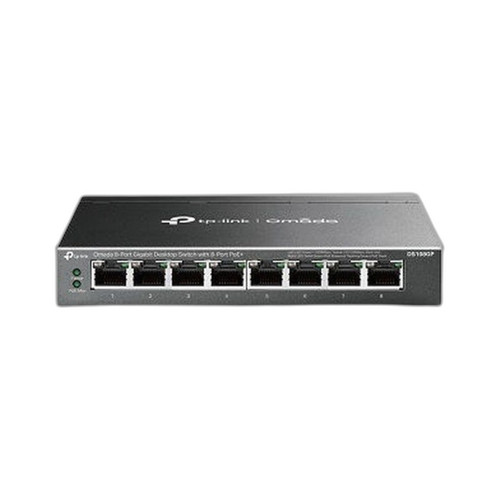
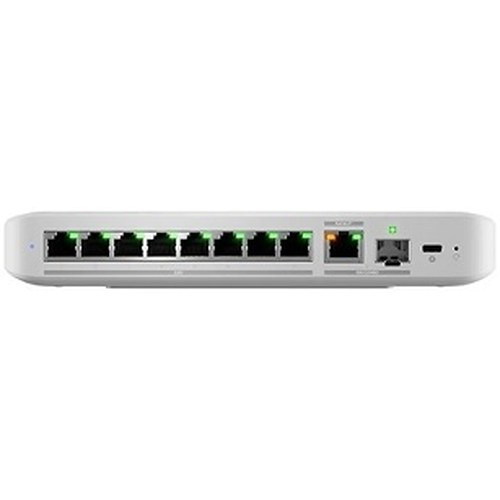
Both products are 8-port compact desktop network switches aimed at edge and surveillance deployments, making them directly cross-shoppable by installers evaluating switch infrastructure for small camera clusters or distributed network nodes. The TP-Link DS108GP is an unmanaged Gigabit PoE+ switch targeting budget-conscious or plug-and-play installations, while the Ubiquiti USW-FLEX-2.5G-8 is a managed 2.5GbE switch with a 10G hybrid uplink designed for UniFi ecosystems requiring higher throughput, VLAN segmentation, and flexible mounting options.
In This Guide
- Which switch delivers more bandwidth and throughput for camera backhaul?
- How do PoE power delivery, total power budget, and operating environment compare?
- What management capabilities and physical deployment options does each switch provide?
- Which should you choose: the DS108GP or the USW-FLEX-2.5G-8?
- Side-by-Side Specs
- FAQ
Which switch delivers more bandwidth and throughput for camera backhaul?
The DS108GP provides 8 ports at 1 Gbps (1000 Mbps) each. No aggregate switching capacity or forwarding rate is stated in its specs; throughput figures are absent from the provided data.
The USW-FLEX-2.5G-8 provides 8 ports at 2.5 Gbps each plus one hybrid 10G uplink (RJ45 or SFP+), with a stated switching capacity of 60 Gbps and non-blocking throughput of 30 Gbps at a forwarding rate of 45 Mpps. Per-port bandwidth is 2.5× that of the DS108GP on every access port, and the 10G uplink adds a high-capacity spine link the DS108GP does not offer.
For deployments running high-bitrate 4K or multi-stream cameras where individual port saturation is a concern, the USW-FLEX-2.5G-8's 2.5GbE ports and published throughput figures provide a measurable headroom advantage. The DS108GP's 1 Gbps ports are sufficient for standard 1080p IP camera streams but offer no per-port headroom for future bandwidth growth.
How do PoE power delivery, total power budget, and operating environment compare?
The DS108GP carries a 64 W PoE+ budget (IEEE 802.3at, up to 30 W per port) across its 8 ports and is self-powered via an internal or bundled power supply — the spec lists power consumption at 64 W. Operating temperature ceiling is below 40°C (104°F), with no lower bound stated.
The USW-FLEX-2.5G-8 does not function as a PoE power source; it is a PoE power consumer, accepting PoE+ (802.3at) or USB-C (5V/3A) input, with a maximum power draw of 14 W. It cannot power downstream IP cameras or other PoE devices. Its operating range is -20°C to 45°C (-4°F to 113°F), a substantially wider thermal envelope than the DS108GP.
This is the most critical functional difference: only the DS108GP can supply PoE power to cameras, access control readers, or APs. The USW-FLEX-2.5G-8 requires a separate PoE injector or PoE-capable uplink switch for any powered devices. Conversely, the USW-FLEX-2.5G-8's -20°C lower bound makes it suitable for unheated enclosures, outdoor cabinets, or cold-weather installs where the DS108GP's 0°C-and-above assumption (implied by 'below 40°C' upper-only spec) would require supplemental heating.
What management capabilities and physical deployment options does each switch provide?
The DS108GP is unmanaged: no VLANs, no QoS, no remote configuration interface, no software platform integration. Deployment is plug-and-play with zero configuration overhead, which also means zero traffic segmentation or prioritization capability.
The USW-FLEX-2.5G-8 is managed via Ethernet and integrates with the UniFi controller ecosystem, supporting 256 VLANs with QoS. This enables camera VLAN isolation, traffic prioritization, and centralized network visibility — capabilities absent from the DS108GP. NDAA compliance is explicitly stated for the USW-FLEX-2.5G-8; the DS108GP spec does not address NDAA status.
Physically, the DS108GP's form factor is listed as 'cable' (desktop); mounting options are not specified beyond desktop placement. The USW-FLEX-2.5G-8 supports wall, DIN-rail, and magnetic mounting in a 212.9 × 76 × 33.5 mm, 395 g polycarbonate enclosure — significantly more flexible for field enclosures, junction boxes, or tight rack spaces. Certifications (CE, FCC, IC, Anatel) are documented for the USW-FLEX-2.5G-8; the DS108GP spec lists none.
Which should you choose: the DS108GP or the USW-FLEX-2.5G-8?
Our take: The DS108GP is the stronger choice when the installation requires direct PoE+ power delivery to cameras or other edge devices and the network is simple enough to operate without VLANs or centralized management — its 64 W PoE+ budget at 802.3at can power up to eight 30 W devices simultaneously, while the USW-FLEX-2.5G-8 provides zero PoE output. Conversely, the USW-FLEX-2.5G-8 is the correct choice for UniFi-managed networks, bandwidth-intensive deployments, or harsh-environment installs: its 2.5 Gbps per-port speed is 2.5× the DS108GP's 1 Gbps, its 10G hybrid uplink has no equivalent on the DS108GP, and its -20°C to 45°C operating range far exceeds the DS108GP's stated below-40°C upper-only limit. Buyers running NDAA-sensitive projects should note that only the USW-FLEX-2.5G-8 carries an explicit NDAA-compliant designation in the provided specs.
Side-by-Side Comparison
Spec-for-spec, from manufacturer data.
| Specification | TP-Link DS108GP | Ubiquiti USW-FLEX-2.5G-8 |
|---|---|---|
| Product Type | Unmanaged Desktop PoE+ Switch | Managed 2.5GbE Compact Switch |
| Managed | Unmanaged | Yes (UniFi / Ethernet) |
| Ports | 8 × 1GbE | 8 × 2.5GbE + 1 × 10G hybrid (RJ45/SFP+) |
| Port Speed | 1,000 Mbps | 2,500 Mbps (10G uplink) |
| Switching Capacity | — | 60 Gbps |
| Non-Blocking Throughput | — | 30 Gbps |
| Forwarding Rate | — | 45 Mpps |
| PoE Output | PoE+ (802.3at), 64 W budget | None (PoE consumer only) |
| Max PoE Per Port | 30 W | — |
| Power Input / Consumption | 64 W (self-powered) | 14 W max (PoE+ or USB-C 5V/3A input) |
| VLAN Support | None | 256 VLANs with QoS |
| Operating Temperature | Below 40°C (104°F); lower bound not stated | -20°C to 45°C (-4°F to 113°F) |
| Mount Options | Desktop only (no additional mounts specified) | Desktop, wall, DIN-rail, magnetic |
| Enclosure / Weight | Not specified | Polycarbonate, 395 g (0.87 lb) |
| NDAA Compliant | Not stated in specs | Yes |
| Certifications | Not stated in specs | CE, FCC, IC, Anatel |
Frequently Asked Questions
Which should you choose: the DS108GP or the USW-FLEX-2.5G-8?
The DS108GP is the stronger choice when the installation requires direct PoE+ power delivery to cameras or other edge devices and the network is simple enough to operate without VLANs or centralized management — its 64 W PoE+ budget at 802.3at can power up to eight 30 W devices simultaneously, while the USW-FLEX-2.5G-8 provides zero PoE output. Conversely, the USW-FLEX-2.5G-8 is the correct choice for UniFi-managed networks, bandwidth-intensive deployments, or harsh-environment installs: its 2.5 Gbps per-port speed is 2.5× the DS108GP's 1 Gbps, its 10G hybrid uplink has no equivalent on the DS108GP, and its -20°C to 45°C operating range far exceeds the DS108GP's stated below-40°C upper-only limit. Buyers running NDAA-sensitive projects should note that only the USW-FLEX-2.5G-8 carries an explicit NDAA-compliant designation in the provided specs.
Can either switch power my IP cameras directly over PoE?
Only the DS108GP can. It provides a 64 W PoE+ (802.3at) budget across all 8 ports, capable of delivering up to 30 W per port. The USW-FLEX-2.5G-8 is a PoE consumer — it accepts PoE+ as an input power source but cannot supply PoE power to downstream devices. If your cameras need PoE, the DS108GP is the only option between these two.
Is the USW-FLEX-2.5G-8 or DS108GP better for a UniFi network with VLAN segmentation?
The USW-FLEX-2.5G-8 is purpose-built for this use case. It supports 256 VLANs with QoS and is managed through the UniFi controller via Ethernet. The DS108GP is unmanaged and provides no VLAN, QoS, or remote management capability whatsoever. If your deployment requires camera traffic isolation or integration with a UniFi controller, the DS108GP cannot fulfill that requirement.
Which switch is rated for outdoor or cold-weather enclosure use?
The USW-FLEX-2.5G-8 is rated from -20°C to 45°C (-4°F to 113°F), making it suitable for unheated enclosures and cold-climate installations. The DS108GP spec only states an upper operating limit of below 40°C (104°F) with no lower bound specified — installers should treat its cold-weather suitability as undocumented based on the provided data. The USW-FLEX-2.5G-8 also supports wall, DIN-rail, and magnetic mounting, which are common in outdoor or industrial enclosure deployments.
More Network Switch Comparisons
- TP-Link SG2210XMP-M2 vs Ubiquiti USW-FLEX-2.5G-8
- TP-Link SG2210XMP-M2 vs Comnet CNGE8MS
- TP-Link SG2210XMP-M2 vs Lantronix S2220-1014-NA
- TP-Link SG2210XMP-M2 vs TP-Link S4500-8GP
- TP-Link SG2210XMP-M2 vs TP-Link SG2008P
- TP-Link S4500-8GP vs Ubiquiti USW-FLEX-2.5G-8
Network Switch Buying Guides
Get a Second Opinion on Your Camera Choice
Share your site layout, coverage goals, and budget. Our team will validate the camera selection, flag anything we would change, and recommend products that match the use case.