
TP-Link DS108GP vs Comnet CNGE8MS: Specification Comparison
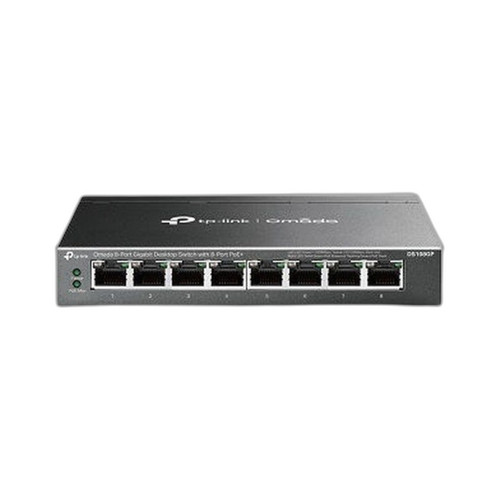
Both the TP-Link DS108GP and Comnet CNGE8MS are 8-port, 1000 Mbps switches aimed at physical-security and commercial LAN deployments. The DS108GP is an unmanaged desktop PoE+ switch targeting SMB edge locations, while the CNGE8MS is a hardened, fully managed industrial switch with fiber combo ports and ring-redundancy support. Buyers choosing between them are weighing convenience and PoE power delivery against ruggedization, management depth, and environmental tolerance — a common crossroads in surveillance and access-control infrastructure.
In This Guide
- How do port mix, throughput, and PoE delivery compare between the DS108GP and CNGE8MS?
- Which switch is better suited for harsh or outdoor-adjacent operating environments?
- What network management and redundancy features does each switch offer?
- Which should you choose: the DS108GP or the CNGE8MS?
- Side-by-Side Specs
- FAQ
How do port mix, throughput, and PoE delivery compare between the DS108GP and CNGE8MS?
The DS108GP provides 8 copper RJ-45 gigabit ports, all PoE+-capable (IEEE 802.3at, up to 30 W per port) with a shared PoE budget of 64 W. This supports up to roughly two to three simultaneously powered devices at full draw, or more at lower wattages typical of IP cameras. No fiber uplink or SFP option is specified.
The CNGE8MS delivers 8 ports split as 4 x RJ-45 copper and 4 x SFP combo ports at 1000 Mbps. Switching bandwidth is specified at 16 Gbps with 7 μs latency and an 8,192-entry MAC table. No PoE capability is listed for the CNGE8MS. The four SFP combo slots allow fiber uplinks for distance or electrical-isolation requirements common in industrial and campus-security runs — a capability absent from the DS108GP spec sheet.
Which switch is better suited for harsh or outdoor-adjacent operating environments?
The DS108GP specifies an operating temperature ceiling of below 40°C (104°F) and is described as a desktop form factor with cable mounting. No lower temperature bound, humidity range, ingress-protection rating, or DIN-rail/wall-mount option is stated in the provided specs. This positions it as a climate-controlled indoor device.
The CNGE8MS is explicitly hardened: operating range is -40°C to +75°C, storage to -40°C to +85°C, with humidity tolerance of 5%–95% non-condensing. It mounts on DIN-rail or wall and accepts dual DC inputs ranging from 12–48 VDC — standard for industrial cabinet and field enclosure wiring. Power consumption is 25 W typical. These characteristics directly address outdoor-shelter, rooftop-IDF, and transportation-facility deployments where the DS108GP's thermal limits and desktop form factor would be disqualifying.
What network management and redundancy features does each switch offer?
The DS108GP is unmanaged. No VLAN segmentation, QoS prioritization, port mirroring, SNMP monitoring, or any software-configurable feature is listed. It operates plug-and-play, which lowers deployment complexity but eliminates the ability to isolate camera VLANs, enforce 802.1X port authentication, or integrate into a network management system.
The CNGE8MS is a fully managed switch. Its spec sheet documents support for 4,096 VLANs (802.1Q), 802.1p QoS, 802.1X port-based authentication, 802.1AB LLDP, LACP (802.3ad), and Spanning Tree variants (802.1D/w/s). Critically, it adds proprietary ring-redundancy protocols — C-Ring, Legacy Ring, and C-RSTP — enabling sub-50 ms failover loops common in industrial Ethernet topologies. The CNGE8MS also carries a lifetime warranty; no warranty term is stated for the DS108GP in the provided specs.
Which should you choose: the DS108GP or the CNGE8MS?
Our take: The CNGE8MS is the stronger choice when the deployment demands hardened environmental performance, fiber uplinks, network segmentation, or ring-redundancy. Its -40°C to +75°C operating range, DIN-rail mounting, dual DC power inputs, 4,096-VLAN capacity, 802.1X authentication, and C-Ring/C-RSTP failover are purpose-built for industrial control cabinets, transportation hubs, and any site where the wiring closet is not climate-controlled. The DS108GP, by contrast, delivers 64 W of PoE+ budget across all 8 copper ports — a capability the CNGE8MS lacks entirely per its spec sheet — making it the appropriate pick when powering IP cameras or access-control readers from a single, indoor desktop device is the primary requirement. Buyers should note that the DS108GP's 40°C upper operating limit and unmanaged architecture rule it out for any segment requiring VLAN isolation, 802.1X enforcement, or outdoor-adjacent enclosures. Platform qualifier: CNGE8MS fits managed industrial networks; DS108GP fits simple, PoE-dependent, indoor edge closets.
Side-by-Side Comparison
Spec-for-spec, from manufacturer data.
| Specification | TP-Link DS108GP | Comnet CNGE8MS |
|---|---|---|
| Device Class | Unmanaged Desktop PoE+ Switch | Managed Hardened Industrial Switch |
| Total Ports | 8 | 8 |
| Port Types | 8 x RJ-45 Copper | 4 x RJ-45, 4 x SFP Combo |
| Data Rate | 1000 Mbps | 1000 Mbps |
| Switching Bandwidth | — | 16 Gbps |
| Switching Latency | — | 7 μs |
| MAC Table Size | — | 8,192 entries |
| PoE Standard | IEEE 802.3at (PoE+) | — |
| PoE Budget | 64 W | — |
| Max PoE per Port | 30 W | — |
| Management | Unmanaged | Fully Managed |
| VLANs Supported | — | 4,096 (802.1Q) |
| Ring Redundancy | — | C-Ring, Legacy Ring, C-RSTP |
| Operating Temperature | Below 40°C (104°F) | -40°C to +75°C |
| Power Input | Not specified | Dual DC 12–48 VDC |
| Power Consumption | 64 W | 25 W typical |
| Mounting | Desktop | DIN-Rail or Wall |
| Warranty | — | Lifetime |
Frequently Asked Questions
Which should you choose: the DS108GP or the CNGE8MS?
The CNGE8MS is the stronger choice when the deployment demands hardened environmental performance, fiber uplinks, network segmentation, or ring-redundancy. Its -40°C to +75°C operating range, DIN-rail mounting, dual DC power inputs, 4,096-VLAN capacity, 802.1X authentication, and C-Ring/C-RSTP failover are purpose-built for industrial control cabinets, transportation hubs, and any site where the wiring closet is not climate-controlled. The DS108GP, by contrast, delivers 64 W of PoE+ budget across all 8 copper ports — a capability the CNGE8MS lacks entirely per its spec sheet — making it the appropriate pick when powering IP cameras or access-control readers from a single, indoor desktop device is the primary requirement. Buyers should note that the DS108GP's 40°C upper operating limit and unmanaged architecture rule it out for any segment requiring VLAN isolation, 802.1X enforcement, or outdoor-adjacent enclosures. Platform qualifier: CNGE8MS fits managed industrial networks; DS108GP fits simple, PoE-dependent, indoor edge closets.
Can either switch power IP cameras directly over the cable run?
Only the DS108GP provides PoE+ (IEEE 802.3at) with a 64 W shared budget and up to 30 W per port. The CNGE8MS does not list any PoE capability in its specifications, so cameras or access-control readers requiring PoE would need a separate power injector or mid-span device on that switch.
Is the DS108GP or CNGE8MS better for a deployment in an outdoor enclosure or unheated building?
The CNGE8MS is the appropriate choice. It is rated for -40°C to +75°C operation with a DIN-rail mount and dual DC inputs suited to industrial enclosures. The DS108GP specifies only a maximum of 40°C (104°F) with no lower bound stated and a desktop form factor — conditions that make it unsuitable for outdoor or thermally uncontrolled environments.
Does either switch support VLAN segmentation to isolate camera traffic from corporate LAN?
Only the CNGE8MS supports VLANs — up to 4,096 via IEEE 802.1Q — along with 802.1p QoS and 802.1X port authentication. The DS108GP is unmanaged; no VLAN, QoS, or authentication features are listed in its specifications. If network segmentation is a requirement, the CNGE8MS is the only viable option between these two.
More Network Switch Comparisons
- TP-Link SG2210XMP-M2 vs Ubiquiti USW-FLEX-2.5G-8
- TP-Link SG2210XMP-M2 vs Comnet CNGE8MS
- TP-Link SG2210XMP-M2 vs Lantronix S2220-1014-NA
- TP-Link SG2210XMP-M2 vs TP-Link S4500-8GP
- TP-Link SG2210XMP-M2 vs TP-Link SG2008P
- TP-Link S4500-8GP vs Ubiquiti USW-FLEX-2.5G-8
Network Switch Buying Guides
Get a Second Opinion on Your Camera Choice
Share your site layout, coverage goals, and budget. Our team will validate the camera selection, flag anything we would change, and recommend products that match the use case.