
TP-Link DS108G vs Ubiquiti USW-FLEX-2.5G-8: Specification Comparison
Both the TP-Link DS108G and Ubiquiti USW-FLEX-2.5G-8 are 8-port 2.5GbE desktop switches targeting installers who need Multi-Gig connectivity for dense camera clusters, Wi-Fi 6 access points, or NAS arrays. The core class is the same, but the two diverge meaningfully on management capability, uplink architecture, mounting versatility, and operating environment — making a structured spec comparison directly useful for B2B buyers deciding between a zero-configuration unmanaged unit and a managed, ecosystem-integrated switch.

In This Guide
- How do port count, uplink capacity, and switching throughput compare between the DS108G and USW-FLEX-2.5G-8?
- Which switch offers more management flexibility, VLAN support, and platform integration?
- How do power input options, operating temperature range, and physical mounting flexibility differ?
- Which should you choose: the DS108G or the USW-FLEX-2.5G-8?
- Side-by-Side Specs
- FAQ
How do port count, uplink capacity, and switching throughput compare between the DS108G and USW-FLEX-2.5G-8?
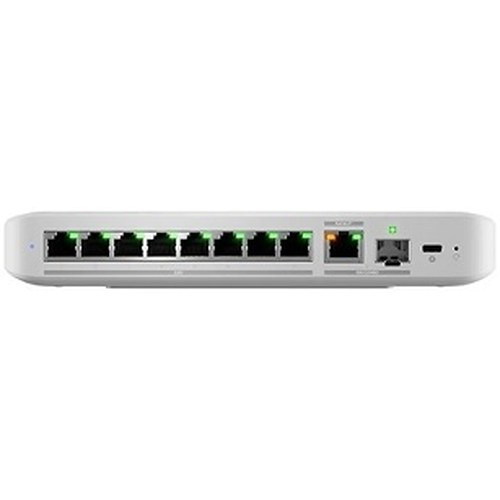
Both switches provide eight 2.5GbE access ports via RJ45 with auto-negotiation down to 100 Mbps (DS108G spec) and 2.5G per port (USW-FLEX-2.5G-8 spec). The USW-FLEX-2.5G-8 adds a ninth hybrid 10G port accepting either RJ45 or SFP+, giving it a dedicated high-speed uplink that the DS108G entirely lacks — the DS108G has no uplink port called out in its specifications.
Switching capacity favors the USW-FLEX-2.5G-8 at 60 Gbps versus 40 Gbps for the DS108G. The USW-FLEX-2.5G-8 also publishes a non-blocking throughput figure of 30 Gbps and a forwarding rate of 45 Mpps; the DS108G spec lists a 40 Gbps switching capacity but does not publish a forwarding rate or a separate non-blocking throughput figure. For installations where the uplink to a core switch or NVR is a bottleneck, the hybrid 10G port on the Ubiquiti unit is a concrete architectural advantage.
Which switch offers more management flexibility, VLAN support, and platform integration?
The DS108G is explicitly unmanaged: no VLAN support, no QoS, no remote configuration, and no software platform are listed in its specifications. It operates via auto-negotiation and AUTO MDI/MDIX only. This means zero configuration overhead and no licensing cost, but also no ability to segment traffic, prioritize video streams, or monitor port utilization remotely.
The USW-FLEX-2.5G-8 supports 256 VLANs with QoS and is managed via Ethernet, integrating into Ubiquiti's UniFi ecosystem. VLAN segmentation is directly relevant in multi-tenant camera deployments or installations that must isolate surveillance traffic from corporate LAN traffic. No additional management license cost is specified in the provided data, but the UniFi controller software (hardware or cloud-hosted) is a prerequisite for full feature access — buyers not already in the UniFi ecosystem should factor in that dependency.
How do power input options, operating temperature range, and physical mounting flexibility differ?
The DS108G is powered by an external AC/DC power adapter (included in package contents) and draws a maximum of 8.679 W. Its operating temperature range is 0–40°C (32–104°F), and it mounts on a wall or sits on a desktop via rubber feet. DIN-rail mounting is explicitly listed as 'No' in its specifications. No PoE output is indicated in the specs — the PoE tag in the source data appears to describe PoE input compatibility, not PoE delivery; no PoE budget is published.
The USW-FLEX-2.5G-8 accepts power via USB-C (5V/3A) or PoE+ (802.3at) input, drawing a maximum of 14 W. Its operating temperature range is -20 to 45°C (-4 to 113°F) — 20 degrees colder at the low end and 5 degrees warmer at the high end compared to the DS108G. It mounts on a wall, DIN-rail, or magnetic surface and weighs 395 g. The polycarbonate enclosure and wider thermal range make it more suitable for IDF closets, outdoor enclosures, or installations in unheated spaces. The DS108G's narrower thermal window and adapter-only power limit its placement flexibility.
Which should you choose: the DS108G or the USW-FLEX-2.5G-8?
Our take: The USW-FLEX-2.5G-8 is the stronger choice when the installation requires managed switching, VLAN segmentation, a 10G uplink, or deployment in environments below 0°C. It delivers a 60 Gbps switching fabric versus 40 Gbps, adds a hybrid 10G RJ45/SFP+ uplink the DS108G entirely lacks, supports 256 VLANs with QoS, and operates from -20°C to 45°C against the DS108G's 0–40°C ceiling. The DS108G is the appropriate choice when the project calls for a plug-and-play, zero-configuration unit in a temperature-controlled indoor space: at 8.679 W maximum draw versus 14 W, it consumes less power, and it ships with its power adapter. Buyers already invested in the UniFi platform gain the most from the USW-FLEX-2.5G-8's management integration; those running a flat, unmanaged edge with no VLAN requirement and a fixed indoor environment may find the DS108G sufficient.
Side-by-Side Comparison
Spec-for-spec, from manufacturer data.
| Specification | TP-Link DS108G | Ubiquiti USW-FLEX-2.5G-8 |
|---|---|---|
| Product Type | Unmanaged Desktop Switch | Managed Compact Switch |
| Access Ports | 8 × RJ45 2.5GbE | 8 × RJ45 2.5GbE |
| Uplink Port | — | 1 × Hybrid 10G (RJ45/SFP+) |
| Switching Capacity | 40 Gbps | 60 Gbps |
| Non-Blocking Throughput | — | 30 Gbps |
| Forwarding Rate | — | 45 Mpps |
| Management | Unmanaged | Ethernet / UniFi |
| VLAN Support | — | 256 VLANs with QoS |
| Power Input | External AC adapter (included) | USB-C 5V/3A or PoE+ input |
| Max Power Consumption | 8.679 W | 14 W |
| Operating Temperature | 0–40°C (32–104°F) | -20–45°C (-4–113°F) |
| Mount Options | Wall, desktop | Wall, DIN-rail, magnetic, desktop |
| DIN-Rail Mount | No | Yes |
| Dimensions | 158 × 100.7 × 25.4 mm | 212.9 × 76 × 33.5 mm |
| Weight | — | 395 g (0.87 lb) |
| NDAA Compliant | — | Yes |
| Certifications | FCC, CE, RoHS | CE, FCC, IC, Anatel |
Frequently Asked Questions
Which should you choose: the DS108G or the USW-FLEX-2.5G-8?
The USW-FLEX-2.5G-8 is the stronger choice when the installation requires managed switching, VLAN segmentation, a 10G uplink, or deployment in environments below 0°C. It delivers a 60 Gbps switching fabric versus 40 Gbps, adds a hybrid 10G RJ45/SFP+ uplink the DS108G entirely lacks, supports 256 VLANs with QoS, and operates from -20°C to 45°C against the DS108G's 0–40°C ceiling. The DS108G is the appropriate choice when the project calls for a plug-and-play, zero-configuration unit in a temperature-controlled indoor space: at 8.679 W maximum draw versus 14 W, it consumes less power, and it ships with its power adapter. Buyers already invested in the UniFi platform gain the most from the USW-FLEX-2.5G-8's management integration; those running a flat, unmanaged edge with no VLAN requirement and a fixed indoor environment may find the DS108G sufficient.
Can I use the DS108G or USW-FLEX-2.5G-8 to power PoE cameras directly?
Neither switch is specified as a PoE power-sourcing device in the provided specs. The DS108G lists 'PoE' as a tag but publishes no PoE output budget or port-level PoE delivery figures; the USW-FLEX-2.5G-8 accepts PoE+ input to power itself but no PoE output budget to downstream devices is listed in the provided specifications. Verify PoE output capability directly with the manufacturer datasheets before deploying either switch as a camera power source.
Is the USW-FLEX-2.5G-8 or DS108G better suited for installation in an unheated equipment cabinet or outdoor enclosure?
The USW-FLEX-2.5G-8 is the better fit. Its specified operating temperature range is -20°C to 45°C, covering cold-weather IDF closets or thermally managed outdoor enclosures. The DS108G is rated only to 0°C at the low end, ruling it out for any installation where ambient temperature can drop below freezing. Both switches are rated to at least 40°C at the high end.
Do I need the UniFi controller to use the USW-FLEX-2.5G-8, and does the DS108G require any software at all?
The DS108G requires no software — it is unmanaged and operates via auto-negotiation only, with no configuration interface. The USW-FLEX-2.5G-8 is managed via Ethernet and integrates with the UniFi ecosystem; full VLAN and QoS features depend on a UniFi controller (hardware console or software instance). The controller itself is not bundled with the switch and is not priced in the provided specifications. Buyers without an existing UniFi deployment should account for that dependency before selecting the USW-FLEX-2.5G-8.
More Network Switch Comparisons
- TP-Link SG2210XMP-M2 vs Ubiquiti USW-FLEX-2.5G-8
- TP-Link SG2210XMP-M2 vs Comnet CNGE8MS
- TP-Link SG2210XMP-M2 vs Lantronix S2220-1014-NA
- TP-Link SG2210XMP-M2 vs TP-Link S4500-8GP
- TP-Link SG2210XMP-M2 vs TP-Link SG2008P
- TP-Link S4500-8GP vs Ubiquiti USW-FLEX-2.5G-8
Network Switch Buying Guides
Get a Second Opinion on Your Camera Choice
Share your site layout, coverage goals, and budget. Our team will validate the camera selection, flag anything we would change, and recommend products that match the use case.