
TP-Link DS1016GE vs TP-Link SG3218XP-M2: Specification Comparison
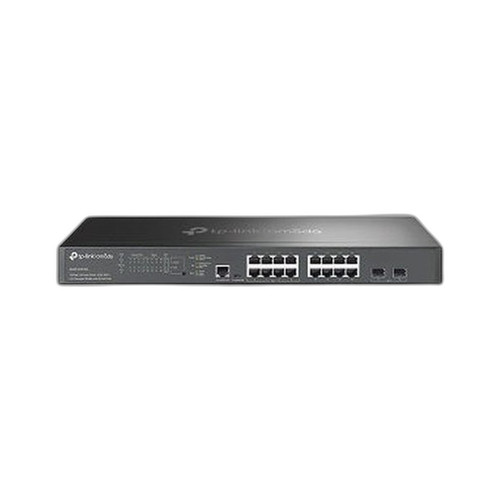
Both products are TP-Link Omada managed switches with 16 data ports in a rack-mount form factor, making them directly comparable for installers evaluating network infrastructure for IP security camera deployments or SMB LAN builds. The DS1016GE is a 1Gbps Easy Smart switch aimed at cost-sensitive, simpler managed deployments, while the SG3218XP-M2 is an L2+ managed switch with 2.5GBASE-T ports, 802.3bt PoE++, and 10G uplinks. A buyer choosing between these is trading simplicity and price point against throughput, PoE capability, and uplink speed.

In This Guide
- Which switch delivers the ports, speeds, and throughput your deployment actually needs?
- How do the two switches compare on PoE budget, power draw, and operating environment?
- What management depth and integration options does each switch support?
- Which should you choose: the DS1016GE or the SG3218XP-M2?
- Side-by-Side Specs
- FAQ
Which switch delivers the ports, speeds, and throughput your deployment actually needs?
The DS1016GE provides 16 RJ45 ports running at 1000 Mbps (1GbE). No switching capacity figure is provided in the supplied specifications. It is positioned for small-to-medium deployments where gigabit per-port bandwidth is sufficient.
The SG3218XP-M2 provides 16 RJ45 ports operating at 2.5GBASE-T, plus 2 dedicated 10G SFP+ uplink slots (dual-mode fiber). Switching capacity is specified at 80 Gbps with a throughput figure also listed as 80 Gbps. The 2.5G copper ports allow standard Cat5e cabling to carry 2.5× the bandwidth of gigabit without rewiring, a meaningful advantage in retrofit camera or Wi-Fi 6 AP deployments.
For deployments running high-resolution camera streams, multi-gig access points, or NVRs requiring fast uplink aggregation, the SG3218XP-M2's 2.5G access ports and 10G uplinks represent a significant capacity advantage. The DS1016GE's switching capacity is not specified, which limits direct numerical comparison on this dimension.
How do the two switches compare on PoE budget, power draw, and operating environment?
The DS1016GE lists PoE as a feature, but no PoE standard (802.3af/at/bt), total PoE budget in watts, or per-port wattage is provided in the supplied specifications. Buyers requiring PoE must verify these figures from the datasheet before specifying.
The SG3218XP-M2 specifies 802.3bt (PoE++) with 802.3af/at backward compatibility and a total PoE budget of 240W across 8 powered ports. The power supply is rated 100–240V AC, 50/60 Hz; total power consumption is listed at 240W. Maximum heat dissipation is 51.18 BTU/hr. Operating temperature is 0°C to 50°C (32°F to 122°F).
For camera deployments using high-wattage devices such as PTZ cameras, multi-sensor units, or 802.3bt-powered Wi-Fi 6 APs, the SG3218XP-M2's 240W PoE++ budget and confirmed 802.3bt standard are decisive. The DS1016GE's PoE spec is unconfirmed from the provided data, making it unsuitable to spec into a PoE-dependent design without consulting its datasheet.
What management depth and integration options does each switch support?
The DS1016GE is described as an 'Easy Smart' switch managed via a web interface. Supported features listed are VLAN, QoS, and IGMP snooping. No CLI, SNMP version, RMON, or routing protocol support is mentioned in the provided specifications. The management model is browser-only, which suits IT teams without dedicated network engineering resources.
The SG3218XP-M2 is an L2+ managed switch supporting CLI, SNMP v1/v2c/v3, and RMON in addition to a web interface. Operating modes include Static Routing, VLAN, QoS, ACL, and STP/RSTP/MSTP. Flash storage is 32 MB. The SNMP and RMON support enables integration with network management systems (NMS) and allows proactive alerting on switch status.
For enterprise-adjacent or multi-site deployments where NMS integration, ACL-based security policy, or spanning tree fault tolerance is required, the SG3218XP-M2's CLI and SNMP v3 support is a clear differentiator. The DS1016GE's Easy Smart positioning is appropriate for straightforward VLANs and QoS at a site where browser management is acceptable and NMS integration is not needed.
Which should you choose: the DS1016GE or the SG3218XP-M2?
Our take: The SG3218XP-M2 is the stronger choice when the deployment requires PoE-powered devices, higher per-port throughput, or integration with a network management system. Concretely: it delivers 2.5GBASE-T on all 16 access ports versus the DS1016GE's 1GbE, a confirmed 240W 802.3bt PoE++ budget versus an unspecified PoE capability on the DS1016GE, and L2+ management with SNMP v3/CLI/ACL versus browser-only Easy Smart controls. The DS1016GE is the appropriate selection for cost-sensitive, non-PoE or lightly managed gigabit LAN segments where VLAN and IGMP snooping cover the full feature requirement and where a simpler management model reduces operational overhead. Installers should note that the DS1016GE's PoE specification is absent from the provided data and must be confirmed from the datasheet before it is written into any PoE device design.
Side-by-Side Comparison
Spec-for-spec, from manufacturer data.
| Specification | TP-Link DS1016GE | TP-Link SG3218XP-M2 |
|---|---|---|
| Product Type | Easy Smart Managed Switch | L2+ Managed Switch |
| Access Port Count | 16 | 16 |
| Access Port Speed | 1000 Mbps (1GbE) | 2.5GBASE-T |
| Uplink Ports | — | 2 × 10G SFP+ |
| Switching Capacity | — | 80 Gbps |
| PoE Standard | PoE (standard not specified) | 802.3bt (PoE++), 802.3af/at |
| PoE Budget | — | 240 W |
| Powered Ports | — | 8 |
| Power Supply | — | 100–240 V AC, 50/60 Hz |
| Total Power Consumption | — | 240 W |
| Management Interface | Web (browser) | Web, CLI, SNMP v1/v2c/v3, RMON |
| Layer | L2 (Easy Smart) | L2+ |
| Supported Protocols | VLAN, QoS, IGMP Snooping | VLAN, QoS, ACL, STP/RSTP/MSTP, Static Routing |
| Flash Storage | — | 32 MB |
| Operating Temperature | — | 0°C to 50°C (32°F to 122°F) |
| Form Factor | 1U 19-inch Rack / Wall-Mount | Rack (11.6 × 7.1 × 1.7 in) |
Frequently Asked Questions
Which should you choose: the DS1016GE or the SG3218XP-M2?
The SG3218XP-M2 is the stronger choice when the deployment requires PoE-powered devices, higher per-port throughput, or integration with a network management system. Concretely: it delivers 2.5GBASE-T on all 16 access ports versus the DS1016GE's 1GbE, a confirmed 240W 802.3bt PoE++ budget versus an unspecified PoE capability on the DS1016GE, and L2+ management with SNMP v3/CLI/ACL versus browser-only Easy Smart controls. The DS1016GE is the appropriate selection for cost-sensitive, non-PoE or lightly managed gigabit LAN segments where VLAN and IGMP snooping cover the full feature requirement and where a simpler management model reduces operational overhead. Installers should note that the DS1016GE's PoE specification is absent from the provided data and must be confirmed from the datasheet before it is written into any PoE device design.
Can either switch power PTZ cameras or multi-sensor cameras over PoE++?
Only the SG3218XP-M2 is specified with 802.3bt (PoE++) support and a 240W total budget across 8 ports, which is compatible with high-wattage PTZ and multi-sensor cameras. The DS1016GE lists PoE as a feature but provides no PoE standard or budget in the supplied specifications, so its suitability for PoE++ devices cannot be confirmed from the available data.
Is the DS1016GE or SG3218XP-M2 better for a deployment that already runs Cat5e cabling?
The SG3218XP-M2 is specified to support 2.5GBASE-T over Cat5e, enabling 2.5× the bandwidth of gigabit without rewiring. The DS1016GE operates at 1GbE, which also runs on Cat5e but caps per-port bandwidth at 1 Gbps. If the goal is to extract more throughput from existing Cat5e infrastructure, the SG3218XP-M2 provides a measurable advantage.
Which switch is appropriate if the site uses a network management system (NMS) for monitoring?
The SG3218XP-M2 supports SNMP v1/v2c/v3 and RMON, which are standard protocols for NMS integration and alerting. The DS1016GE's provided specifications list only web-interface management with VLAN, QoS, and IGMP snooping; no SNMP support is mentioned. For any deployment requiring NMS polling or trap-based alerting, the SG3218XP-M2 is the specified option.
More Network Switch Comparisons
- TP-Link SG3218XP-M2 vs Ubiquiti USW-PRO-MAX-16
- TP-Link SG3218XP-M2 vs TP-Link DS1016G
- TP-Link SG3218XP-M2 vs TP-Link SG2218
- TP-Link DS1016G vs Ubiquiti USW-PRO-MAX-16
- TP-Link DS1016G vs TP-Link SG2218
- TP-Link SG2218 vs Ubiquiti USW-PRO-MAX-16
Network Switch Buying Guides
Get a Second Opinion on Your Camera Choice
Share your site layout, coverage goals, and budget. Our team will validate the camera selection, flag anything we would change, and recommend products that match the use case.