
NETGEAR GS348PP-100NAS vs Ubiquiti ES-48-500W: Specification Comparison
Both the NETGEAR GS348PP-100NAS and the Ubiquiti ES-48-500W are 1U-class, 48-port Gigabit PoE+ switches aimed at physical-security and enterprise-edge deployments where powering cameras, access-control readers, and wireless APs from a single device is the primary requirement. The comparison turns on three practical axes: port density and PoE power budget, uplink throughput and switching capacity, and management depth — all of which differ meaningfully between the two models.

In This Guide
- Which switch delivers more PoE power and how is that budget distributed across 48 ports?
- How do switching capacity, uplink speed, and management capability compare between the two switches?
- What are the physical installation requirements and form-factor differences between these two switches?
- Which should you choose: the GS348PP-100NAS or the ES-48-500W?
- Side-by-Side Specs
- FAQ
Which switch delivers more PoE power and how is that budget distributed across 48 ports?
The NETGEAR GS348PP-100NAS carries a 380W PoE budget across its 48 ports. Its spec sheet lists PoE++ (802.3bt) capability, though the Card Bullets describe 24 of those ports as PoE+ (802.3at) at the 380W shared total. Per-port wattage ceiling is not explicitly stated in the provided specs beyond the 802.3bt/at references and the 380W aggregate figure.
The Ubiquiti ES-48-500W provides a 500W shared PoE budget — 120W more than the NETGEAR — with a documented per-port maximum of 34.2W under PoE+ (802.3at). It also supports Passive PoE at 17W per port. The 500W figure appears consistently across multiple spec fields and the Card Bullets, giving higher confidence in that number.
For deployments where many ports carry high-draw devices simultaneously — PTZ cameras, dual-radio APs, or door controllers with electric locks — the ES-48-500W's 500W budget provides more headroom. The GS348PP-100NAS's 380W budget is workable for lighter mixed loads but constrained on dense, high-draw installations.
How do switching capacity, uplink speed, and management capability compare between the two switches?
The NETGEAR GS348PP-100NAS is an unmanaged switch. No CLI, no web GUI, no SNMP, and no VLAN capability are listed in its specs. Its form factor is listed as 'Unmanaged Switch.' Uplink ports are not explicitly broken out in the provided specs beyond the 48 Gigabit ports, and switching capacity figures are not provided in the spec data supplied.
The Ubiquiti ES-48-500W is a Layer 2/3 managed switch with a web GUI, CLI, SNMP, and an RJ45 serial console. It adds dual 10G SFP+ uplinks and dual 1G SFP ports beyond its 48 Gigabit RJ45 ports, yielding 52 total ports. Switching capacity is stated at both 140 Gbps (Card Bullets) and 20 Gbps (spec field) — these figures conflict in the provided data; the 20 Gbps field and 14.88 Mpps forwarding rate appear to reflect the RJ45 fabric, while 140 Gbps may reflect total switching capacity. Buyers should verify against the official Ubiquiti datasheet.
For segmented camera VLANs, ACLs, SNMP monitoring, or integration with a network management platform, only the ES-48-500W provides those capabilities. The GS348PP-100NAS offers none of that — it is plug-and-play with no configuration surface.
What are the physical installation requirements and form-factor differences between these two switches?
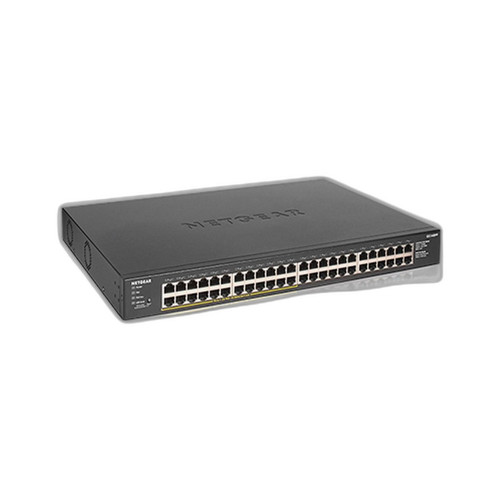
The NETGEAR GS348PP-100NAS specifies a plastic housing with wall and ceiling mounting options. It is not described as a rackmount unit in the provided specs, making it suited to closet or wall-mount installations where rack space is unavailable or cost-prohibitive. Weight is not provided in the spec data.
The Ubiquiti ES-48-500W is a 1U rackmount unit weighing 16.25 lbs. Its dimensions are listed as 204" × 43" × 235" — these values appear to contain a unit error in the source data (likely mm, not inches); buyers should confirm physical dimensions against the Ubiquiti datasheet before rack planning. It requires a standard 19-inch equipment rack.
The GS348PP-100NAS targets distributed or non-rack environments such as IDF closets or above-ceiling mounting. The ES-48-500W targets MDF or IDF rack bays in structured-cabling installations. Neither unit's operating-temperature range is provided in numerical form in the supplied specs, so environmental suitability for outdoor enclosures or unconditioned spaces cannot be confirmed from the data given.
Which should you choose: the GS348PP-100NAS or the ES-48-500W?
Our take: The ES-48-500W is the stronger choice when the installation requires network segmentation, centralized monitoring, or upstream bandwidth beyond 1G. It delivers a 500W PoE budget — 120W more than the GS348PP-100NAS's 380W — supports dual 10G SFP+ uplinks that the NETGEAR lacks entirely, and provides full Layer 2/3 management including VLAN, CLI, SNMP, and serial console access. The GS348PP-100NAS, conversely, is the appropriate choice when the environment is a small, isolated camera network that requires zero configuration, no rack space is available, and per-port power draw stays within the 380W aggregate. Its plastic wall/ceiling-mount housing suits distributed closet deployments the 1U rack-only Ubiquiti cannot address. Platform qualifier: the ES-48-500W integrates with managed network environments; the GS348PP-100NAS does not.
Side-by-Side Comparison
Spec-for-spec, from manufacturer data.
| Specification | NETGEAR GS348PP-100NAS | Ubiquiti ES-48-500W |
|---|---|---|
| PoE Standard | PoE++ (802.3bt) listed; PoE+ (802.3at) per Card Bullets | PoE+ (802.3at); Passive PoE 17W |
| PoE Power Budget | 380W total | 500W total |
| Per-Port PoE Maximum | Not stated in provided specs | 34.2W (PoE+); 17W (Passive PoE) |
| Total RJ45 Ports | 48 Gigabit | 48 Gigabit |
| SFP+ Uplink Ports (10G) | — | 2× SFP+ (10G) |
| SFP Uplink Ports (1G) | — | 2× SFP (1G) |
| Switching Capacity | Not provided in specs | 20 Gbps (spec field); 140 Gbps (Card Bullet) — conflicting values |
| Forwarding Rate | Not provided in specs | 14.88 Mpps |
| Management | Unmanaged | Layer 2/3; Web GUI; CLI; SNMP; RJ45 serial console |
| VLAN / ACL Support | Not supported (unmanaged) | Supported (Layer 2/3 managed) |
| Form Factor / Mounting | Plastic; Wall and Ceiling mount | 1U Rackmount; 16.25 lbs |
| Warranty | 5 years | Manufacturer Warranty (duration not specified in provided specs) |
| Certifications | Not listed in provided specs | CE, FCC, IC |
| Country of Origin | Not listed in provided specs | CN |
| Operating Temperature (numerical) | Not provided in specs | Not provided in specs |
Frequently Asked Questions
Which should you choose: the GS348PP-100NAS or the ES-48-500W?
The ES-48-500W is the stronger choice when the installation requires network segmentation, centralized monitoring, or upstream bandwidth beyond 1G. It delivers a 500W PoE budget — 120W more than the GS348PP-100NAS's 380W — supports dual 10G SFP+ uplinks that the NETGEAR lacks entirely, and provides full Layer 2/3 management including VLAN, CLI, SNMP, and serial console access. The GS348PP-100NAS, conversely, is the appropriate choice when the environment is a small, isolated camera network that requires zero configuration, no rack space is available, and per-port power draw stays within the 380W aggregate. Its plastic wall/ceiling-mount housing suits distributed closet deployments the 1U rack-only Ubiquiti cannot address. Platform qualifier: the ES-48-500W integrates with managed network environments; the GS348PP-100NAS does not.
Is the GS348PP-100NAS or ES-48-500W better for larger deployments with PTZ cameras and dual-radio APs?
The ES-48-500W is better suited to that scenario. Its 500W PoE budget (vs. the GS348PP-100NAS's 380W) provides more headroom for high-draw devices, and its documented 34.2W per-port ceiling under 802.3at covers most PTZ and dual-radio AP requirements. The GS348PP-100NAS's per-port ceiling is not explicitly stated in the provided specs, and its 380W aggregate constrains simultaneous high-draw loads.
Can the GS348PP-100NAS be managed remotely or integrated with SNMP monitoring tools?
No. The GS348PP-100NAS is listed as an unmanaged switch in its specs. It provides no web GUI, CLI, SNMP, or VLAN capability. The ES-48-500W supports all of those management interfaces, including an RJ45 serial console for out-of-band access.
Does either switch support 10G uplinks to a core switch or NVR?
Only the ES-48-500W provides 10G uplinks — two SFP+ ports rated at 10G plus two additional 1G SFP ports. The GS348PP-100NAS spec data does not list any dedicated uplink ports or speeds beyond its 48 Gigabit RJ45 ports, so 10G upstream connectivity is not supported based on the provided specifications.
More Network Switch Comparisons
- NETGEAR GS748PP-100NAS vs Ubiquiti USW-48-POE
- NETGEAR GS748PP-100NAS vs Ubiquiti USW-PRO-MAX-48-POE
- NETGEAR GS748PP-100NAS vs Ubiquiti USW-ENTERPRISE-48-POE
- NETGEAR GS748PP-100NAS vs Ubiquiti ES-48-500W
- NETGEAR GS748PP-100NAS vs NETGEAR GS348PP-100NAS
- Ubiquiti USW-48-POE vs NETGEAR GS348PP-100NAS
Network Switch Buying Guides
Get a Second Opinion on Your Camera Choice
Share your site layout, coverage goals, and budget. Our team will validate the camera selection, flag anything we would change, and recommend products that match the use case.