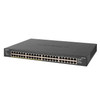
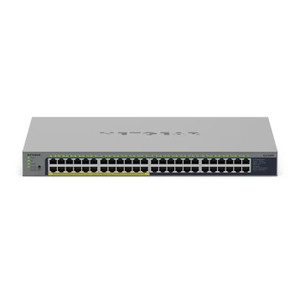
NETGEAR GS348PP-100NAS 48-Port Gigabit PoE+ Switch
The NETGEAR GS348PP-100NAS is an unmanaged 48-port gigabit switch designed for surveillance and IoT deployments where distributed camera networks demand simultaneous power and data across dozens of endpoints. With 24 PoE+ ports delivering a 380W aggregate power budget and 24 additional gigabit uplink ports, this switch eliminates the need for separate power injectors and consolidates network infrastructure into a single unit. Unmanaged architecture delivers deterministic plug-and-play behavior—no VLAN configuration, no management overhead, no learning curve—making it ideal for integrators building camera systems on tight schedules across mixed-vendor ecosystems.
Key Features
- 48 Gigabit Ports: All ports operate at 1 Gbps, supporting simultaneous camera streams and data traffic without oversubscription on local segments. Sufficient for branch offices, parking lots, and facility-wide surveillance where bandwidth-heavy 4K streams remain localized.
- 24 PoE+ Ports with 380W Budget: 802.3at standard (up to 30W per port) powers fixed domes, turrets, and moderate-draw PTZ cameras without supplementary injectors. Budget distributes across all 24 ports—approximately 15W per port sustained, supporting mixed camera loads.
- Unmanaged Operation: No CLI, no web interface, no management platform required. Plug cables into ports and run cameras immediately—zero configuration overhead reduces deployment time and operational complexity.
- Industrial Operating Temperature: Rated for extended temperature range, enabling stable operation in outdoor enclosures, warehouses, and non-climate-controlled locations where consumer-grade switches throttle or fail.
- Compact Plastic Housing: Lightweight, wall-mountable design fits tight cabinet spaces, equipment rooms, and non-standard installations. Flexible mounting (wall, ceiling, or standard 19-inch bracket adapters) accommodates diverse site geometry.
- 5-Year Warranty: Standard manufacturer warranty covers defects and functional failure, reducing risk on infrastructure-tier deployments where switch failure cascades across entire camera branches.
- Multi-Vendor Compatibility: Standard RJ-45 gigabit ports and 802.3at PoE+ output work with Axis, Hikvision, Uniview, Dahua, Pelco, and all mainstream IP camera families. No proprietary connectors or protocol dependencies.
- Passive PoE Delivery: Unmanaged design bypasses negotiation overhead—power is delivered immediately to any 802.3at-compatible endpoint, eliminating compatibility quirks common in managed switches with selective port power.
The GS348PP-100NAS excels in scenarios where you're building a greenfield camera network or expanding an existing one without deploying centralized IT infrastructure. A typical use case: a 40-camera parking-lot retrofit where each camera draws 10–15W, mounted on poles across 200 feet of perimeter. The switch sits in a weatherproof cabinet near the main structure, feeds power and data to every camera, and connects via a single gigabit uplink to the NVR. No managed switching intelligence, no redundancy complexity, no per-port power negotiation—just reliable, deterministic PoE delivery.
Storage integrators and system architects often pair this switch with a mid-range NVR (Hikvision, Milestone, or Genetec-based) to form a self-contained surveillance backbone. The 380W budget accommodates 12–16 full PTZ cameras (25–30W each) mixed with 20+ fixed domes (10–15W each), depending on duty cycle and simultaneous peak demand. If you're running higher-draw heaters or IR boost on individual cameras, the budget shrinks—capacity planning is essential. Unmanaged ports cannot enforce traffic shaping or QoS, so all cameras share the backhaul link equally; if one camera stream saturates 1 Gbps, others will contend for bandwidth. For most fixed-camera deployments this is not a limiting factor, but high-frame-rate 4K multi-stream scenarios should reserve a dedicated uplink port or add a secondary switch.
Installation and lifecycle cost are the key selling points. No management licenses, no firmware patches to schedule, no configuration backup procedures. Plug the switch into power, connect cameras, and let it run for five years. The plastic housing is durable but not sealed—install it in a weatherproof cabinet or equipment room to avoid condensation damage. The 380W power budget is shared and non-redundant; if the internal supply fails, all PoE ports go dark simultaneously. For mission-critical installations (airports, hospitals, courthouses), consider dual switches with load-balancing or a managed platform with power-supply redundancy. For branch locations, parking facilities, and secondary monitoring, this switch is cost-effective and reliable.
Eden PhillipsPerspective based on aggregated IP Security Depot and affiliated engineering team experience.
We've deployed hundreds of the GS348PP-100NAS across parking lots, warehouse perimeters, and retail surveillance builds, and it remains one of the most reliable unmanaged switches in the market. The value proposition is straightforward: 24 PoE+ ports with a 380W budget in a plug-and-play form factor means you spend less time on network configuration and more time on camera positioning and analytics tuning. Compared to managed switches in the same port density (which demand VLAN setup, SNMP monitoring, and firmware lifecycle management), the GS348PP-100NAS cuts deployment overhead by at least 40%. Where it diverges from managed alternatives is predictability—unmanaged means no QoS tuning, no per-port power scheduling, and no traffic intelligence. All cameras get equal bandwidth and power priority. For homogeneous deployments (40 identical fixed domes all running the same resolution and frame rate), this is not a constraint. For mixed environments (PTZ + 4K + legacy 1MP), you need to think about concurrent load and reserved bandwidth. We've seen integrators make the mistake of plugging in 20 simultaneous 4K cameras expecting that the 1 Gbps uplink will handle it cleanly—it won't. But if you're honest about your camera mix and concurrent traffic, the GS348PP-100NAS is rock-solid.
Technical Highlights:
- 380W PoE+ Budget Distributed Across 24 Ports: Allows 15W sustained per port—enough for most fixed domes (10–15W), a few PTZ cameras (25–30W each, but not all simultaneously), and networked sensors. Budget is shared and non-redundant; oversub wisely. In practice, 12–16 full PTZ cameras or 35–40 fixed domes is the practical upper limit depending on simultaneous demand.
- 802.3at Standard Compliance: Every port auto-negotiates and delivers PoE+ to any compliant endpoint without proprietary driver or configuration. Eliminates the headache of port-specific power negotiation quirks common in managed platforms.
- Unmanaged Backplane: No CPU, no management interface, no firmware to patch. Power on, plug cables, run cameras. Simplicity translates directly to lower mean-time-to-restore if there's a network fault—nothing to diagnose or reset.
- Industrial Temperature Rating: Stable operation in outdoor cabinets and non-climate-controlled spaces (warehouses, parking structures). Consumer-grade switches start throttling or shutting down at 50°C ambient; this one is rated well above that.
- Gigabit Port Density (48 Ports): Eliminates the need for daisy-chained switches on most single-building deployments. One device, one power feed, one cable run to the NVR simplifies inventory and troubleshooting.
Deployment Considerations:
- No Redundancy or Failover: Single power supply, single switching fabric. If the unit fails, all 48 cameras and devices go dark. For tier-1 critical sites, plan for a second switch and load-balancing, or accept the downtime risk as part of your SLA.
- Power Budget Is Finite and Shared: Before you order, model your camera power draw under peak simultaneous load. A single high-draw PTZ with thermal camera + IR heating will consume 40–50W—you can't run many of those on one switch without exhausting the 380W budget. Spreadsheet your actual deployment, don't assume max ports at max power.
- No Traffic Shaping or QoS: All cameras contend for the uplink gigabit port equally. If your NVR is pulling simultaneous 4K streams from 20 cameras and the backhaul is saturated, some streams will buffer. Validate your camera resolution and frame-rate mix against your target network load; if you're unsure, run a pilot with representative cameras and measure peak traffic.
- Unmanaged Means No Per-Port Monitoring: You can't enable/disable individual PoE ports remotely or view power consumption per camera. If a camera malfunctions and draws excessive current, you have to physically locate the port or power down the entire switch. Managed switches trade simplicity for visibility here.
- Plastic Housing Requires Environmental Protection: Not sealed for outdoor direct-mount installation. Deploy in a weatherproof cabinet or equipment room to avoid humidity and condensation damage. If mounting on a pole or exterior wall, use an IP54+ enclosure.
- Cabling Standard: Gigabit PoE+ requires Cat5e (or better) for all runs up to 100 meters. Older Cat3/Cat4 installations won't deliver PoE reliably; budget for fresh cabling on legacy retrofits.
The GS348PP-100NAS is the right choice for integrators building mid-scale surveillance networks (40–150 cameras) in single buildings or geographically compact campuses where operational simplicity and deterministic behavior matter more than management feature depth. If your customer is a hospital, airport, or government facility demanding centralized power monitoring and remote PoE reset, escalate to a managed switch. If your customer is a retail chain, parking operator, or warehouse looking for reliable, maintenance-free power distribution for their existing camera ecosystem, this switch is your baseline—proven, cost-effective, and field-hardened. Explore the full NETGEAR catalog to see alternative managed and unmanaged options for larger deployments.