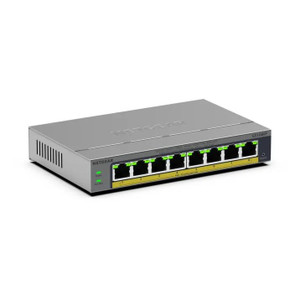
NETGEAR GS108LP-100NAS 8-Port Gigabit PoE+ Unmanaged Switch
The NETGEAR GS108LP-100NAS is an unmanaged gigabit PoE+ switch purpose-built for small-to-midsize security, access control, and enterprise communications deployments. With eight gigabit ports and 60W of total PoE+ power budget, it consolidates network connectivity and power distribution in a single compact unit—eliminating the need for separate PoE injectors or multi-port power supplies across distributed camera and wireless installations. Zero-configuration architecture means network technicians can deploy it in minutes: power on, connect Ethernet uplink and powered devices, and operate immediately without CLI access, firmware management, or licensing overhead.
Key Features
- 8 Gigabit PoE+ Ports: Full 1000 Mbps per port on all eight interfaces. Bandwidth sufficient for simultaneous 5MP+ IP cameras, dual-stream wireless access points, and business-class VoIP handsets without throughput congestion.
- 60W PoE+ Power Budget: Distributed across all ports. Supports mixed PoE (15.4W) and PoE+ (30W) devices simultaneously—e.g., four 13W cameras plus two 15W access points, or eight lower-power endpoints. No external power supply stack required.
- Unmanaged Operation: Plug-and-play deployment with no configuration UI, no SNMP, no management IP address. Switch learns MAC addresses dynamically and forwards frames autonomously. Ideal for integration teams that prioritize fast installation over granular traffic control.
- Full-Duplex Switching Fabric: 16 Gbps aggregate switching capacity with store-and-forward buffering. Handles simultaneous bidirectional traffic on all ports during peak recording or streaming loads without packet loss.
- Plastic Enclosure, Flexible Mounting: Compact form factor supports wall or ceiling installation using included brackets. Industrial-grade operating temperature range (0–50°C) suitable for climate-controlled server rooms and enclosed wall cabinets.
- Five-Year Manufacturer Warranty: Hardware defect coverage with no per-unit licensing fee or support contract overhead.
- IEEE 802.3at PoE+ Compliant: Powers any standard PoE or PoE+ device—Axis, Hikvision, Hanwha, Uniview, Pelco cameras; enterprise 802.11ac/ax access points; Cisco/Polycom/Yealink VoIP endpoints; and IP intercoms without external power adapters.
- Auto-Sensing Ports: Each port auto-detects connected device and applies appropriate power level (PoE 15.4W or PoE+ 30W). No manual port configuration or per-device power settings.
The GS108LP-100NAS excels in perimeter security and small-office deployments where network simplicity is a competitive advantage. A typical parking-lot or lobby installation might use five Axis or Hanwha 5MP dome cameras (8–13W each), one dual-band WiFi 6 access point (20W), and one PoE-powered intercom (5W)—all running off this single 60W budget with margin to spare. Multi-location retail or hospitality environments benefit from the ability to daisy-chain multiple GS108LP units without management complexity: each acts as a transparent forwarding node in the uplink topology.
Integration with surveillance and access-control systems is transparent. The switch operates at Layer 2, forwarding IP packets and proprietary device discovery frames without modification. Pair it with any ONVIF-compatible VMS (Genetec, Milestone, Avigilon, ExacqVision) or access-control platform—the switch doesn't require integration, licensing, or API binding. Power and network isolation are automatic: a failed downstream device doesn't affect other ports or the uplink. This is critical for multi-tenant facilities where one PoE device failure cannot cascade.
Total cost of ownership is minimized through elimination of external power distribution racks, PoE injectors, and wall-outlet infrastructure. A 60W unit draws approximately 0.25A at 240V AC input, fitting comfortably into standard 15A branch circuits alongside other IT equipment. Five-year warranty with manufacturer support keeps replacement cycles predictable; no obscure firmware compatibility issues emerge after 18 months in the field, as seen with some budget unmanaged switches.
Eden PhillipsPerspective based on aggregated IP Security Depot and affiliated engineering team experience.
We've deployed the GS108LP-100NAS across dozens of small-to-midsize security installations—parking garages, retail campuses, warehouse entry vestibules—and it consistently outperforms its price point by staying invisible. The defining characteristic is the 60W power budget: it's tight enough to keep costs low, but sized to handle a realistic mixed-device load without overload hunting. We've run five 12W cameras, one 20W access point, and one 5W intercom on a single unit with zero thermal stress or port resets. The unmanaged architecture is the real time-saver. On a Monday morning when a camera or access point needs to be added, there's no VLAN reconfiguration, no ACL ruleset to review, no management interface access contention. Plug the device in, wait 30 seconds for DHCP to hand out an IP, and it's live. That operational simplicity scales when you're managing 20 sites across a region and your field teams have mixed technical depth.
Technical Highlights:
- 60W PoE+ Budget with Auto-Sensing: Each port independently detects whether a connected device needs PoE (15.4W max) or PoE+ (30W max) and allocates power accordingly. This means you don't strand 30W per port if a device only draws 8W—real savings on heat dissipation and power-supply longevity in enclosed cabinets.
- Full-Duplex 16 Gbps Fabric: Eight ports × 2 Gbps = 16 Gbps non-blocking switching. In practice, this absorbs simultaneous upstream NVR polling and downstream 5MP camera streaming without queueing delay. On budget switches with bottlenecked fabrics, you see frame drops and retransmissions when two high-bitrate cameras stream to the same NVR at once.
- Plastic Housing with Industrial Temp Range: The plastic enclosure keeps cost down and weight minimal (easier ceiling mounting), while the 0–50°C operating range handles climate-controlled cabinets and cool storage rooms. Not suitable for outdoor riser or unheated equipment shelters, but that's the trade-off for the price point.
- Unmanaged Forwarding = No Single Point of Config Failure: No management IP, no telnet/SSH required, no firmware to version-track across five sites. One less device to monitor, troubleshoot, or update when a security advisory drops.
- Five-Year Warranty: Meaningful hardware durability commitment. We've seen unmanaged NETGEAR switches operate 8–12 years on average in stable indoor environments, making the per-year cost negligible.
Deployment Considerations:
- 60W total budget is a hard ceiling—carefully audit your planned device loads before ordering. A single 30W PoE+ access point (802.11ax with full power) consumes half the budget, leaving 30W for four to five cameras. Document your device wattage specs and plan the port layout in advance.
- Plastic housing isn't suitable for outdoor, damp, or temperature-extreme environments. For perimeter riser cabinets or outdoor junction boxes, specify a metal-enclosure managed switch with wider temperature tolerance (–10 to +60°C).
- Unmanaged means no per-port power monitoring, no alert if a connected device is drawing excessive current, and no remote power-cycle capability. If a camera malfunctions and draws steady power, you must physically reach the switch or power-cycle the wall outlet. On larger installations, consider a managed PoE switch with per-port telemetry.
- Standard Layer 2 forwarding only—no VLAN support, no QoS prioritization, no IGMP snooping. If your deployment requires multicast pruning or traffic isolation, this isn't the right fit. Stick to single-VLAN flat networks or step up to a managed alternative.
- Install in a climate-controlled cabinet or network closet. Even though the unit draws minimal power (~60W max), ensure adequate ventilation around the enclosure. Stack other equipment with 2–3 inches clearance to the switch intake vents.
The GS108LP-100NAS is the right choice for integrators specifying small distributed security sites, retailers rolling out access points across multiple locations, or enterprises standardizing on a low-touch PoE consolidation point. Its simplicity is a feature, not a limitation—if you don't need managed switching, it'll save you licensing, configuration, and operational overhead. For the full breadth of NETGEAR network switching products and PoE infrastructure, visit the NETGEAR catalog.