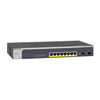
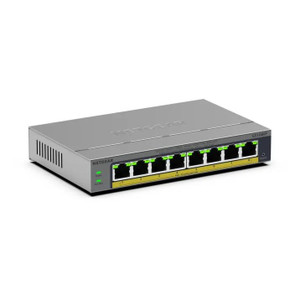
NETGEAR GS510TPP-100NAS 8-Port Gigabit PoE+ Smart Managed Switch
The NETGEAR GS510TPP-100NAS is a compact 8-port Gigabit PoE+ smart-managed switch engineered for distributed IP security, wireless, and IoT deployments where space and power consolidation matter. Every port delivers simultaneous 1000 Mbps Ethernet and PoE+ power at up to 30W per port, with a 240W total power budget supporting all eight ports at full draw. The smart-managed feature set—including VLAN segmentation, QoS traffic prioritization, and web GUI/CLI configuration—lets integrators isolate surveillance streams from office traffic and prevent bandwidth starvation during high-density video recording or dual-band AP provisioning. Compact plastic enclosure mounts on wall or ceiling, fitting into distributed edge closets, electrical rooms, and cable-tray installations where rack footprint is unavailable.
Key Features
- 8 Gigabit Ports with PoE+: All ports deliver 1000 Mbps + PoE+ (802.3at, 30W per port). Supports any standards-compliant PoE-hungry camera, access point, or networked sensor without separate power infrastructure.
- 240W Total Power Budget: Sufficient for all eight ports at maximum draw—no throttling if you load 8× 30W devices simultaneously. Plan staging carefully on initial deployment to avoid brownout.
- Smart-Managed Architecture: Web GUI and CLI configuration; VLAN tagging for traffic isolation; QoS with priority queuing to protect video bitstreams from office-network congestion.
- Compact Wall/Ceiling Mount: Plastic desktop or wall-bracketed form factor; no rack rails required. Mounts in 2–3 minutes with included hardware, ideal for perimeter closets and above-ceiling distribution.
- Cat5e/Cat6 Compatible: Standard RJ45 connectors; works with any Gigabit Ethernet cabling at distances up to 100 meters—no proprietary connectors or special cable runs.
- Wide Device Compatibility: Upstream of NETGEAR Insight APs, NETGEAR Business Essentials WiFi, and third-party PoE IP cameras (Axis, Hikvision, Uniview, Hanwha, etc.)—any device certified for 802.3at/802.3bt power.
- Bandwidth Management: QoS controls assign priority to video and critical traffic, preventing bitrate drops when multiple cameras and office devices compete for uplink capacity.
- 5-Year Manufacturer Warranty: Factory-new genuine product backed by NETGEAR standard terms, sourced direct from the manufacturer or US channel partner.
In small-to-mid-size security builds, this switch consolidates power and data in a single compact footprint. Eight simultaneous PoE+ ports mean you can hydrate eight full-power cameras (or access points, or 4× cameras + 2× APs + sensors) without running separate DC runs or stacking multiple wall adapters. The 240W ceiling enforces realistic planning—if you need to support 10–12 cameras, you'll need two switches or hybrid power solutions, and the GS510TPP forces that conversation early.
Smart management features distinguish this unit from unmanaged alternatives. VLAN segmentation lets you isolate guest WiFi from surveillance without Layer 3 routing overhead. QoS packet tagging prioritizes H.264/H.265 video streams so that a burst of office file transfers doesn't drop camera frames. CLI and web configuration run on any standard Gigabit uplink—no special software installation, no learning curve for integrators already managing heterogeneous vendor networks.
Deployment context matters: this switch shines in distributed architectures—branch offices with 4–6 cameras, parking structures with local AP coverage, retail locations with a single closet serving both security and WiFi. In large centralized NOCs, you'd reach for industrial-grade managed switches with redundancy and modular expansion. The plastic housing is appropriate for indoor mounting; avoid direct sunlight, standing water, and prolonged exposure above 40°C. Wall and ceiling mounts accommodate cable-tray routes and above-dropped-ceiling runs without ducting or conduit.
The GS510TPP-100NAS integrates transparently into NETGEAR Insight cloud management if you're running Insight-capable APs on the same circuit, but operates independently if you don't need Insight. Standard ONVIF-compliant IP cameras and third-party access points require only web GUI or CLI setup—no proprietary software lock-in. Power consumption itself is modest (~15–20W idle, scaling to full 240W draw); pair the external adapter with a UPS output if surveillance uptime is non-negotiable during mains failures.
Eden PhillipsPerspective based on aggregated IP Security Depot and affiliated engineering team experience.
We've spec'd the GS510TPP-100NAS into branch-office and distributed-site security builds for years—it's the switch we reach for when an integrator says "I need PoE+ for 6–8 devices and I don't have a network closet." The appeal is straightforward: 240W budget supports a realistic 6–7 full-power cameras or a 4-camera + 2-AP mix without cascading switches or hunting for wall outlets. Smart-managed features—specifically VLAN and QoS—are table stakes once you're splitting surveillance and office WiFi over the same uplink. We've seen too many integrators spec unmanaged switches and then watch video bitrate collapse during business hours when the marketing team uploads video to the cloud. This switch prevents that.
The trade-off is obvious: plastic housing and 240W cap. If your deployment demands 12+ cameras or harsh industrial conditions (salt spray, vibration, extreme temperature swings), you need industrial-grade metal switches and redundant power supplies. In a clean office closet or above a dropped ceiling in a retail location, plastic is fine. The 240W limit is real—if all eight ports draw 30W simultaneously, you're at ceiling. In practice, most PoE devices idle lower and spike only during provisioning or heavy traffic; we size conservatively and usually see 140–180W sustained across a diverse deployment.
Technical Highlights:
- PoE+ 802.3at (30W per port): Standard power delivery for Axis, Hikvision, and NETGEAR APs. Sufficient for turret cameras, small domes, and dual-band APs; insufficient for pan-tilt-zoom heads or high-wattage thermal. Know your device power consumption before finalizing the topology.
- 240W Total Budget (scaled across 8 ports): Means you can run 8× cameras at 30W each simultaneously, or 6× cameras + 2× APs, or hybrid mixes—but not oversubscribed. Use a power calculator (NETGEAR publishes one) at design time to avoid field surprises.
- Gigabit Switching Fabric: All ports forward at line rate (1000 Mbps). No bottleneck between cameras and NVR on the backhaul, assuming your uplink to the core network or NVR is also Gigabit or higher.
- Smart Managed (VLAN + QoS): Tag surveillance traffic on VLAN 10, office on VLAN 20. QoS rules can prioritize video during congestion. This is the difference between a camera app that freezes occasionally versus one that stays live during business hours.
- Wall/Ceiling Flexibilty: Includes brackets for both mounting orientations. Cable entry is top/back, so plan your patch routes before mounting to avoid sharp bends.
Deployment Considerations:
- Power Budget is a Hard Ceiling: If you load all eight ports at 30W each, the power supply limits you. Most PoE devices won't draw 30W at idle, but thermal cameras, IP intercoms, and PTZ units will. Verify device datasheets and build a power worksheet before installation.
- Plastic Housing — Indoor Only: Not rated for outdoor or salt-spray environments. Install in conditioned space (closet, server room, above ceiling). If you need PoE+ outdoors or in an electrical enclosure, spec industrial-grade managed switches instead.
- UPS Recommend for Surveillance Continuity: The external power adapter is not PoE-powered itself, so mains loss stops all PoE delivery. If you're feeding an NVR and cameras from this switch, put it on a small UPS to maintain recording during brief outages.
- Uplink Port Selection Matters: All eight ports are PoE+ only—there's no dedicated uplink. If you need gigabit backhaul to your NVR or core switch, use one of the eight ports and reduce the number of available PoE endpoints by one.
- Configuration Persistence: VLAN and QoS settings survive power-off, but there's no SNMP traps or syslog forwarding in this smart-managed tier. If you need remote alerting or detailed analytics, integrate with a management platform or add monitoring at the NVR level.
The GS510TPP-100NAS is the right fit for integrators building branch-office or distributed-site deployments where 6–8 PoE devices need compact, wall-mounted consolidation and traffic isolation. It's not the choice for large centralized NOCs, outdoor harsh environments, or designs that demand 12+ simultaneous PoE endpoints. Check the NETGEAR catalog for industrial-managed switches if you need redundancy or hardened enclosures.