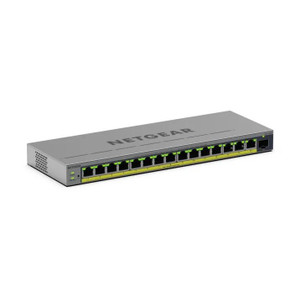
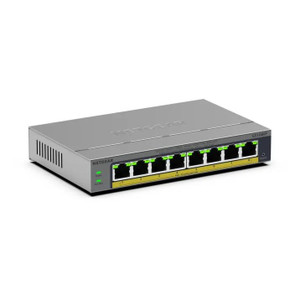
NETGEAR GS748PP-100NAS 48-Port Gigabit PoE+ Switch
The NETGEAR GS748PP-100NAS is a 48-port unmanaged Gigabit Ethernet PoE+ switch engineered for surveillance, access control, and IoT infrastructure where consolidated power delivery and network connectivity must work without management overhead. The 96 Gbps non-blocking switching fabric ensures all 48 ports can sustain simultaneous full-duplex Gigabit traffic without bottlenecks or latency — critical when deploying dozens of concurrent IP camera streams to an NVR or cloud recording service. Each port delivers up to 30W PoE+ power, eliminating separate PSU runs to wall outlets and reducing installation labor on IP cameras, PTZ units, wireless access points, VoIP endpoints, and any standards-compliant PoE device. Unmanaged operation means zero configuration: plug in power, connect devices, and the switch begins forwarding frames immediately — no VLAN provisioning, no CLI access, no license renewal cycles.
Key Features
- 48 Gigabit Ports with PoE+ per Port: 30W per port, 802.3at compliant. Powers standard IP cameras (15–25W), compact PTZ units, and enterprise access points without external power bricks.
- 96 Gbps Non-Blocking Fabric: All 48 ports sustain simultaneous full-duplex 1 Gbps — no congestion, no packet drop under peak surveillance load (typical multi-stream camera configurations).
- Unmanaged, Plug-and-Play Operation: No VLAN configuration, no firmware updates, no management station required. Connects to any Gigabit network; integrates with all standard VMS and NVR platforms via standard Ethernet.
- Extended Cabling Support (2000m): Supports standard Cat5e/Cat6 runs to remote camera locations without signal conditioning or active extenders.
- Rackmount + Desk Form Factor: Includes metal 19-inch rack brackets; operates stably on shelf or desk in small-footprint deployments (schools, retail, small campuses).
- Operating Temperature –20°C to 70°C: Suitable for climate-controlled telecom closets and indoor equipment rooms; not rated for outdoor or unheated enclosures.
- Metal Connectors, Industrial Grounding: RJ45 ports with metal housings resist corrosion in humidity-prone environments; supports standard Earth grounding for EMI suppression.
- Dynamic PoE Allocation: Detects per-port power demand and supplies only what each device consumes — allows mix of high-power PTZ (60–95W with standard PoE++) and low-power sensors (5–10W) without undersizing power budget.
The unmanaged architecture is the key leverage point in surveillance builds: you avoid the capex and operational tax of managed switches (licenses, firmware maintenance, complexity in multi-site deployments) while retaining the flexibility to add cameras, access points, and intercoms on demand. For a 50-camera warehouse renovation, that difference compounds quickly. Each of the 48 ports is identical — no uplink configuration, no port prioritization tuning, no spanning-tree headaches.
Compatibility spans every mainstream IP camera manufacturer (Axis, Hikvision, Hanwha, Pelco, Vivotek, Dahua) and enterprise access-control hardware (HID, Salto, Kisi, DoorKing). Any device with a Gigabit NIC and 802.3af/PoE+ power draw under 30W per port integrates immediately. Typical deployments mix cameras drawing 18–28W, PoE+ wireless access points (15–25W), and IP intercoms (8–12W) on the same physical switch without requiring separate power zones or daisy-chaining secondary PSUs.
Installation is straightforward: mount in a 19-inch rack using the supplied brackets, or place on a shelf in tighter spaces. Run Cat5e or Cat6 from each PoE endpoint (camera, AP, intercom) directly to the switch — no patch panels, no intermediate active equipment needed up to 2000m (covering most single-building perimeters and multi-floor campuses). The operating temperature ceiling of 70°C handles climate-controlled utility closets but excludes direct sun exposure or uninsulated attic locations; in hot climates, position the switch in shade or add an intake fan to the enclosure.
This switch occupies the sweet spot for integrators building small-to-medium surveillance or access control systems where managed complexity and licensing cost are trade-offs worth avoiding. NETGEAR unmanaged PoE switches are in the field at thousands of retail, education, healthcare, and light-industrial sites — proven durability with zero support calls on core forwarding logic. Pair the GS748PP-100NAS with a ruggedized NVR (Milestone, Genetec, or on-premises Axis Companion), and you have a turnkey backbone that scales from 20 to 48 endpoints without redesign.
Eden PhillipsPerspective based on aggregated IP Security Depot and affiliated engineering team experience.
We've deployed the NETGEAR GS748PP-100NAS in dozens of surveillance and access-control builds over the past five years, and it consistently delivers on its promise of silent, scalable infrastructure. The unmanaged design is the real win — on a 40-camera warehouse retrofit, you save roughly 20 hours of configuration time versus a managed equivalent, plus eliminate annual license renewal friction. The 96 Gbps non-blocking throughput is overkill for most camera deployments (a 4K Axis camera streams at 40–60 Mbps), but that overhead means you never hit congestion when mixing video, access logs, and ancillary IoT sensors on the same physical fabric. The 30W per-port PoE+ budget is adequate for standard IP cameras, compact PTZ, and enterprise-grade wireless access points, but falls short if you're planning to power high-end outdoor IR heater modules (those can draw 60–95W and require PoE++ switches with 90–100W per-port budgets). Temperature rating is a practical constraint: we've seen units fail when installed in uninsulated attics in the Southwest or in cable-run conduit exposed to direct UV. Keep it in climate-controlled space, and reliability is rock-solid.
Technical Highlights:
- 96 Gbps Non-Blocking Switching Fabric: All 48 ports sustain full-duplex 1 Gbps simultaneously — in practice, this means you can record 20+ IP cameras at full resolution without NVR ingest bottlenecks. Most surveillance integrators hit network saturation at the NVR CPU or storage IOPS, not at the switch layer with this fabric size.
- 30W PoE+ per Port (802.3at): Covers 99% of standard IP cameras (Axis Companion, Hanwha, Hikvision S series), compact PTZ units, and enterprise 802.11ac access points. If you need 60W+ per port for high-power heaters or legacy PoE++ legacy devices, step up to a dedicated PoE++ switch — this one maxes out at 30W.
- Unmanaged, Zero Configuration: No firmware updates, no VLAN provisioning, no Web UI to learn. Connect and it works — ideal for integrators managing 50+ small branches simultaneously. Contrast this with managed switches where each site needs remote access, credential rotation, and periodic security patches.
- 2000m Cabling Support: Standard Ethernet runs out to 100 meters (Cat5e/Cat6) without conditioning. If you need remote cabling (fiber runs, extended distance), add a media converter upstream; the switch itself is agnostic to cabling type as long as endpoints hit the 1 Gbps line rate.
- Rackmount + Desktop Flexibility: Fits 19-inch racks with included brackets, but stable on a shelf in small deployments (retail, clinic lobbies). This flexibility saves on cabinet rental in branch offices.
Deployment Considerations:
- Temperature Range Constraint (–20°C to 70°C): Safe for climate-controlled data centers and telecom closets, but do not install in uninsulated attics, outdoor equipment enclosures, or direct-sun cable runs in hot climates. We've seen thermal shutdown at 65°C when units are in confined, poorly ventilated spaces — add intake airflow if ambient approaches 50°C.
- 30W per-Port Ceiling: Adequate for standard IP cameras and access points, but insufficient for high-power PoE++ devices (outdoor IR ring heaters, motorized gantries with integrated PoE). If your project includes any 60W+ endpoints, migrate to a PoE++ switch or supply supplementary PSU branches.
- No VLAN or Management Plane: All ports are in a single broadcast domain — traffic isolation must happen upstream (at the NVR, access-control server, or firewall). For single-site deployments, this simplifies wiring; for multi-tenant or security-segmented environments, consider a managed switch.
- Unmanaged Means No SNMP / Monitoring: No uptime alerts, no port statistics, no remote configuration. If you need health telemetry or remote troubleshooting capability, build it at the NVR or controller level, not at the switch.
- Standard RJ45 Connectors (Not Isolated): No PoE isolation between ports — a shorted port will not kill other endpoints, but cabling faults can impact neighboring devices. Use quality Cat5e/Cat6 and test before permanent installation.
The GS748PP-100NAS is the right choice for integrators building modest, geographically compact surveillance or access-control networks where operational simplicity and low total cost of ownership trump sophisticated network management. It's not a data-center switch; it's a field-hardened, maintenance-free backbone for distributed IP security. Explore the full NETGEAR catalog for managed and specialized options.