
NETGEAR GS748PP-100NAS vs Ubiquiti USW-ENTERPRISE-48-POE: Specification Comparison
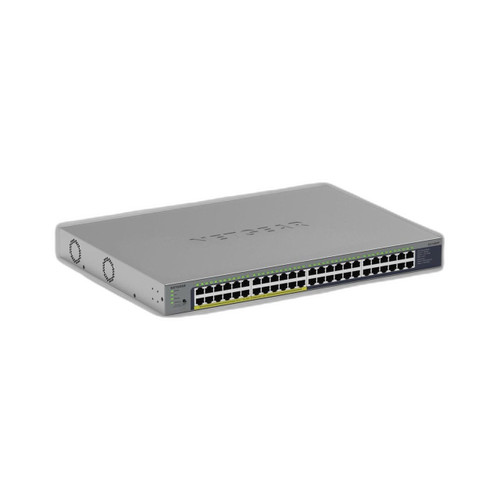
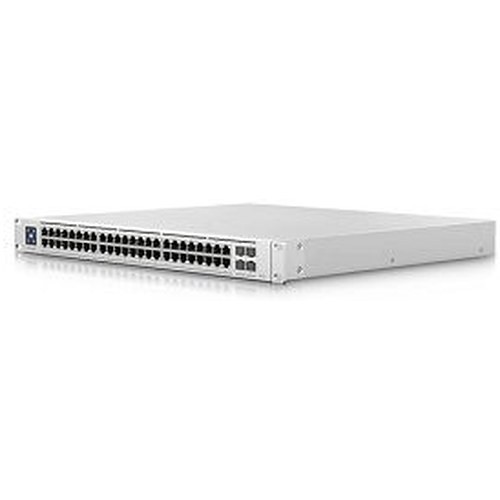
Both the NETGEAR GS748PP-100NAS and the Ubiquiti USW-ENTERPRISE-48-POE are 48-port rackmount PoE switches targeting physical-security and enterprise LAN deployments — a class where port density, PoE power budget, throughput, and manageability drive purchasing decisions. This comparison evaluates per-port speed and aggregate throughput, PoE power budget and standards support, and management capability, drawing exclusively on the specifications provided for each model.
In This Guide
- Which switch delivers more bandwidth per port and across the fabric?
- How much PoE power does each switch deliver, and to which 802.3 standard?
- What management capabilities, environmental ratings, and compliance certifications does each switch carry?
- Which should you choose: the GS748PP-100NAS or the USW-ENTERPRISE-48-POE?
- Side-by-Side Specs
- FAQ
Which switch delivers more bandwidth per port and across the fabric?
The NETGEAR GS748PP-100NAS provides 1 Gbps per port across all 48 RJ45 ports, yielding a non-blocking switching fabric of 96 Gbps. No uplink ports beyond the 48 data ports are specified in the provided specs.
The Ubiquiti USW-ENTERPRISE-48-POE runs all 48 RJ45 ports at 2.5 Gbps — 2.5× the per-port throughput of the NETGEAR — and adds four dedicated 10G SFP+ uplink ports. Its non-blocking switching capacity is 160 Gbps with a forwarding rate of 238 Mpps. The four 10G SFP+ uplinks are critical for aggregation tiers or high-density NVR/server uplinks where a 1G uplink would bottleneck.
For deployments running cameras or access-control endpoints that generate sustained multi-gigabit streams — or where the switch feeds a core aggregation layer — the Ubiquiti's 2.5G access tier and 10G uplinks represent a meaningful architectural difference. For standard 1G endpoints with no current need for 2.5G NICs, the NETGEAR's 96 Gbps fabric is sufficient at full 1G line rate.
How much PoE power does each switch deliver, and to which 802.3 standard?
The NETGEAR GS748PP-100NAS specifies a PoE power budget of 30W — and separately lists '30W per port' — but does not state a total aggregate PoE budget in the provided specifications. The PoE standard is listed as both PoE++ (802.3bt) and PoE+ (802.3at) in different spec fields; the per-port 30W figure is consistent with 802.3at (PoE+), not 802.3bt (which supports up to 90W per port). Buyers should verify the aggregate budget with NETGEAR's datasheet before specifying this switch for high-density PoE deployments.
The Ubiquiti USW-ENTERPRISE-48-POE specifies 720W of total PoE output across all 48 ports, with a maximum system draw of 870W (including the 150W base load). The PoE standard is 802.3at (PoE+), supporting up to approximately 30W per port. At 720W total, the switch can realistically power 40–50 802.3at devices simultaneously without load-shedding.
The Ubiquiti's explicitly stated 720W aggregate budget gives installers a concrete figure for load planning. The NETGEAR's aggregate PoE budget is not stated in the provided specs, which introduces uncertainty for high-density camera or AP deployments. Neither switch specifies 802.3bt (60W/90W) per-port delivery in a way that is internally consistent with the other specs provided.
What management capabilities, environmental ratings, and compliance certifications does each switch carry?
The NETGEAR GS748PP-100NAS is unmanaged — no VLAN support, no QoS configuration, no remote monitoring, and no CLI or GUI management interface. It is plug-and-play by design. The operating storage temperature range is listed as –20° to 70°C; no operating temperature range distinct from storage is provided in the supplied specs. No NDAA compliance status is stated.
The Ubiquiti USW-ENTERPRISE-48-POE is a managed switch, operated via Ubiquiti's UniFi Network application. It supports up to 1,000 VLANs and includes a 1.3-inch LCM color touchscreen for local status. The operating temperature is specified at –5 to 40°C. The switch is NDAA compliant and carries CE, FCC, IC, and Anatel certifications. The SGCC steel enclosure and 1U rackmount form factor at 442 × 400 × 44 mm and 6.2 kg are fully specified.
For any deployment requiring network segmentation (camera VLANs isolated from corporate LAN), access control, traffic prioritization, or remote management, the Ubiquiti's managed feature set is required. The NETGEAR's unmanaged design suits simple, flat-network installations. NDAA compliance on the Ubiquiti is a differentiator for U.S. federal, state, and local government projects where Section 889 applies; no equivalent statement is present for the NETGEAR in the provided specs.
Which should you choose: the GS748PP-100NAS or the USW-ENTERPRISE-48-POE?
Our take: The USW-ENTERPRISE-48-POE is the stronger choice when the deployment requires network segmentation, a defined aggregate PoE budget, higher per-port bandwidth, or NDAA compliance. Three concrete spec deltas illustrate the gap: the Ubiquiti delivers 720W of stated aggregate PoE output versus an unstated aggregate budget on the NETGEAR; it runs every access port at 2.5 Gbps with four 10G SFP+ uplinks against the NETGEAR's 1 Gbps per port and no dedicated uplinks; and it supports 1,000 VLANs with full UniFi management versus zero management capability on the unmanaged NETGEAR. The GS748PP-100NAS remains a viable option for small, flat-network installations where plug-and-play simplicity is the priority, no VLAN segmentation is required, all endpoints are 1G, and total PoE load can be verified against NETGEAR's datasheet. Buyers running mixed 1G/2.5G endpoints, multi-VLAN security architectures, or government-regulated environments should specify the Ubiquiti.
Side-by-Side Comparison
Spec-for-spec, from manufacturer data.
| Specification | NETGEAR GS748PP-100NAS | Ubiquiti USW-ENTERPRISE-48-POE |
|---|---|---|
| Port Count (RJ45) | 48 x 1G | 48 x 2.5G |
| Uplink Ports | — | 4 x 10G SFP+ |
| Switching Capacity | 96 Gbps non-blocking | 160 Gbps non-blocking |
| Forwarding Rate | — | 238 Mpps |
| PoE Standard | 802.3at (PoE+) | 802.3at (PoE+) |
| PoE Budget (Aggregate) | Not stated in provided specs | 720W |
| Max PoE Per Port | 30W | ~30W (802.3at) |
| Total Power Supply | — | 870W internal |
| Base Power Consumption | — | 150W (excluding PoE) |
| Management | Unmanaged | Managed (UniFi) |
| VLAN Support | — | 1,000 VLANs |
| Local Display | — | 1.3-inch LCM color touchscreen |
| Form Factor | 1U Rackmount | 1U Rackmount |
| Dimensions | Not stated in provided specs | 442 x 400 x 44 mm |
| Operating Temperature | Not stated (storage: -20 to 70°C) | -5 to 40°C |
| NDAA Compliant | — | Yes |
Frequently Asked Questions
Which should you choose: the GS748PP-100NAS or the USW-ENTERPRISE-48-POE?
The USW-ENTERPRISE-48-POE is the stronger choice when the deployment requires network segmentation, a defined aggregate PoE budget, higher per-port bandwidth, or NDAA compliance. Three concrete spec deltas illustrate the gap: the Ubiquiti delivers 720W of stated aggregate PoE output versus an unstated aggregate budget on the NETGEAR; it runs every access port at 2.5 Gbps with four 10G SFP+ uplinks against the NETGEAR's 1 Gbps per port and no dedicated uplinks; and it supports 1,000 VLANs with full UniFi management versus zero management capability on the unmanaged NETGEAR. The GS748PP-100NAS remains a viable option for small, flat-network installations where plug-and-play simplicity is the priority, no VLAN segmentation is required, all endpoints are 1G, and total PoE load can be verified against NETGEAR's datasheet. Buyers running mixed 1G/2.5G endpoints, multi-VLAN security architectures, or government-regulated environments should specify the Ubiquiti.
Is the GS748PP-100NAS or the USW-ENTERPRISE-48-POE better for a large camera deployment with 40+ PoE cameras?
Based on the provided specs, the USW-ENTERPRISE-48-POE is better specified for that scenario. It states a 720W aggregate PoE output budget, which the manufacturer says is sufficient to power 40–50 802.3at cameras simultaneously. The NETGEAR GS748PP-100NAS does not state an aggregate PoE budget in the provided specifications, making it impossible to confirm whether it can sustain full load across all 48 ports without consulting NETGEAR's datasheet directly.
Do I need a managed switch like the USW-ENTERPRISE-48-POE, or will the unmanaged NETGEAR GS748PP-100NAS work for a security camera network?
It depends on your network architecture. The NETGEAR GS748PP-100NAS is unmanaged — it forwards all traffic on a single flat network with no VLAN, QoS, or access-control configuration. If your cameras share a network with corporate IT systems, an unmanaged switch cannot isolate camera traffic. The Ubiquiti USW-ENTERPRISE-48-POE supports up to 1,000 VLANs and is managed via the UniFi application, enabling camera-network segmentation, traffic prioritization, and remote monitoring. Most enterprise or multi-tenant security deployments require the managed capability.
Which switch is NDAA compliant for a government or public-sector installation?
Of the two models compared, only the Ubiquiti USW-ENTERPRISE-48-POE is listed as NDAA compliant in the provided specifications. No NDAA compliance statement is present for the NETGEAR GS748PP-100NAS in the specs provided. For U.S. federal, state, or local government projects subject to Section 889 of the NDAA, buyers should confirm compliance status directly with each manufacturer before specifying either product.
More Network Switch Comparisons
- NETGEAR GS748PP-100NAS vs Ubiquiti USW-48-POE
- NETGEAR GS748PP-100NAS vs Ubiquiti USW-PRO-MAX-48-POE
- NETGEAR GS748PP-100NAS vs Ubiquiti ES-48-500W
- NETGEAR GS748PP-100NAS vs NETGEAR GS348PP-100NAS
- Ubiquiti USW-48-POE vs NETGEAR GS348PP-100NAS
- Ubiquiti USW-48-POE vs Hanwha GS980M/52PS-10
Network Switch Buying Guides
Get a Second Opinion on Your Camera Choice
Share your site layout, coverage goals, and budget. Our team will validate the camera selection, flag anything we would change, and recommend products that match the use case.