
NETGEAR GS748PP-100NAS vs Ubiquiti USW-PRO-MAX-48-POE: Specification Comparison
Both the NETGEAR GS748PP-100NAS and the Ubiquiti USW-PRO-MAX-48-POE are 48-port, rack-mount Gigabit PoE switches targeting physical-security and enterprise LAN deployments. The comparison centers on three dimensions that matter most in this product class: PoE power budget and port density, switching throughput and port-speed flexibility, and management depth with network-segmentation capability. Buyers choosing between them are weighing simplicity and low total cost of ownership against managed-network features and raw power headroom for dense camera or AP deployments.

In This Guide
- Which switch delivers enough PoE power budget for a dense camera or AP deployment?
- How do switching throughput and available port speeds compare for bandwidth-intensive surveillance or mixed traffic?
- Which switch supports the VLAN segmentation and network management features required for a secure, segmented deployment?
- Which should you choose: the GS748PP-100NAS or the USW-PRO-MAX-48-POE?
- Side-by-Side Specs
- FAQ
Which switch delivers enough PoE power budget for a dense camera or AP deployment?
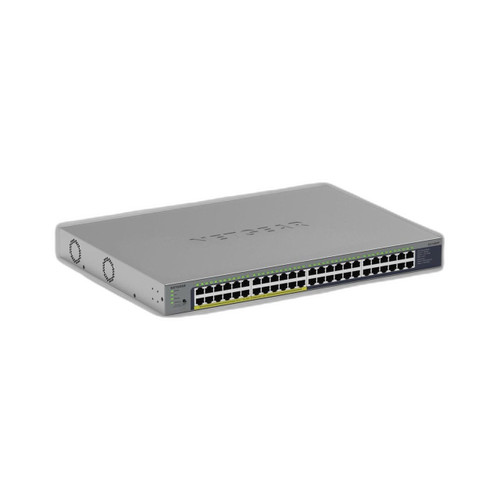
The NETGEAR GS748PP-100NAS specifies a 30W total PoE budget—listed both as a per-port figure and as the overall wattage. At face value this means the switch cannot sustain simultaneous PoE draws across all 48 ports beyond 30W aggregate, which limits it to powering a single high-draw device or a handful of low-draw endpoints concurrently. The spec listing '30W per port' alongside a '30W total' figure is internally inconsistent; buyers should verify the actual aggregate budget with NETGEAR's datasheet before committing to a multi-device deployment.
The Ubiquiti USW-PRO-MAX-48-POE specifies 720W of total simultaneous PoE availability, backed by an internal 870W AC power supply rated at 100–240V. The switch supports PoE++ (802.3bt) across its port population. At 720W shared across 48 ports, the average available budget per port is 15W, though individual ports can draw more where the aggregate headroom permits. For deployments powering 802.3bt devices such as multi-sensor cameras or Wi-Fi 6E access points, the Ubiquiti's power plant is materially larger and its budget is unambiguously stated.
How do switching throughput and available port speeds compare for bandwidth-intensive surveillance or mixed traffic?
The NETGEAR GS748PP-100NAS offers 96 Gbps non-blocking switching fabric across its 48 × 1G RJ-45 ports, which is the mathematically correct full-duplex figure for 48 × 1 Gbps ports (48 × 2 Gbps = 96 Gbps). All ports are fixed at 1 Gbps; no multi-gigabit or uplink SFP+ ports are listed in the provided specifications. This makes the switch suitable for standard 1G edge deployments but limits aggregation or uplink flexibility.
The Ubiquiti USW-PRO-MAX-48-POE is specified at 224 Gbps switching capacity with 112 Gbps non-blocking throughput and a 167 Mpps forwarding rate. Its port complement includes 48 × 1G RJ-45, 8 × 2.5G ports, and 2 × 10G SFP+ uplinks, enabling multi-speed edge connections and high-bandwidth uplinks to core switches or NVRs. The 10G SFP+ ports specifically address aggregation scenarios where a 1G uplink would become a bottleneck under simultaneous full-stream camera or NVR traffic.
Which switch supports the VLAN segmentation and network management features required for a secure, segmented deployment?
The NETGEAR GS748PP-100NAS is specified as unmanaged. An unmanaged switch has no configuration interface, no VLAN support, no QoS controls, and no SNMP or remote monitoring capability. It forwards all traffic on a flat Layer 2 domain. For small, isolated deployments where network segmentation is not required and zero-touch operation is the priority, this is functionally adequate. However, it cannot satisfy security policies that mandate camera-network isolation, storm control, or access-port restrictions.
The Ubiquiti USW-PRO-MAX-48-POE is a managed switch supporting up to 1,000 VLANs, enabling full traffic segmentation between camera networks, access-control systems, corporate LANs, and guest networks on a single physical device. Management is handled via Ethernet (UniFi Controller or UniFi OS); the provided specs list 'Ethernet' as the management interface type. The switch is also listed as NDAA-compliant and carries CE, FCC, IC, and Anatel certifications. The operating temperature range is specified as -5°C to 40°C, compared to the NETGEAR's broader -20°C to 70°C storage (note: NETGEAR's spec labels this 'Storage Temperature,' not operating temperature, so a direct operating-temperature comparison cannot be made from the data provided).
Which should you choose: the GS748PP-100NAS or the USW-PRO-MAX-48-POE?
Our take: The USW-PRO-MAX-48-POE is the stronger choice when the deployment requires managed segmentation, multi-speed uplinks, or a substantial PoE power plant. Its 720W PoE budget versus the GS748PP-100NAS's stated 30W aggregate represents a 24× difference in available PoE capacity, making the NETGEAR unsuitable for simultaneously powering more than one or two PoE devices. The Ubiquiti's 224 Gbps switching capacity and 10G SFP+ uplinks also outclass the NETGEAR's 96 Gbps / 1G-only architecture for aggregation-layer or NVR-connected roles. Support for 1,000 VLANs and NDAA compliance further qualifies the Ubiquiti for government-adjacent and enterprise-security deployments where the NETGEAR, being unmanaged, cannot meet policy requirements. The GS748PP-100NAS is appropriate only for a small, flat, single-segment network where plug-and-play simplicity is the primary requirement and PoE demand is negligible—note that its 30W total budget figure should be independently verified before purchase.
Side-by-Side Comparison
Spec-for-spec, from manufacturer data.
| Specification | NETGEAR GS748PP-100NAS | Ubiquiti USW-PRO-MAX-48-POE |
|---|---|---|
| Product Type | Unmanaged Switch | Managed Switch |
| Total Ports | 48 | 48 × 1G RJ-45 + 8 × 2.5G + 2 × 10G SFP+ |
| Port Speed (RJ-45) | 1G | 1G (48 ports) / 2.5G (8 ports) |
| Uplink Speed | — | 2 × 10G SFP+ |
| PoE Standard | PoE++ (802.3bt) | PoE++ (802.3bt) |
| PoE Power Budget | 30W (see spec note) | 720W simultaneous |
| Internal Power Supply | — | 870W AC |
| Switching Capacity | 96 Gbps non-blocking | 224 Gbps |
| Non-Blocking Throughput | 96 Gbps | 112 Gbps |
| Forwarding Rate | — | 167 Mpps |
| VLAN Support | None (unmanaged) | Up to 1,000 VLANs |
| Management Interface | None | Ethernet (UniFi) |
| Form Factor | 1U Rack / Desktop | 1U Rack |
| Operating Temperature | Not specified (–20° to 70°C listed as Storage) | -5°C to 40°C |
| NDAA Compliant | — | Yes |
| Certifications | — | CE, FCC, IC, Anatel (06373-24-08356) |
Frequently Asked Questions
Which should you choose: the GS748PP-100NAS or the USW-PRO-MAX-48-POE?
The USW-PRO-MAX-48-POE is the stronger choice when the deployment requires managed segmentation, multi-speed uplinks, or a substantial PoE power plant. Its 720W PoE budget versus the GS748PP-100NAS's stated 30W aggregate represents a 24× difference in available PoE capacity, making the NETGEAR unsuitable for simultaneously powering more than one or two PoE devices. The Ubiquiti's 224 Gbps switching capacity and 10G SFP+ uplinks also outclass the NETGEAR's 96 Gbps / 1G-only architecture for aggregation-layer or NVR-connected roles. Support for 1,000 VLANs and NDAA compliance further qualifies the Ubiquiti for government-adjacent and enterprise-security deployments where the NETGEAR, being unmanaged, cannot meet policy requirements. The GS748PP-100NAS is appropriate only for a small, flat, single-segment network where plug-and-play simplicity is the primary requirement and PoE demand is negligible—note that its 30W total budget figure should be independently verified before purchase.
Is the GS748PP-100NAS or USW-PRO-MAX-48-POE better for powering a full floor of IP cameras?
Based on the provided specifications, the USW-PRO-MAX-48-POE is the clear choice for powering a full floor of IP cameras. It specifies 720W of total simultaneous PoE availability backed by an internal 870W power supply, supporting PoE++ (802.3bt) across its ports. The GS748PP-100NAS lists a 30W PoE budget—whether that is a per-port or aggregate figure is ambiguous in the spec data—making it inadequate for simultaneously powering multiple cameras. Verify the NETGEAR's true aggregate budget against its datasheet before using it in any multi-device PoE scenario.
Can either switch support VLAN segmentation to isolate my camera network from the corporate LAN?
Only the Ubiquiti USW-PRO-MAX-48-POE supports VLANs; it is specified to support up to 1,000 VLANs, enabling full isolation of camera traffic, access-control systems, and corporate data on one physical switch. The NETGEAR GS748PP-100NAS is an unmanaged switch and, by definition, has no VLAN, QoS, or access-control configuration capability. If network segmentation is a requirement—whether for security policy, compliance, or traffic management—the NETGEAR does not qualify.
Does either switch offer uplink ports faster than 1 Gbps for connecting to a core switch or NVR?
Yes, the Ubiquiti USW-PRO-MAX-48-POE includes 2 × 10G SFP+ uplink ports and 8 × 2.5G ports, enabling high-speed aggregation to a core switch or a high-throughput NVR. The NETGEAR GS748PP-100NAS specifications do not list any SFP+ or multi-gigabit ports; all ports appear to be 1G RJ-45. If your NVR or core infrastructure can accept a 10G uplink—or if aggregate camera bandwidth is likely to saturate a 1G uplink—the Ubiquiti's port mix is the appropriate choice.
More Network Switch Comparisons
- NETGEAR GS748PP-100NAS vs Ubiquiti USW-48-POE
- NETGEAR GS748PP-100NAS vs Ubiquiti USW-ENTERPRISE-48-POE
- NETGEAR GS748PP-100NAS vs Ubiquiti ES-48-500W
- NETGEAR GS748PP-100NAS vs NETGEAR GS348PP-100NAS
- Ubiquiti USW-48-POE vs NETGEAR GS348PP-100NAS
- Ubiquiti USW-48-POE vs Hanwha GS980M/52PS-10
Network Switch Buying Guides
Get a Second Opinion on Your Camera Choice
Share your site layout, coverage goals, and budget. Our team will validate the camera selection, flag anything we would change, and recommend products that match the use case.