
NETGEAR GS748PP-100NAS vs Ubiquiti USW-48-POE: Specification Comparison
Both the NETGEAR GS748PP-100NAS and the Ubiquiti USW-48-POE are 48-port, 1 Gbps per-port, rack-mount PoE switches aimed at access-layer deployments in commercial surveillance, wireless, and enterprise edge environments. The comparison centers on three axes where the two diverge meaningfully for installers and IT buyers: PoE power delivery and port allocation, throughput architecture and switching capacity, and management depth with platform integration. Neither unit is an outlier in device class; both are reasonable cross-shop candidates for a 48-port PoE access switch procurement.
In This Guide
- Which switch delivers more usable PoE power, and how is it distributed across ports?
- How do the two switches compare on switching fabric, forwarding rate, and uplink options?
- What level of management and platform integration does each switch provide?
- Which should you choose: the GS748PP-100NAS or the USW-48-POE?
- Side-by-Side Specs
- FAQ
Which switch delivers more usable PoE power, and how is it distributed across ports?
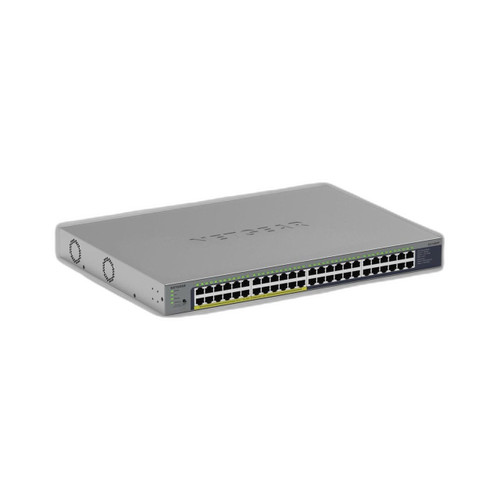
The NETGEAR GS748PP-100NAS specifies a 30W PoE budget listed in the provided specs, with all 48 ports carrying PoE++ (802.3bt) capability at up to 30W per port simultaneously. However, a 30W total budget across 48 simultaneous 30W-capable ports is a significant internal inconsistency in the supplied spec data; buyers should verify the aggregate PoE budget from the manufacturer datasheet before sizing a deployment. The per-port standard is listed as 802.3bt (PoE++), which supports up to 90W per port at the standard level, though the budget figure supplied contradicts that scale.
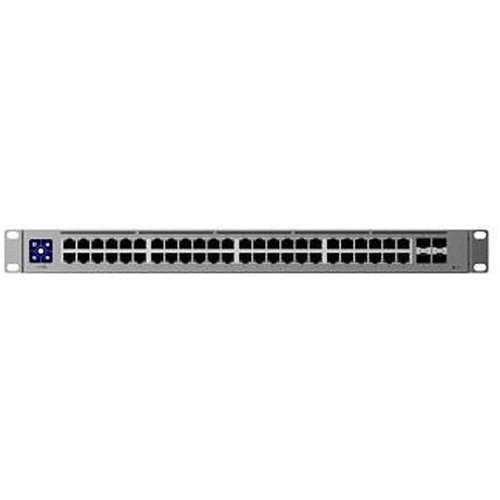
The Ubiquiti USW-48-POE specifies a 195W maximum PoE output budget. Of its 48 ports, 32 are PoE+ (802.3at, up to 30W each); the remaining 16 ports are non-PoE data-only. Four 1G SFP uplink ports are also present. At 195W shared across up to 32 active PoE devices, the average available power per PoE port is approximately 6W under full simultaneous load, though individual ports can deliver up to 30W where budget permits. The power supply is rated at 240W internal, with 45W consumed by switch circuitry excluding PoE output.
For deployments requiring PoE on every single port, the NETGEAR's 48 PoE-capable ports (versus Ubiquiti's 32) is structurally advantageous — provided the aggregate power budget can support the connected load. The Ubiquiti's 195W stated total budget is a verified spec; the NETGEAR's 30W total figure as stated is anomalous and warrants datasheet confirmation before installation planning.
How do the two switches compare on switching fabric, forwarding rate, and uplink options?
The NETGEAR GS748PP-100NAS is specified with a 96 Gbps non-blocking switching bandwidth. No forwarding rate in Mpps is provided in the supplied specs. No uplink port count or SFP port specification is listed; the port count is given as 48 with no distinction between access and uplink ports.
The Ubiquiti USW-48-POE lists a switching capacity of 104 Gbps and a non-blocking throughput of 52 Gbps, with a forwarding rate of 77 Mpps. It includes four 1G SFP uplink ports in addition to the 48 copper ports, providing dedicated uplink bandwidth that does not consume access PoE ports.
The NETGEAR's 96 Gbps fabric exceeds the Ubiquiti's stated 52 Gbps non-blocking throughput figure, though the Ubiquiti also cites 104 Gbps switching capacity — these figures likely reflect half-duplex vs. full-duplex accounting conventions. The Ubiquiti's inclusion of four dedicated SFP uplinks is a meaningful architectural advantage for aggregation topologies, as it preserves all 48 copper ports for endpoint devices. NETGEAR's spec data does not indicate dedicated uplink ports.
What level of management and platform integration does each switch provide?
The NETGEAR GS748PP-100NAS is explicitly specified as Unmanaged. This means no VLAN segmentation, no QoS configuration, no port mirroring, no SNMP, no traffic prioritization, and no remote management interface of any kind. It operates as a plug-and-play Layer 2 forwarding device. For installations where simplicity and zero-configuration operation are the priority, this is a feature; for any deployment requiring network segmentation, traffic shaping, or centralized monitoring, it is a hard limitation.
The Ubiquiti USW-48-POE is a managed switch with Ethernet management access and native integration into the Ubiquiti UniFi controller platform. It supports 1,000 VLANs. The supplied specs note a 1.3-inch LCM color touchscreen display on the unit. Certifications include CE, FCC, IC, and Anatel, and it is listed as NDAA compliant. Management via the UniFi controller enables centralized configuration, monitoring, firmware updates, and traffic analytics across a UniFi network fabric.
For any deployment involving VLANs — standard practice in enterprise surveillance and multi-tenant access networks — the Ubiquiti is the only viable option of the two. The NETGEAR's unmanaged architecture precludes VLAN-based camera/IT traffic isolation, which is a common installer and IT security requirement. The Ubiquiti's NDAA compliance designation is also relevant for federally funded or government-adjacent installations where that status is required.
Which should you choose: the GS748PP-100NAS or the USW-48-POE?
Our take: The USW-48-POE is the stronger choice when the deployment requires VLAN segmentation, centralized management, or NDAA compliance. The Ubiquiti provides 1,000 VLAN support and full UniFi controller integration versus the NETGEAR's unmanaged, zero-configuration architecture — a categorical difference for any installer handling camera/IT traffic isolation or multi-site monitoring. The Ubiquiti also includes four dedicated 1G SFP uplinks not present in the NETGEAR spec, preserving all 48 copper ports for endpoints. The NETGEAR lists 48 PoE-capable ports versus Ubiquiti's 32, and its 96 Gbps fabric exceeds Ubiquiti's stated 52 Gbps non-blocking figure; however, NETGEAR's 30W aggregate PoE budget as supplied is inconsistent with 48-port simultaneous PoE++ delivery and must be verified before deployment planning. The GS748PP-100NAS suits small, flat networks where plug-and-play simplicity is sufficient and management overhead is undesirable. The USW-48-POE suits UniFi-ecosystem access layers requiring segmentation and visibility.
Side-by-Side Comparison
Spec-for-spec, from manufacturer data.
| Specification | NETGEAR GS748PP-100NAS | Ubiquiti USW-48-POE |
|---|---|---|
| Port Count (Copper) | 48 x 1GbE | 48 x 1GbE |
| PoE-Capable Ports | 48 (all ports) | 32 of 48 |
| PoE Standard | PoE++ (802.3bt) | PoE+ (802.3at) |
| Aggregate PoE Budget | 30W (as supplied — verify datasheet) | 195W maximum |
| Per-Port Max PoE | 30W (as supplied) | 30W |
| Uplink / SFP Ports | — (not specified) | 4 x 1G SFP |
| Switching Fabric | 96 Gbps non-blocking | 104 Gbps capacity / 52 Gbps non-blocking |
| Forwarding Rate | — (not specified) | 77 Mpps |
| Management | Unmanaged | Managed (UniFi controller) |
| VLAN Support | — (unmanaged, no VLAN) | 1,000 VLANs |
| Form Factor | 1U Rack Mount | 1U Rack Mount |
| Power Supply | — (not specified) | 240W internal AC/DC |
| Input Voltage | — (not specified) | 100–240V AC, 50/60 Hz |
| Operating Temperature | –20° to 70°C | –5° to 40°C |
| NDAA Compliant | — (not specified) | Yes |
| Enclosure Material | — (not specified) | SGCC steel |
Frequently Asked Questions
Which should you choose: the GS748PP-100NAS or the USW-48-POE?
The USW-48-POE is the stronger choice when the deployment requires VLAN segmentation, centralized management, or NDAA compliance. The Ubiquiti provides 1,000 VLAN support and full UniFi controller integration versus the NETGEAR's unmanaged, zero-configuration architecture — a categorical difference for any installer handling camera/IT traffic isolation or multi-site monitoring. The Ubiquiti also includes four dedicated 1G SFP uplinks not present in the NETGEAR spec, preserving all 48 copper ports for endpoints. The NETGEAR lists 48 PoE-capable ports versus Ubiquiti's 32, and its 96 Gbps fabric exceeds Ubiquiti's stated 52 Gbps non-blocking figure; however, NETGEAR's 30W aggregate PoE budget as supplied is inconsistent with 48-port simultaneous PoE++ delivery and must be verified before deployment planning. The GS748PP-100NAS suits small, flat networks where plug-and-play simplicity is sufficient and management overhead is undesirable. The USW-48-POE suits UniFi-ecosystem access layers requiring segmentation and visibility.
Can the NETGEAR GS748PP-100NAS support VLANs to separate camera traffic from the corporate network?
No. The GS748PP-100NAS is specified as an unmanaged switch, which means it has no VLAN, QoS, or any other Layer 2/3 management capability. If traffic segmentation between surveillance and corporate networks is required, the USW-48-POE — which supports up to 1,000 VLANs via the UniFi controller — is the appropriate choice.
Does the Ubiquiti USW-48-POE provide PoE on all 48 ports?
No. Per the supplied specifications, the USW-48-POE provides PoE+ (802.3at, up to 30W) on 32 of its 48 copper ports. The remaining 16 copper ports are data-only, and the four SFP uplink ports do not carry PoE. The total PoE power budget is 195W maximum. If PoE is needed on all 48 ports, buyers should verify whether the NETGEAR GS748PP-100NAS's aggregate PoE budget supports their load, as the 30W figure supplied in the specs is inconsistent and requires manufacturer datasheet confirmation.
Is either switch suitable for a government or federally funded surveillance installation requiring NDAA compliance?
Based on the supplied specifications, only the Ubiquiti USW-48-POE carries an explicit NDAA Compliant: Yes designation. The NETGEAR GS748PP-100NAS spec data does not include an NDAA compliance statement. Installers working on federally funded projects or with agencies that require NDAA Section 889 compliance should use the Ubiquiti and confirm compliance documentation directly with the manufacturer.
More Network Switch Comparisons
- NETGEAR GS748PP-100NAS vs Ubiquiti USW-PRO-MAX-48-POE
- NETGEAR GS748PP-100NAS vs Ubiquiti USW-ENTERPRISE-48-POE
- NETGEAR GS748PP-100NAS vs Ubiquiti ES-48-500W
- NETGEAR GS748PP-100NAS vs NETGEAR GS348PP-100NAS
- Ubiquiti USW-48-POE vs NETGEAR GS348PP-100NAS
- Ubiquiti USW-48-POE vs Hanwha GS980M/52PS-10
Network Switch Buying Guides
Get a Second Opinion on Your Camera Choice
Share your site layout, coverage goals, and budget. Our team will validate the camera selection, flag anything we would change, and recommend products that match the use case.