
NETGEAR GS748PP-100NAS vs Ubiquiti ES-48-500W: Specification Comparison
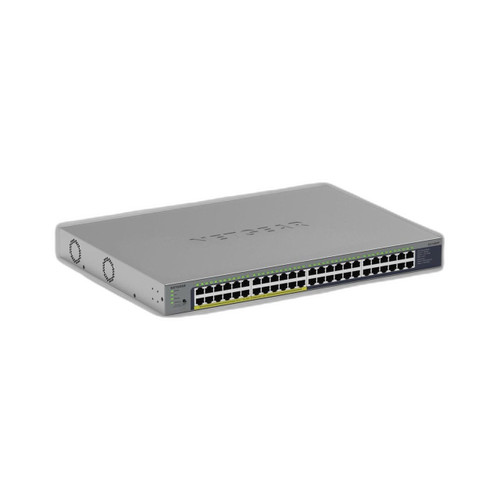
Both the NETGEAR GS748PP-100NAS and the Ubiquiti ES-48-500W are 1U rackmount 48-port Gigabit PoE switches targeting networked physical-security and enterprise access-layer deployments — identical port count, same RJ45 copper Gigabit standard, and both supplying PoE power to cameras, APs, and VoIP endpoints. The comparison focuses on the three dimensions that drive buying decisions in this class: PoE power budget and per-port delivery, switching fabric and uplink capacity, and management depth alongside certifications and physical characteristics.

In This Guide
- Which switch delivers more PoE power — and how does the per-port budget compare?
- How do the two switches compare on switching capacity, forwarding rate, and uplink options?
- What management interfaces and certifications does each switch offer?
- Which should you choose: the GS748PP-100NAS or the ES-48-500W?
- Side-by-Side Specs
- FAQ
Which switch delivers more PoE power — and how does the per-port budget compare?
The ES-48-500W carries a 500 W total PoE budget versus the GS748PP-100NAS's stated 30 W budget. If the NETGEAR figure represents a per-port maximum (PoE++ / 802.3bt allows up to 90 W per port, and the spec lists '30W per port'), the aggregate budget is not stated and cannot be confirmed from the provided specifications. The Ubiquiti spec is explicit: 500 W shared across all 48 ports, with up to 34.2 W per port under PoE+ (802.3at) and 17 W per port for Passive PoE.
The NETGEAR spec lists PoE standard as both 'PoE++ (802.3bt)' and 'PoE+ (802.3bt) 30W per port' — these are internally inconsistent (802.3bt is PoE++, not PoE+), so the true per-port ceiling cannot be confirmed from the provided data. The Ubiquiti standard is listed as IEEE 802.3af/at, capping at 30 W per port (802.3at), with a documented 34.2 W delivered per port. Buyers powering high-draw PTZ cameras or dual-radio Wi-Fi 6 APs will find the Ubiquiti's 500 W aggregate budget and confirmed per-port figures more actionable from the provided specs.
How do the two switches compare on switching capacity, forwarding rate, and uplink options?
The ES-48-500W is specified at 140 Gbps switching capacity with a forwarding rate of 104.16 Mpps (per the card bullets and structured specs). The GS748PP-100NAS is specified at 96 Gbps non-blocking throughput; no forwarding rate in Mpps is provided in the supplied specifications.
Uplink flexibility is a material differentiator. The Ubiquiti adds 2× SFP+ (10G) and 2× SFP (1G) fiber/copper uplink ports on top of its 48 RJ45 ports, with LAG (Link Aggregation) support stated. The NETGEAR GS748PP-100NAS uplink ports are not described in the provided specifications — no SFP or SFP+ ports are listed. Buyers aggregating traffic to a core switch or NVR server over fiber will find the 10G uplink capability of the ES-48-500W a concrete advantage; that option is simply absent from the NETGEAR spec sheet as provided.
What management interfaces and certifications does each switch offer?
The GS748PP-100NAS is specified as Unmanaged. There is no CLI, no web GUI, no SNMP, and no VLAN or QoS configuration available. Setup is plug-and-play with zero configuration required — a deliberate design choice that eliminates IT overhead but also eliminates traffic segmentation, port-level monitoring, and remote diagnostics.
The ES-48-500W is Layer 2/3 Managed, supporting Web GUI, CLI, SNMP, and a hardware RJ45 serial console for out-of-band access. Layer 3 routing capability is listed, though the depth of routing features is not detailed in the provided specs. Certifications listed for the Ubiquiti are CE, FCC, and IC. No certifications are stated in the NETGEAR specifications as provided. The NETGEAR spec notes a storage temperature range of –20° to 70°C; the Ubiquiti operating temperature is listed inconsistently alongside power supply variants and cannot be cleanly extracted from the provided data.
Which should you choose: the GS748PP-100NAS or the ES-48-500W?
Our take: The ES-48-500W is the stronger choice when PoE power headroom, upstream bandwidth, and network management are priorities. Its 500 W PoE budget dwarfs the NETGEAR's stated 30 W figure (which is ambiguous in the provided specs as to whether it is per-port or aggregate), its 140 Gbps switching capacity exceeds the GS748PP-100NAS's 96 Gbps, and its dual 10G SFP+ uplinks — absent entirely from the NETGEAR spec — prevent core uplink saturation in larger deployments. Full Layer 2/3 management with SNMP and serial console enables VLAN segmentation and remote monitoring critical in enterprise physical-security networks. The GS748PP-100NAS is appropriate where simplicity and zero-configuration operation are the primary requirements — small branch sites, isolated camera subnets, or installations where no IT staff will manage the switch — provided its ambiguous PoE budget is confirmed against actual load before deployment.
Side-by-Side Comparison
Spec-for-spec, from manufacturer data.
| Specification | NETGEAR GS748PP-100NAS | Ubiquiti ES-48-500W |
|---|---|---|
| Port Count (RJ45) | 48× Gigabit RJ45 | 48× Gigabit RJ45 |
| RJ45 Speed | 1 Gbps | 1 Gbps |
| Uplink Ports | Not specified | 2× SFP+ (10G) + 2× SFP (1G) |
| Switching Capacity | 96 Gbps non-blocking | 140 Gbps |
| Forwarding Rate | — | 104.16 Mpps |
| PoE Standard | 802.3bt listed (inconsistent with 30W figure in spec) | IEEE 802.3af/at (802.3at max 34.2W/port) |
| PoE Budget (Total) | 30 W (per-port or aggregate unclear from spec) | 500 W shared |
| Max Per-Port PoE | 30 W (per spec; standard inconsistency noted) | 34.2 W (PoE+); 17 W (Passive PoE) |
| Management | Unmanaged | Layer 2/3; Web GUI; CLI; SNMP; RJ45 serial console |
| VLAN / QoS | — | Supported (Layer 2/3 managed) |
| LAG Support | — | Yes |
| Form Factor | Rackmount / Desktop | 1U Rackmount |
| Weight | — | 16.25 lb |
| Certifications | — | CE, FCC, IC |
| Storage Temperature | –20° to 70°C | — |
| Country of Origin | — | CN |
Frequently Asked Questions
Which should you choose: the GS748PP-100NAS or the ES-48-500W?
The ES-48-500W is the stronger choice when PoE power headroom, upstream bandwidth, and network management are priorities. Its 500 W PoE budget dwarfs the NETGEAR's stated 30 W figure (which is ambiguous in the provided specs as to whether it is per-port or aggregate), its 140 Gbps switching capacity exceeds the GS748PP-100NAS's 96 Gbps, and its dual 10G SFP+ uplinks — absent entirely from the NETGEAR spec — prevent core uplink saturation in larger deployments. Full Layer 2/3 management with SNMP and serial console enables VLAN segmentation and remote monitoring critical in enterprise physical-security networks. The GS748PP-100NAS is appropriate where simplicity and zero-configuration operation are the primary requirements — small branch sites, isolated camera subnets, or installations where no IT staff will manage the switch — provided its ambiguous PoE budget is confirmed against actual load before deployment.
Is the GS748PP-100NAS or the ES-48-500W better for powering a full deployment of PTZ cameras and dual-radio APs?
Based on the provided specifications, the ES-48-500W is better suited. It documents a 500 W total PoE budget with up to 34.2 W per port (802.3at), which supports high-draw PTZ cameras and dual-radio APs simultaneously. The GS748PP-100NAS lists 30 W in its specs, but whether that is per-port or aggregate is internally inconsistent in the provided data — confirm with NETGEAR before sizing the deployment.
Can either switch connect to a fiber uplink or a 10G core switch?
Only the ES-48-500W, per the provided specifications. It includes 2× SFP+ ports (10G) and 2× SFP ports (1G) for fiber or copper uplinks, with LAG support. The GS748PP-100NAS specifications as provided list no SFP or SFP+ uplink ports.
Which switch is appropriate if the site has no IT staff and needs zero-touch setup?
The GS748PP-100NAS is specified as Unmanaged — no configuration is required; connect and it forwards traffic immediately. The ES-48-500W is a Layer 2/3 Managed switch requiring initial setup via Web GUI, CLI, or serial console. For sites where management complexity is a barrier, the NETGEAR is the simpler option, assuming its PoE budget is sufficient for the connected load.
More Network Switch Comparisons
- NETGEAR GS748PP-100NAS vs Ubiquiti USW-48-POE
- NETGEAR GS748PP-100NAS vs Ubiquiti USW-PRO-MAX-48-POE
- NETGEAR GS748PP-100NAS vs Ubiquiti USW-ENTERPRISE-48-POE
- NETGEAR GS748PP-100NAS vs NETGEAR GS348PP-100NAS
- Ubiquiti USW-48-POE vs NETGEAR GS348PP-100NAS
- Ubiquiti USW-48-POE vs Hanwha GS980M/52PS-10
Network Switch Buying Guides
Get a Second Opinion on Your Camera Choice
Share your site layout, coverage goals, and budget. Our team will validate the camera selection, flag anything we would change, and recommend products that match the use case.